
Story by Harry Crowther
UNC-Chapel Hill has a new (but old) logo.
In early November, there was a subtle but not insignificant change on UNC’s social media accounts and main website. The Old Well — which was previously the university’s primary brand mark — had vanished.
In its place were two familiar letters, joined together in bold sans-serif font: the interlocking NC.
The mark is more than 150 years old. It has been used to represent the university’s athletic programs since the late 1800s. And now, it is the official primary mark of the university at large.
To announce the change, UNC posted a video and story on Nov. 3 highlighting the interlocking NC. The video’s caption called the mark “a logo with a legacy.”
“We’re fortunate to have a logo that carries worldwide recognition while also representing the great state of North Carolina, which the university serves through our research, teaching, work and studies,” Associate Vice Chancellor for Marketing Adrienne King told University Communications and Marketing. “It’s only right that this symbol with so much history should serve as a unifying mark for the birthplace of public higher education.”
The change comes in conjunction with a new university marketing campaign. “First. And for all” is the new tagline seen on banners across campus. The campaign is intended to promote UNC as the nation’s first public university and leader across a variety of higher education categories.
In recent years, UNC’s brand has included many different logos. The move to the interlocking NC is a step toward a more unified, consistent and recognizable identity.
“UNC was not very good at managing their brand,” said UNC Hussman School of Journalism and Media advertising professor Gary Kayye. “If you look at the last two decades, it’s been all over the place.”
Gathering research and stakeholder feedback
In an effort to better tell the university’s story, UNC created its first-ever centralized marketing department this year under Chancellor Lee Roberts, according to Fast Company.
King came on board from Indiana University in February and began researching the university’s branding image and strategy. According to an email statement from University Communications and Marketing, the process to adopt the interlocking NC, a major branding decision, was “comprehensive and inclusive.”
The process began with qualitative research. King, along with University Marketing and Communications, compiled 31 hours of focus groups and small group discussions involving about 80 individual stakeholders. These included students, faculty, staff and alumni. Based on the initial feedback, a campuswide market research survey followed. The university collected over 7,400 survey responses.
“Throughout the process,” according to a statement from University Communications and Marketing, “the university emphasized broad participation, transparency and ongoing feedback from campus groups to ensure the final decision truly reflects the identity and aspirations of the Carolina community.”
Data analysis of the survey results helped reveal the values and perceptions of stakeholders, informing new brand strategy. After analyzing results, proposed changes were presented back to about 40 stakeholders for more feedback and reactions.
The focus groups and surveys revealed the interlocking NC is more recognizable, both in the state and around the world, compared to the Old Well logo.
“Stakeholder feedback indicated that the interlocking NC more authentically represents the university’s impact and legacy,” according to University Communications and Marketing. “This change also supports the university’s goal of unifying its identity across all schools and departments, making Carolina instantly recognizable and strengthening its overall brand equity.”
The university is still in the process of implementing the changes. The UNC identity website has been wiped clean of the old branding guidelines centered around the Old Well logo. Guidelines on the new logo and brand have yet to be published.
The Old Well logo is still the social media profile pictures of UNC departments such as the School of Medicine and the Kenan-Flagler Business School. According to University Communications and Marketing, the change to the interlocking NC will be extended to all schools and departments. The Old Well will retain its trademarked status but will only be used in special contexts.
A golden rule of branding
Gary Kayye is the founder and creative strategist at THE rAVe Agency. He is a UNC alumnus and has been an associate professor at the Hussman School since 2009.
Kayye has used the university’s brand as a case study for his creative advertising class.
“As a ‘what not to do,’” he said.
For one of their projects, Kayye told his students to go to the UNC Student Stores and count the different shades of Carolina Blue.
There are many.
The next step of the assignment was to drive to Durham and visit Duke University Stores, where they would count only one shade of Duke Blue.
A golden rule of branding is the principle of one. Pick one thing. Show and tell it well. In the case of visual identity, pick one primary brand mark and one primary color.
With many different marks and colors — even different versions of the same mark and different shades of one color — UNC’s visual identity had become an inundated hodgepodge. In fact, King counted 666 variations of the UNC logo in use, according to Fast Company.
“It’s been a plethora of other things,” Kayye said. “You just walk through our student store, walk through any of the stores on Franklin Street, and you’ll see all sorts of different brand marks. You’ll actually see two or potentially three versions of Rameses, not just one version of Rameses. You’ll see different fonts for the NC. You’ll see different fonts for the word ‘Carolina.’”
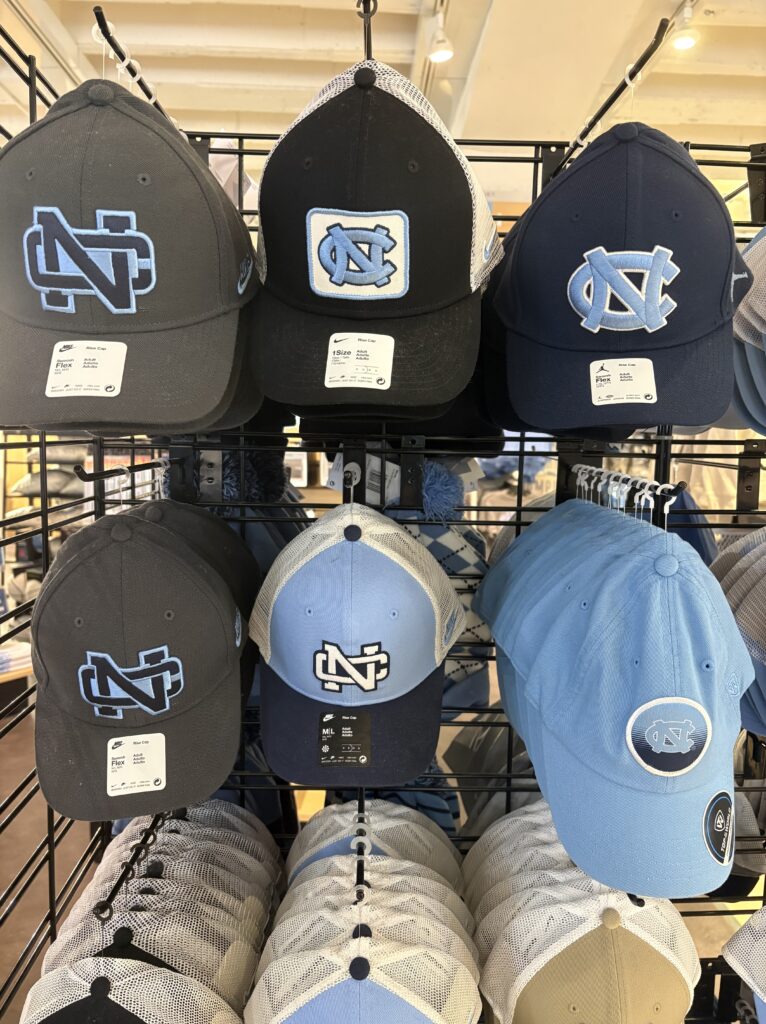
The UNC Student Stores sells merchandise with different versions of the interlocking NC and different shades of Carolina Blue. Photo by Harry Crowther.
The athletic department asked one of Kayye’s classes to help with a rebranding effort. The class developed a report that was also shared with University Communications and Marketing. In the report, the class said that it didn’t matter which logo UNC chose, but that it needed to choose a singular brand mark to represent the university.
Kayye cited McDonald’s and Apple as strong brands with one, instantly recognizable logo that also means something. The golden arches form an ‘M’ for McDonald’s. Apple is represented by an apple. These marks define their brands, and everyone knows them.
During the early years of the university and still today, the school’s main source of exposure outside the state is through athletics. Hussman student Gwen Peace, a senior from Alexandria, Va., said she imagines when most people think of UNC, they think of basketball first. It’s the interlocking NC, not the Old Well, at center court in the Dean E. Smith Center and on the first national championship banner from 1924.
Both of Peace’s parents went to UNC. She remembers drawing logos on Christmas cards to her dad.
“I always associated the logo with the interlocking NC,” Peace said. “I can say confidently that I never drew an Old Well to represent UNC. I think, even subconsciously, as somebody who was raised with the university being very present in my early life, I never associated the logo with being the Old Well. So, I think it’s smart from that standpoint. I agree that it’s 100 percent more recognizable, even to people who are very familiar with the university.”
Kayye proposed the thought experiment of showing the Old Well logo to a random person in California.
“If you showed the average person an interlocking NC and said, ‘What is this?’ Kayye said, “they may not know it’s specifically for North Carolina, but they would say it’s an ‘N’ and a ‘C.’ But if you ask somebody what the Old Well is, there are people that would say it looks like a trash can. Or, ‘I don’t know what it is. I don’t know, it looks like the Rotunda on the top of the Capitol.’”
Kayye said that the interlocking NC as the primary brand mark for UNC is “genius” because, like McDonald’s and Apple, it is simple and recognizable. Along with the Carolina Blue, it’s a mark that tells people the story of the university.
“Ours is magical,” Kayye said, “because ours actually tells who we are.”
A mark that has stood the test of time
While University Archivist Nicholas Graham said it is unknown how the logo came to be, the interlocking NC dates all the way back to the 1870s. Graham said he believes the use of interlocking letters has been a long-used and widespread design practice. A more formal and regal version of the mark first appeared on Commencement invitations.
UNC athletic teams adopted the interlocking NC in the 1890s. The first photograph of the mark in the UNC yearbook, then known as the Hellenian and now the Yackety Yack, came in 1893. The baseball team was the first to adopt the logo. They are pictured wearing uniforms with the interlocking NC prominently displayed on the front. The football and basketball teams would follow suit.
“When UNC teams started competing in intercollegiate sports, they were looking for something to wear to say where they came from,” Graham said to University Communications and Marketing. “They adopted the symbol, that may have been in use by the state of North Carolina, because they would have seen themselves as representing all of North Carolina.”
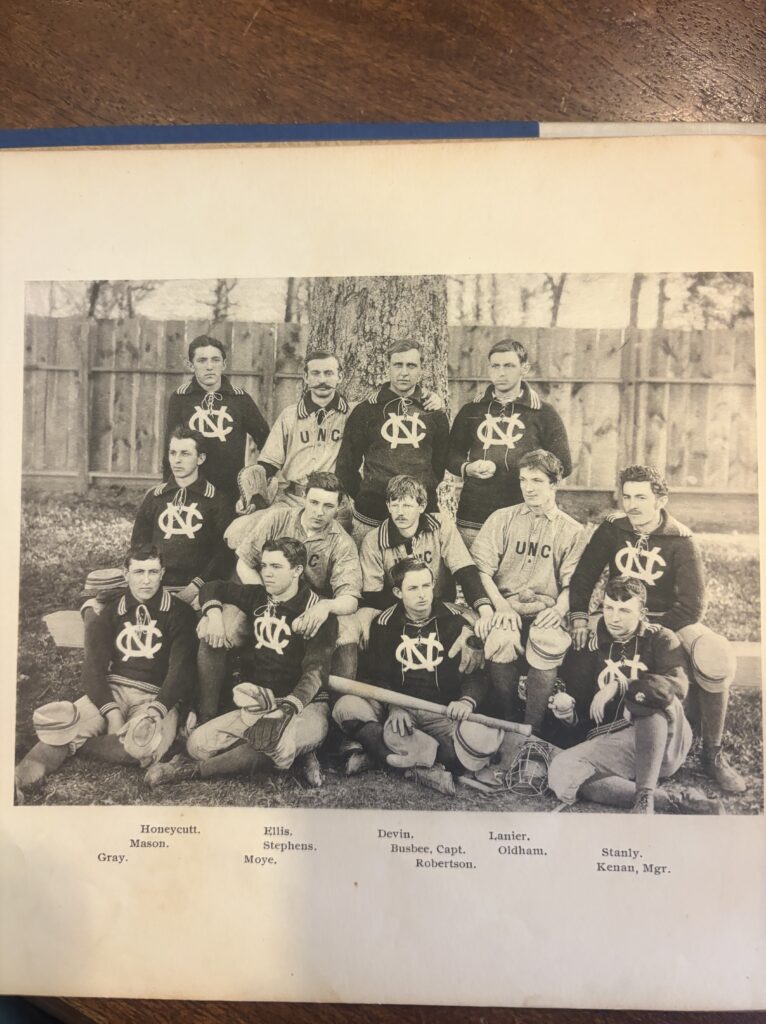
The UNC baseball team wears the interlocking NC on its uniform in a photo in the 1893 Hellenian. Photo by Harry Crowther. Special thanks to Freddie Kiger.
In addition to being on UNC uniforms, the logo was seen on a State Board of Health license in the 1890s and on a 1930 Davie County license plate. It is a symbol of not only the university but of the state as a whole.
There have been different versions of the mark. It has evolved with time. Graham said he’s unsure how many times the interlocking NC has changed.
“Artists and designers have taken many different approaches over the years,” he said in an email interview.
But the interlocking NC has stood the test of time. The first athletic version of the mark seen in the 1890s is remarkably close to the one painted today at midfield in Kenan Stadium. The 2025 interlocking NC is slightly bolder and wider. The sans-serif font is the same.
The baseball team tinkered with the logo in the 1960s. In the 1960s yearbooks, a narrow version of the interlocking NC with small crowns at the top of the ‘N’ appeared on the team’s caps.
In the 1980s, a Rameses logo featured an interlocking NC on the ram’s sweater in a different font. This version’s typography is sharp rather than smooth, and the interlocking feature is three-dimensional.
The university combined the ram and the interlocking NC into one mark in the late 1990s. The NC is the same as today, only with a thicker navy-blue outline. In the center is a ram with ‘Carolina’ on the top of the ‘C’ and ‘Tar Heels’ on the bottom.
Compared to the 150-year history of the interlocking NC, the Old Well logo is only about 22 years old.
The path toward better brand
With the change from the Old Well logo to the interlocking NC for the entire university, UNC has changed sides in the higher education branding divide. With one, lettered brand mark, the university has left behind a conflicting and confusing brand and joins what will perhaps become a trend.
Like UNC did before, top schools such as the University of Notre Dame, the University of Georgia and the University of Virginia all still use two separate logos — one for the university and one for athletics.
For their main logo, Georgia and Viriginia use a campus landmark rather than their recognizable ‘G’ and ‘V’ respectively. Notre Dame has a separate mark designated for academics that includes a cross, star and book. This is despite the acknowledgment on Notre Dame’s identity website that the famous ‘ND’ is its most recognizable mark.
UNC is now part of a cohort that includes the University of Michigan, the Ohio State University, Vanderbilt University and Virginia Tech as schools that have adopted the “principle of one” with their brands.
The next step for UNC as it continues the rollout of the change, Kayye said, is consistency within the branding guidelines. For example, the shade of Carolina Blue in the university’s main social media profile picture is noticeably different from the one used in athletic teams’ profile pictures.
“Once it’s been decided what the brand mark is,” Kayye said, “make sure that everything you approve uses the right style, format, sizing, leading, everything. And second is color. The color has to be accurate. If it’s not Carolina Blue, it should not be approved.”
While brand management requires constant evaluation and care, the interlocking NC provides a solid foundation built over time for the university to work toward better branding in higher education.
“I’m sure,” Graham said, “it’ll be a clear symbol of the university for a long time to come.”