
Story by Rachel Moody.
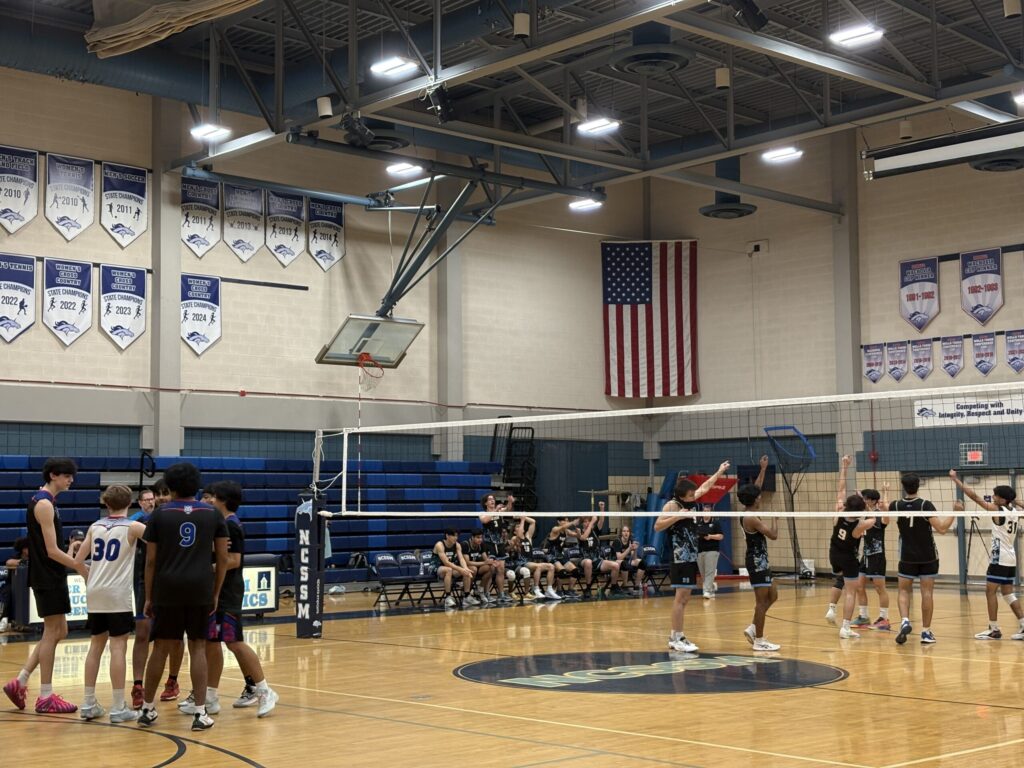
In Durham, Lev Marushevskyi cheers on the Triangle Math and Science Academy Tigers as they make a “kill” in a recent match. They’re playing against their rivals, The North Carolina School of Science and Mathematics Unicorns.
Marushevskyi graduated last year and is now a student at UNC-Chapel Hill. But he’s still passionate about getting boys’ high school volleyball sanctioned. After all, he did co-found the team at TMSA – an Apex charter school.
In the past few years, volleyball has been spiking its way into the hearts of high school boys all across the state. However, the North Carolina High School Athletic Association still doesn’t recognize it. Now, athletes and coaches are pushing for statewide sanctioning to bring high school boys’ volleyball up to the next level.
“I had to reach out to other teams’ coaches to schedule tournaments and matches, as well as knowing whether we had enough money to be able to afford going to states each year,” Marushevskyi says.
Being unsanctioned means many teams face extra hurdles compared to other sports. Hurdles like finding a practice space, buying jerseys, or even getting a coach. Manny Price founded a team at a Gaston County charter school.
“I had meetings with the principal, just like, you’re not going to have any equipment. Like you need to get a net, and then it was just like we can use the girls net,” Price says. “We practiced in an elementary school gym.”
Price later transferred out of his charter school. He’s now a senior at NCSSM where he still plays volleyball. He says statewide sanctioning will advance the sport.
“A lot more people are gonna know about it. And they’re gonna know like, okay, it’s varsity men’s volleyball. It’s not club anymore. It’s official,” he says. “It’s gonna be taken a lot more seriously. Teams are going to be practicing more. The jerseys are going to be a little bit more sophisticated I feel like.”
That’s also the hope of Sarah Conklin, the founder and director of North Carolina Boys’ Volleyball Association.
“I was a mom with a son who wanted to play volleyball,” Conklin says. “He said he wanted to play for his school. I was like, well, it doesn’t exist. And he’s like, can’t we just start it?”
Since then, her association has helped grow the number of teams in the state from just seven in 2022 to more than 100 this year.
“We run the entire state season until we’re sanctioned, which God willing will be this spring,” she says.
Before a sport can be sanctioned by the NCHSAA, at least 25% of member schools must participate in the sport. That’s 112, which they’ve already surpassed at 118.
Conklin says they’ve submitted a proposal to the athletic association which the board is scheduled to vote on next month.
“Our foot has been on the gas pedal to get this across the finish line because hundreds of boys, if not thousands of boys across the state will have the opportunity to play,” Conklin says.
Marushevskyi says that despite all the barriers that came with being the captain of an unsanctioned team, the competition kept him motivated.
“As long as I got the opportunity to win another volleyball game, I’d be willing to do all these logistics.” Marushevskyi says. “It’s no problem at all.”
If the NCHSAA votes to sanction, public high schools across the state will have their first official season of boys’ volleyball next spring.