
By Corrie Kelleigh
North Carolina’s rapid population growth is transforming the state’s business landscape, while testing the very assets and infrastructure that are enticing people to move. Since 2015, with the exception of 2020, North Carolina’s population has grown by more than 1 percent annually, roughly double the national average, driving rapid economic expansion and transforming the state’s business landscape. That growth has propelled North Carolina to the top of national business rankings for the past five years. In 2025, CNBC named the state the best in the country for business, citing its economy, workforce and business-friendly climate. But the same forces fueling that success are testing the state’s infrastructure, affordability and the long-term sustainability of small businesses.
To keep North Carolina at the top of the rankings, continued investment is needed, said Dana Magliola, senior director of infrastructure competitiveness at the N.C. Chamber of Commerce.
“We have consistently high grades in everything, but there’s room for improvement,” Magliola said. “We can’t take our foot off the gas.”
Dana said that continued push is focused largely on infrastructure, particularly energy, transportation, water and broadband.
As those systems expand, businesses on the ground are beginning to feel the effects, especially in fast-changing commercial districts.
Some businesses are expanding to adapt to shifting customer habits, including higher foot traffic from new residents and increased demand near campus-centered locations. Meantime Coffee Co., a nonprofit, student-run coffee shop in Chapel Hill, expanded in November 2024, opening a second location on Rosemary Street after outgrowing its original space in the Campus Y at the University of North Carolina at Chapel Hill.
“We have this new customer base coming in, doing tabs with us at our other location that we wouldn’t normally see at the Y location,” Sofia Nyiri, chief marketing officer at Meantime Coffee Co., said.
For other businesses, location and proximity to accessible infrastructure play a more direct role in whether growth translates to consistent sales. Afeef Ul Hassan, store manager at King Tobacco and Vapor, previously worked at the store’s higher-traffic Franklin Street location and moved to help open the company’s newer Rosemary Street storefront, where he has faced ongoing parking challenges.
He said the lack of designated parking near the commercial building has made it difficult to accommodate customers who drive, forcing the store to rely more heavily on foot traffic in a less-frequented area.
“We can’t do anything because there are no parking spots designated to this commercial building,” Hassan said. “We had customers coming from faraway places, but they won’t stop here because it’s not possible with the traffic.”
King Tobacco and Vapor isn’t the only business facing these challenges, particularly in urban areas such as Raleigh, Chapel Hill and Durham. In Chapel Hill, the recently built East Rosemary Street parking deck cost the town more than $51 million, yet businesses are still struggling to grow a customer base that isn’t built solely on foot traffic.
“Population growth means more pressure on the systems already in place,” Magliola said.
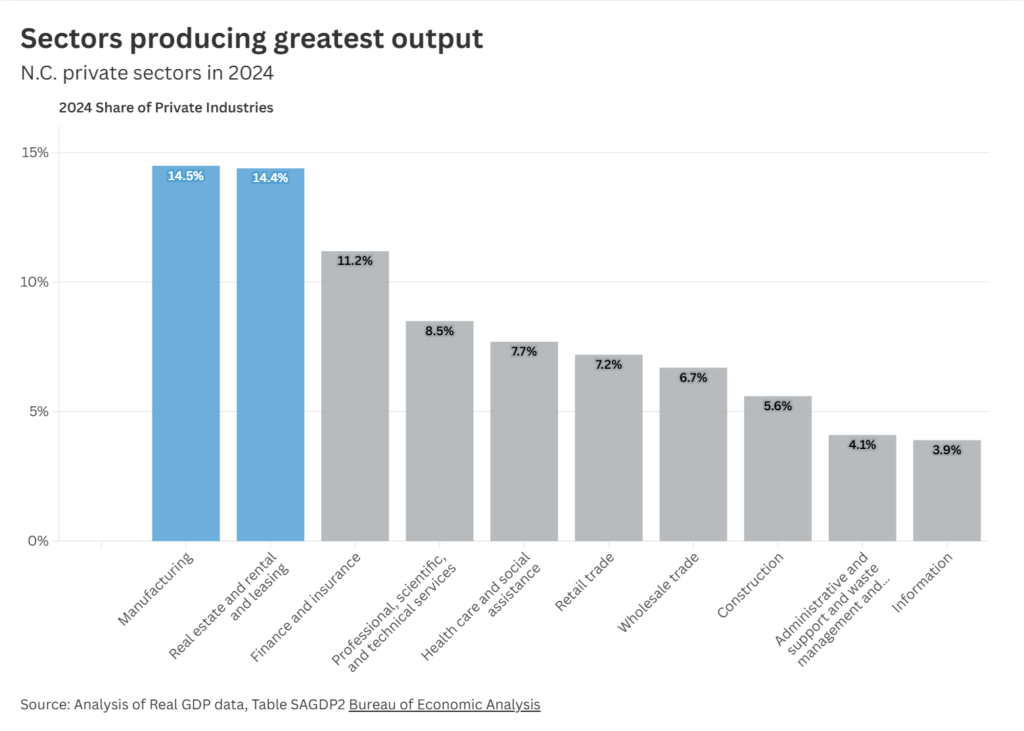
As North Carolina’s population continues to grow, that pressure is increasingly concentrated in the real estate market. Rising demand for commercial space has turned property ownership and leasing into one of the state’s most powerful economic forces. In 2024, real estate accounted for 14.4 percent of North Carolina’s private-sector economy, trailing manufacturing by just 0.1 percentage points.
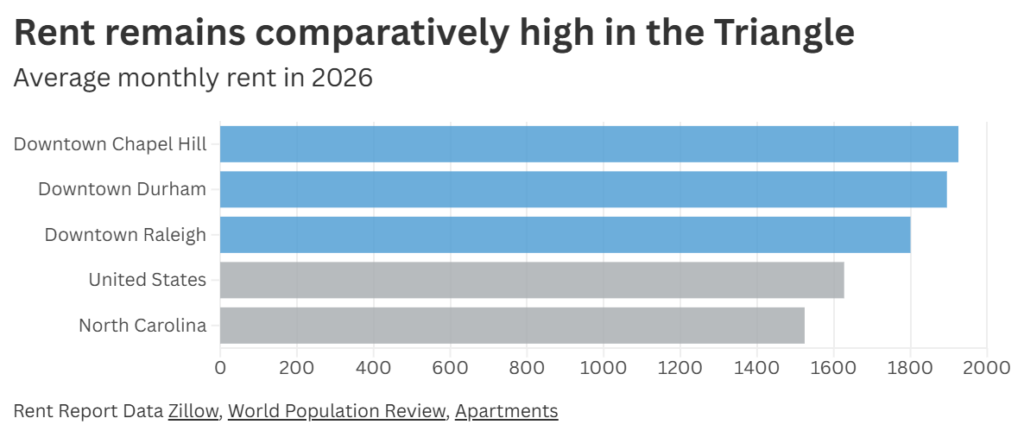
For small businesses, that shift has reshaped not only where they can afford to operate, but how they compete for increasingly limited retail space. The Wall Street Journal has reported that tight retail supply and rising rents have led many landlords to favor creditworthy national chains, making it more difficult for independent businesses to secure prime locations.
That dynamic is visible along Chapel Hill’s Franklin Street, a dense commercial corridor that blends local establishments with national brands. In recent years, Raising Cane’s replaced the longtime Spanky’s Restaurant and Bar, while Purple Bowl, a locally owned açaí shop, relocated farther from campus as demand intensified for high-rent storefronts near university foot traffic.
Momo’s Master is one of seven dumpling restaurants currently operating on Franklin Street. Owner Ramesh Dahal said the clustering of similar businesses extends across cuisines downtown, creating an oversaturated market that makes long-term sustainability difficult.
Dahal said the issue is not competition itself, but repetition driven by economic caution. As rents rise, landlords and developers tend to favor businesses that mirror existing successes, reducing risk but also limiting innovation. The result, he said, is a downtown area that increasingly rewards sameness over originality.
“We have seven dumpling places,” Dahal said. “That should be limited, because at the end of the day, out of eight, five are going to close their doors. Focus on local and the uniqueness of the business and the concept.”
Not all businesses view saturation as a threat. Meantime Coffee Co. operates among several other cafés on Franklin Street, and Nyiri said competition has not altered the organization’s mission.
“We hope our audience sees that we are remaining true to our authentic core within the competition of all these other coffee shops on Franklin Street,” Nyiri said. “There’s purpose behind us using local suppliers and local businesses.”
But even businesses able to withstand competition are not immune to the realities of rising property values and increased oversight. For some owners, the greatest challenge is not attracting customers but navigating the entities that control commercial space.
Hassan said his store has faced ongoing issues with the homeowners association that owns the building. He said the HOA attempted to terminate the lease after the shop renovated the space, citing the nature of the operation, despite having approved the lease beforehand.
He said the decision felt inconsistent, noting that the same HOA previously housed another smoke shop in the same location and currently rents space in the building to a tattoo parlor, a spa and a hair salon. For small business owners, he said, increased scrutiny from homeowners’ associations and property managers has added another layer of instability.
As property values rise, disputes like this have shifted leverage toward property owners and associations, leaving small businesses with little room to absorb risk.
As North Carolina continues into 2026, state leaders and business owners agree that continued growth is inevitable. The question is whether the systems supporting that growth can keep pace.
For small business owners navigating rising rents, shifting infrastructure and increased oversight, that uncertainty has become a defining feature of operating in North Carolina’s fastest-growing cities. As Magliola put it, “Risk is heightened when businesses have uncertainty.”
Magliola said sustaining North Carolina’s position as a top destination for business will require proactive investment at the state level, particularly in infrastructure, housing and long-term planning, before local owners begin to feel relief.
The N.C. Chamber of Commerce has outlined sustained, strategic investment in infrastructure and economic policy in their legislative agenda, as they’ve deemed it necessary to support long-term growth and community prosperity.
Without those adjustments, experts warn that the same growth driving the state’s economic success could strain local infrastructure, small businesses and overall quality of life.