
By Karen Zhu
Rotisha Halls recalls a particular sixth grader who would come to school every day angry – so angry that she reminded Halls of Angry Bird.
And every morning, as the school day began, Halls would greet the student by saying, “Good morning, how you doing today?”
The student’s response: “I hate it here. I don’t want to be here.”
For Halls, now a counselor at Green Magnet Elementary School in Raleigh, being a figure who listens and truly cares when asking, “How are you?” and then helping students sort through their emotions, is an important part of her job.
Yet as anxiety and depression among children and adolescents have escalated in recent years, there’s a statewide shortage of counselors along with other mental health professionals like therapists and psychologists in schools.
To address this, the Wake County Public Schools System (WCPSS) where Halls works as a counselor piloted a school-based mental health program in 2022. The program has made it easier for students to access therapy by partnering with local mental health agencies to have their therapists come on campus to hold therapy sessions. However, federal education funding cuts have made it difficult to expand the program to more schools.
School-based mental health programs like the one in WCPSS can serve as a frontline of youth suicide prevention. A 2023 study has found that investing in school-based mental health services can help increase access to care and reduce youth suicide attempts.
Counselors, social workers, principals, and therapists work together in this program to create a streamlined framework for students to seek help and for educators to identify and offer help to students who show signs of mental distress.
At Green Magnet Elementary, Halls regularly checks in on several students throughout the week to stay posted on how they’re doing.
She meets with students one-on-one, pops in the classroom to see how they’re doing in class, talks with teachers about anything they’ve observed about a student, and visits students during their social hours like at recess or lunchtime.
“My day-to-day is about being visible and making sure students see who I am and I’m there to support them throughout the day,” Halls said.
Halls has a mailbox outside her office where students can drop off letters to her. A letter may say: “Mrs. Halls, I need to see you because I’m having a problem with a peer in my class,” or “Mrs. Halls, I need to talk to you about family stuff.”
Parents have called, emailed, or sent messages to Halls through TalkingPoints, an app used by many school districts across the country to communicate with families, asking her to speak with their child. Teachers also refer students to her when they notice a student is not being their usual self, Halls said.
Some students do not open up about themselves to Halls as easily as others. Nor does she press them to open up.
Instead, Halls spends time playing games with students, throwing some basketball shots with them at the gym, or walking with them during recess. Doing activities together helps students to become more comfortable in talking about themselves.
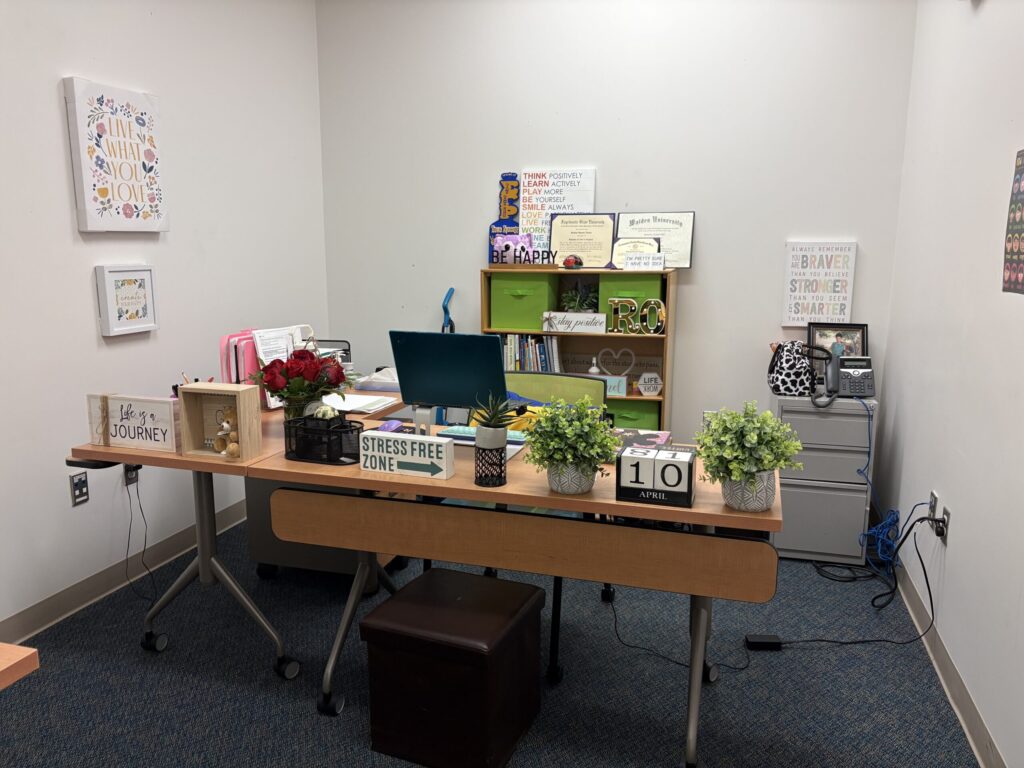
Inside Halls’ office, there are plush stuffed animals, a wooden marble maze board, expandable balls, and Pop-It fidget toys. Hung on her walls are posters showing illustrations of faces expressing different emotions. The word for the emotion is labeled next to each face.
Elementary students often struggle to find words to convey how they feel and tend to express it physically, such as via self-harm. Much of her counseling with young children is to teach them coping skills like breathing techniques and how to reflect rather than react to their emotions, Halls said.
As part of the school-based mental health program, students with more serious mental health conditions for which school counseling won’t suffice can receive referrals to outside agencies for more intensive therapy.
Huma Hasan, who specializes in therapy for elementary school students, is a therapist at Horizon Integrated Wellness Group. Horizon, which has locations in Raleigh, Cary, and Holly Springs, has a contract with Wake County’s school-based mental health program to provide therapy services to referred students.
Challenges at home affect behavior, sleep, appetite, and academics, Hasan said. She listens to students talk about changes in these factors during their sessions. In addition, she frequently uses play-based therapy to understand what children are going through in their lives.
“A child struggling with separation between parents will show frustration when they are having a hard time playing Connect 4,” Hasan said.
Hasan has noticed that whenever a child has anything going on at home and struggles in school, confidence and self-esteem are the first two aspects affected.
“They start feeling that they do not belong, they feel like, ‘People don’t like me. I’m not good enough,’” Hasan said.
When she worked with a student who was frequently suspended from school, Hasan saw little progress in helping the student until she began noticing his merits rather than his faults.
“I don’t pay attention to what he’s doing wrong, I compliment on what he’s doing right,” Hasan said.
After he did a favor for her one day, Hasan told the student he was “such a gentleman.”
“And he looked at me and was so surprised that somebody complimented him in a way that was not, I guess, familiar for him before that,” she said. Since then, the student has been called less to the principal’s office.
Small affirmations make big differences.
The school-based mental health program provides an avenue for youths to reach out to someone who will notice, listen and care.
Teens especially just want to have someone who listens to them, said Haley Spurlins, a licensed clinical mental health counselor and the director of Horizon’s school-based mental health partnership.
Spurlins, Horizon’s school-based therapist for Cary High School, has counseled teens with anxiety, depression, ADHD and autism. During therapy, teens often seek help on navigating interpersonal relationships, such as friend dynamics or family dynamics, she said.
The school-based mental health program allows students to directly find a professional to talk about what’s going on in their lives.
“Something that I really appreciate about the school-based mental health program is the way that it can eliminate barriers to care for families,” Spurlins said.
Many of the students Spurlins works with would not have been able to get therapy otherwise. Transportation and the limited time window to schedule therapy after parents’ work hours makes access to therapy difficult. Having providers come to schools through the school-based mental health program allows students to access therapy onsite.
In this school year, Horizon has received over 80 referrals, even though it has only been a school-based mental health provider since September 2025. They were able to fulfill 70 of those referrals.
Although Wake County has allocated funding for its school-based mental health program, it is only available in 150 of the county’s 200-plus schools. Schools in rural counties, especially in the western and eastern parts of the state, have even less mental health funding.
The shortage of available mental health resources in rural counties leaves youths at risk of suicide more likely to go unnoticed. In rural regions, youth suicide rates are nearly double that of urban regions.
According to the North Carolina Department of Health and Human Services, the statewide suicide rates among youth ages 10-17 almost doubled from 2.6 per 100,000 (2006-2010) to 4.8 (2019-2023). In Chatham County, a historically rural area, the rate spiked to 13.9 per 100,000.
“Not all school districts in North Carolina have the staff support yet to ensure that kids are getting all the preventative care that they need,” said Ashtin Crawford, data analyst for NC Child, an organization that advocates for policies to improve the lives of children in North Carolina.
In North Carolina schools, the mental health workforce does not meet the scale of students’ mental health needs.
The student-to-school psychologist ratio is 1,924:1, and the student-to-social worker ratio is 995:1 — far higher than the Whole Child North Carolina Advisory Committee’s recommended ratios of 500:1 and 250:1, respectively.
“Which in turn leads school districts to go into more of a crisis response situation than preventative mental health care,” Crawford said.
That is, when kids resort to going to the ER.
When children in a mental health crisis are admitted to emergency departments, they often wait for days in the ER before finally receiving psychiatric care. There has long been a shortage of hospital psychiatric beds across the country. In North Carolina, 1 in 5 youths who go to the ER are stuck waiting three or more days for a psychiatric bed.
A child may come to the emergency department severely depressed and suicidal. The hectic bustle of emergency departments exacerbates their mental state, making the ER a less-than-deal first line of mental health support.
School-based mental health programs can prevent a child from arriving at severe mental states, such as feeling suicidal, which helps to avoid an ER visit in the first place.
Suicide is one of the leading causes of death among teens. In North Carolina, reporting of major depressive episodes among adolescents ages 12-17 increased from 15.1% (2018-2019) to 19.1% (2022-2023).
Even when there are available mental health resources, access remains difficult.
When it comes to trying to access therapy through clinics, “I think the No.1 barrier is insurance,” said Lindsay Ray, a licensed clinical social worker and the director of Hope Services, another mental health agency in contract with WCPSS.
Hope Services began with only accepting Medicaid and has now expanded to accepting all private insurance. The expansion comes with a need for more graduates entering the mental health field, but the pipeline is small.
After four years of school, then about two years of graduate school, and having attained a license, it is discouraging for therapists to see their low salary rates, Ray said.
At agencies like Hope Services that mainly take in Medicaid patients, therapists are paid Medicaid reimbursement rates, which are much lower than private insurance rates.
Families that do have private insurance have restricted options of providers to choose from.
Not all clinics take every insurance.
For school social workers trying to refer students to agencies for therapy, figuring out a family’s insurance plan and finding a clinic who will take their insurance is a long process that delays care.
Britanni Bass began her career as a social worker in schools across eastern Wake County, and she saw firsthand how inefficiency in connecting students to providers posed a barrier to care access.
She wanted to take her work to a greater and more efficient scale, so she applied immediately when she saw that Wake County was hiring a coordinator for their school-based mental health program.
Bass is responsible for enrolling providers with the school-based mental health program and then connecting them with individual schools.
She is the person school counselors, social workers, and at times principals contact when they need assistance in finding providers or help initiating conversations with families about addressing their child’s mental health.
For larger cases, Bass coordinates the involvement of counselors, social workers, principals and therapists to help a family. Currently, she is helping a family with three kids, all of whom need mental health support. This is one of those cases where it made sense to bring the entire team on board, Bass said.
Emails flood her inbox every day, and she does her best to quickly respond to all inquiries. But there is only one of her.
“We would love it if we had more of my position because it’s a lot for one person,” Bass said. For school districts with a mental health program like Wake County, sustaining the program and trying to meet all the care requests remains challenging.
WCPSS’ plan for new hires stalled in 2025 when Wake County lost $14.1 million to expand its school-based mental health program because of the Trump administration’s $1 billion cut in school mental health grants.
The money was also intended to hire more social workers and onsite therapists at schools. Using funds to hire onsite therapists would help bypass the insurance and cost barriers.
“Some families have insurance, but there’s a high deductible. Agencies can’t see a student pro bono because they’ll be in violation of their insurance contract,” Bass said.
Meanwhile, some insurance plans are harder to find providers for. “So, I think we’re just stuck,” Bass said.
But hiring onsite therapists using the grant money would have allowed kids to get therapy at school without families having to go through insurance to find a therapist elsewhere.
Despite the $14.1 million funding cut, WCPSS still hopes to expand its mental health program, Bass said.
For now, Bass is working to maintain the program’s ties with existing local agencies and to enroll more agencies into contracts with its school-based mental health program. Having more clinics enrolled means a bigger pool of providers to choose from for students.
Still, connecting students with therapists from contracted agencies requires insurance. WCPSS can circumvent the insurance hurdle if its school-based mental health program directly employed therapists.
Just like how school counselors are permanently staffed, having therapists at school every day would help the program reach more students, Halls said. The lost funding could have made that possible, expanding the suicide prevention safety net.
The Journal of the American Medical Association (JAMA) recently published a study that reported a disproportionately higher use of the 988 Suicide and Crisis Lifeline among adolescents and young adults.
Schools can serve as lifelines.
Whether it’s through contracts with agencies or through school counselors, embedding mental health resources within schools allows educators and parents to meet students where they are – to offer needed supports and services, and sometimes, just an opportunity for students to be seen.
That sixth grader who reminded Halls of Angry Bird? Through counseling with Halls as she progressed through middle school, her anger began to dissipate, and she began looking forward to each day.
Now a freshman in high school, she would often email Halls to update on how well she is doing and how much she loves school.
Beyond just lending an ear to understand why students feel the way they do, “I also try to give them encouragements,” Halls said. “You are beautiful. You are smart,” she would tell them. She wants her students to realize that they are strong and capable of overcoming their challenges, and that they have a wonderful life waiting ahead of them.