
By Lauren Schutter
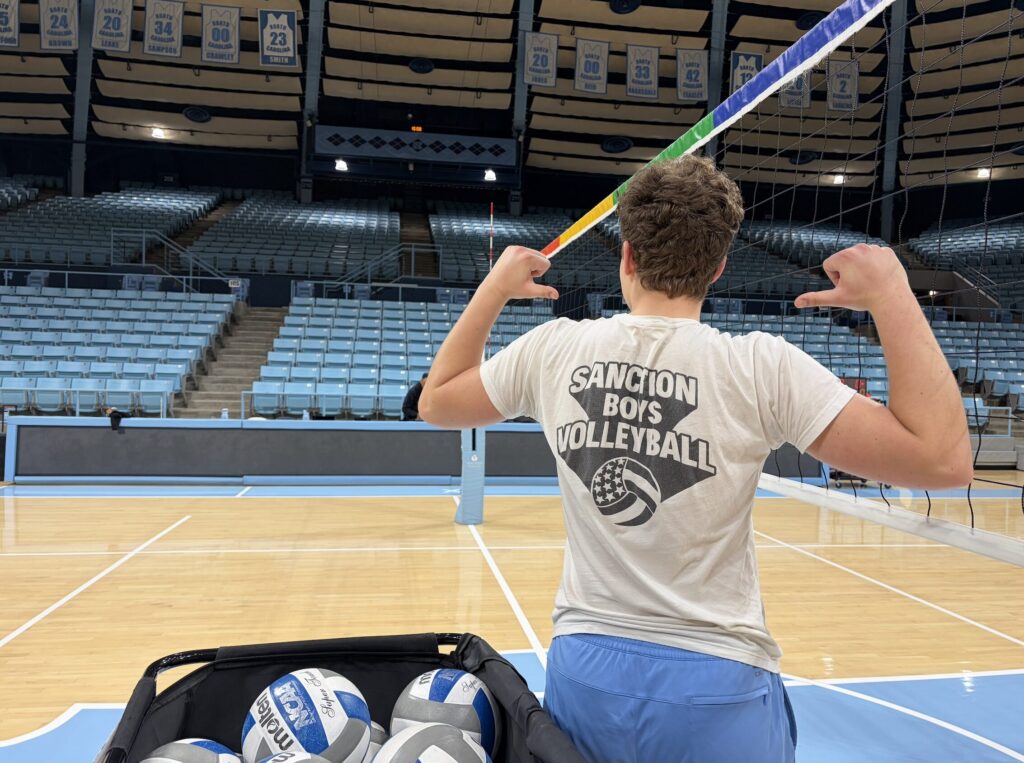
He was just a boy who wanted to play volleyball for his high school.
That was the whole beginning of it. No sweeping mission statement, no statewide blueprint, and no guarantee that anyone else would care enough to help.
Just a son looking at his mom and asking a simple question: “Why doesn’t this exist here?”
North Carolina did not have sanctioned boys high school volleyball — meaning the state didn’t officially recognize the sport. Meaning there was no official funding, no guaranteed coaching support, no consistent scheduling structure, and no statewide championship under the North Carolina High School Activities Association (NCHSAA) umbrella.
For Sarah Conklin, that question became a catalyst — transforming a simple conversation into a mother’s determination to create something that didn’t yet exist.
“It was just a mom trying to create an opportunity,” Conklin said.
That opportunity has now become something much bigger.
Conklin, founder and director of the North Carolina Boys Volleyball Association, has spent nearly a decade helping push the sport toward legitimacy in a state where interest has long outpaced opportunity. What started with four schools has grown into a statewide effort that has finally reached its goal today, May 6, with the vote by the N.C. High School Athletic Association.
And for the people who have poured years of unpaid work, belief and family time into this sport, this feels both emotional and overdue.
“Our youngest is a senior now, so it will be a 10-year journey from start to finish of his older brother wanting to play and then his senior year and it being sanctioned,” Conklin said.
In the beginning, Conklin was not trying to launch a movement. She was just trying to help her son find a place to belong. But as the game spread, the mission grew with it.
“I didn’t start out with that mission,” she said. “But very quickly it became apparent how much of a need there was for not only another sport, but kind of a welcoming environment.”
What she saw, she said, was more than boys learning how to serve, pass and rotate.
“I just saw the confidence rise and the camaraderie and just finding a place to belong,” Conklin said. “And that’s when I realized we need to take this further because there’s a real need for this statewide.”
That need is no longer hard to prove.
Nationally, boys volleyball has been the fastest-growing high school boys’ sport over the past decade, with participation increasing by more than 76%, according to the National Federation of State High School Associations.
According to Conklin, the North Carolina Boys Volleyball Association began with four teams in 2017. This season, she said, it expects close to 200 teams overall, including 133 public schools that count toward sanctioning requirements — well above the threshold needed to make a formal case.
“We’re feeling — I don’t want to say overconfident because that is not true — we feel like we’re in a good place to present a strong case for sanctioning,” Conklin said prior to the vote.
With the vote finally passing, it has marked the start of a new era. However, Conklin is quick to remind people that this growth did not occur because a major institution stepped in and carried it out.
“It’s a labor of love,” she said. “It’s been a lot of work.”
Most of that work has come from volunteers.
“It’s just volunteers, right?” Conklin said. “We spend every moment of our free time figuring out how to spread the word about the game. How do we support schools?”
She has seen coaches pay for seasons out of pocket. She has watched schools scrape together equipment and gym time. She has worked with a small group of people trying to make the sport feel as official as possible before it officially is.
Last season, the association hosted its state championships at Queens University. Conklin said it felt real — officials, game operations, coverage, structure, all of it.
“It was a very professional feeling,” she said. “I think they were like, wow, this is legit. It actually feels like a state championship.”
That has been part of the point all along: build something solid enough that nobody can dismiss it.
Conklin said the sport’s rise has also revealed how deeply volleyball already lives in North Carolina communities. At some schools, girls’ programs have helped boys’ teams learn the game. Club programs have offered support, courts, and connections. Families have spread the word. Players have brought friends.
“It’s pretty remarkable what a small group of people can do when they don’t take no for an answer,” Conklin said.
That spirit shows up in players like Lev Marushevskyi.
Before becoming the UNC men’s club volleyball president, Marushevskyi helped found the first boys’ volleyball team at Triangle Math and Science Academy (TMSA) alongside a small group of teammates. All three years he was there, the team reached the state championship. His senior year, they won.
That ending felt storybook. The process to get there was anything but.
“To found a team during that time, you needed a little bit of funding, and you needed coaches,” Marushevskyi said. “You needed the support of your school.”
For him, boys’ volleyball in North Carolina was never just about his own playing career. He became an ambassador for high school boys volleyball, posted relentlessly on Instagram in support, encouraged other players to start teams, and even spoke at a Wake County Board of Education meeting in support of sanctioning.
“As an ambassador, my no. 1 goal was to just spread the word about boys’ volleyball,” he said.
His reason was simple: he had seen what the sport could do for young men who may not otherwise find their place in athletics.
At Green Hope High School, before he transferred to TMSA, he remembers telling an advisor he played volleyball and hearing the response that it was “a girl’s sport.” Years later, that memory still hangs over the conversation around boys’ volleyball — the assumptions, the lack of visibility, the constant need to explain why this matters.
But Marushevskyi has also seen what happens when boys are finally given the chance to try it.
“It allowed me to be the best player in this smaller setting,” Marushevskyi said of high school volleyball. “I got to lead other people, and it ultimately helped me grow a lot more as a player and fall in love with the game even more.”
For players still in that pipeline, the experience can look very different depending on where they are.
At the North Carolina School of Science and Math, senior Manny Price saw both the growth of the sport and the gaps that still exist.
Like many players in the state, his path into volleyball did not begin with the sport itself, but with another one. Price came to volleyball after years of playing soccer, picking it up as something new — and quickly finding a place in it.
“I picked it up as a second sport after soccer and just fell in love,” Price said.
That path is common, but not always sustainable without school support. Price helped found a team at his previous school, navigating everything from fundraising for jerseys to securing gym space.
“It was a lot of emailing the AD, meeting with the principal of the school, hearing we weren’t going to have any equipment — you need to get a net… it was like ‘we can use the girls’ net,” said Price of the process. “We practiced in an elementary school gym before we could even move into the high school.”
Even now, that lack of structure continues to shape the experience for players across the state.
“It’s hard to get things really organized,” Price said. “Some schools can’t even practice as much because they don’t have gym access. There’s a big gap depending on where you are.”
For Chris Rozario, now a freshman at UNC and a member of the men’s club volleyball team, that transition came even later. He spent most of high school playing lacrosse before turning to volleyball his junior year at NCSSM — a shift that reflects how many players in North Carolina are still discovering the sport.
“I played lacrosse up until my sophomore year of high school, and then I started playing volleyball my junior year,” Rozario said.
Now, just a year removed from NCSSM, he has already seen how quickly that kind of late entry point is becoming more common.
“I think volleyball is a sport that’s very easy to get into,” said Rozario, “I think when people start playing, and really get the hang of it, they see the joy in it, and that’s obviously what we want.”
Both players said that despite the lack of official recognition at the time, the competitiveness is real — but often depends on the resources behind each team.
“At some schools, it’s just someone’s parent coaching,” Price said. “Other schools treat it like a real varsity program. That’s where you see the difference.”
Rozario emphasized this point, specifically pointing to NCSSM as a spearhead for what boys’ volleyball can look like across the state.
“Not every high school sees support from their AD to reserve gym time or to help schools practice, so it creates a barrier between schools. I would say we’re pretty lucky because NCSSM already treats it as a sanctioned sport,” Rozario said.
Sue Anne Lewis, head coach at the North Carolina School of Science and Math, has spent four years building a program that mirrors a sanctioned team — even without official recognition.
“Other than the fact that it’s officially not sanctioned, there’s no difference in how our boys team is run and how our girls team is run,” Lewis said.
Still, she has seen firsthand how uneven the playing field can be.
“When we go to other schools, they may only have one ref, or early on, some didn’t even have an official,” she said.
What has never been lacking, she said, is player investment.
“You don’t have to teach the competitiveness,” Lewis said. “They want to come out, they want to learn, and they want to play.”
That eagerness, she believes, is exactly why sanctioning will accelerate the sport’s growth.
“Even more guys are going to want the opportunity to play,” she said. “Most of our team had never played before — but once they start, they fall in love with it.”
That is part of what makes the vote feel so important. Not just that the sanctioning has validated years of work, but that it will widen the doorway for the next generation.
Marushevskyi said of the vote, his biggest feeling will not be regret that it’s coming a little too late for him, but excitement for those still behind him.
“I’m very, very happy for all the people that are still in high school right now,” he said. “They’re going to get to actually play as NCHSAA athletes during their time in high school.”
At the college level, Andrew Stepanian sees that same ripple effect.
The former UNC men’s club volleyball president did not even realize how close the sport was to sanctioning in North Carolina until recently, but once he did, his reaction was immediate.
“That is exciting,” said Stepanian, a senior. “That’s awesome because that shows that men’s volleyball is growing as a sport.”
Stepanian’s own story reflects the kind of winding path many North Carolina boys have taken into volleyball. He was a swimmer for most of his life. Volleyball came through beach trips, summer camp, and eventually the club team at UNC.
“You don’t know if you like something, if you don’t try it,” he said, “that’s how I got interested in volleyball.”
Now, he leads a UNC men’s club program that has seen significant interest. He said more than 100 people showed up to the open gym in the fall, with nearly 70 at the first round of tryouts.
“There’s always a growth in how many people are interested in playing,” Stepanian said. “There’s always this steady growth, if not exponential growth.”
That is why the sanctioning matters beyond the high school gym.
It affects who discovers the sport. Who stays in it. Who arrives on college campuses already in love with volleyball and ready to keep playing.
Conklin has spent years watching that effect happen in real time. Boys start with one season, then want to play club ball. Some take opportunities to play in college. Everyone finds some way to keep in touch with volleyball — some come back to help the next group, some start things of their own.
“We’re showing these guys that you can just start something and make a difference,” she said.
That might be the heart of this story more than anything else.
Not just that boys’ volleyball in North Carolina is finally officially sanctioned. Not just that the numbers are there.
It is that a sport built by volunteers, parents, players and believers has survived long enough to make the state listen.
“There’s a lot of people that will be over the moon about the sanctioning,” Conklin said.
Because for them, this was never just about volleyball.
It was about making sure the next boy who says he wants to play for his school doesn’t have to hear that there is nowhere for him to go.