
Across the state, an increase in electricity demand from data center projects and manufacturing is driving a dramatic reshaping of North Carolina’s energy environment, bringing a renewed interest in fossil fuel expansion and deregulation of energy projects.
Data centers are booming across the Southeast, and North Carolina is no exception. North Carolina is becoming an increasingly appealing location for tech companies thanks to its prime location, energy availability, and favorable legislation: in fact, data centers are exempt from sales tax on electricity and related equipment.
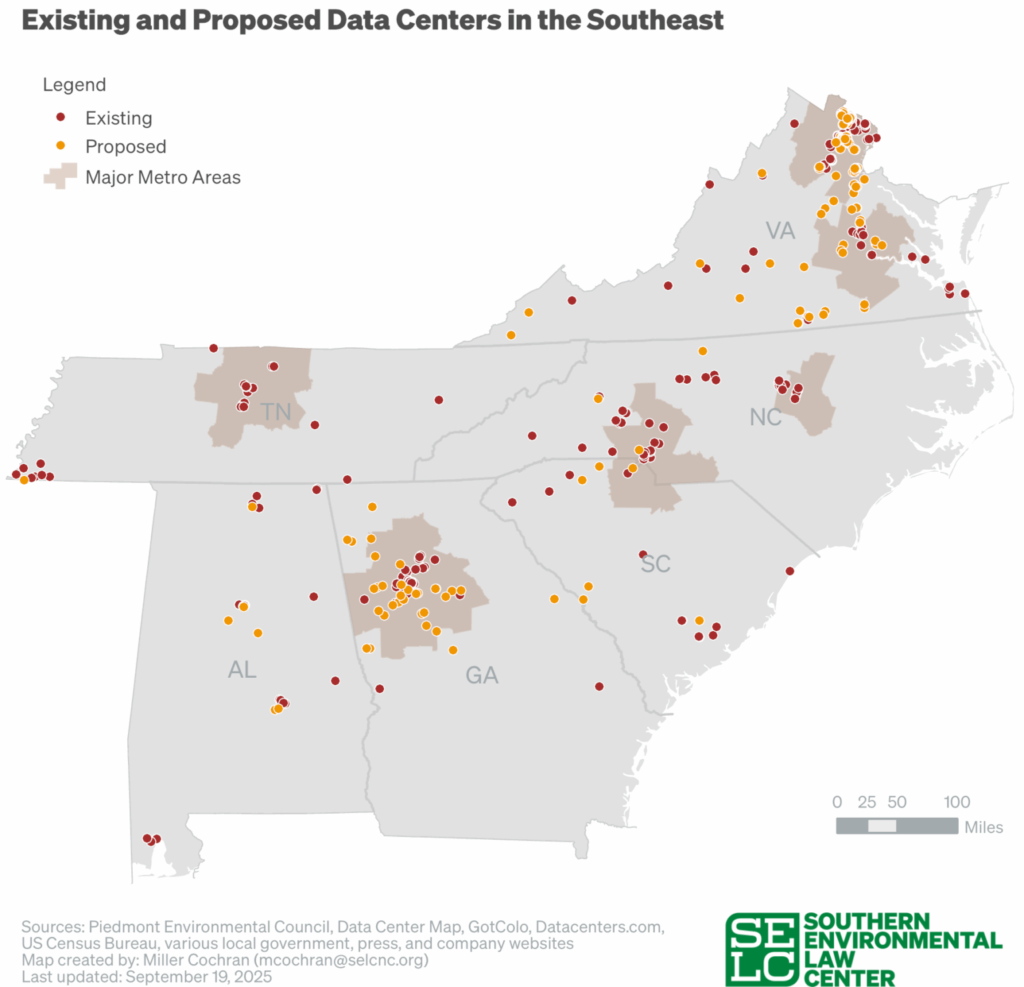
According to Data Center Map, an industry database site which connects buyers and sellers of database services, North Carolina is home to at least 100 data centers, with the proposal and construction of data centers having escalated in recent years. Since 2022, Microsoft has announced a $1 billion investment in four data centers in Catawba County, Apple has released plans for a $175 billion expansion of its existing data center in Catawba County, and Amazon has announced plans to invest another $10 billion to expand its computing and AI infrastructure in the state.
Much of this activity is centered in Catawba County, the epicenter of the state’s “data center corridor.” The county’s retired textile mills offer water systems and electricity connectivity that make Catawba an appealing prospect for data centers, according to the Catawba County Economic Development Corporation.
“We have had a really long-standing tradition of success in manufacturing, furniture and textiles specifically,” Catawba County Manager Mary Furtado said. “Those are employee-intensive industries, and as we’ve been a community that has worked really hard to stoke sustainable population growth, we’ve viewed data centers as a nice counterbalance to some of the more employee-centric industries like furniture and textiles and manufacturing that we’ve enjoyed so far.”
Data centers are buildings full of computer servers and other equipment, used to store and process large amounts of data for AI and other digital functions. As a result, they tend to create relatively few jobs once construction is complete compared to other projects of similar scales. Furtado said that this can actually be a benefit for communities like hers.
“For us, data centers have been a nice complement to some of the more workforce intensive industries, because you get a pretty significant private investment without the workforce demand, which means that the existing employers don’t feel threatened,” Furtado said.
Apple’s original data center in the county, built in 2009 and powered by renewable energy, has been a boon to the local economy. Tax revenue from the project has allowed the Town of Maiden to build a new Town Hall and a fire station, all while lowering the local tax rate.
“All things in moderation,” Furtado said. “We take a middle path approach. We believe that data centers are good economic investments for us and for our community, as long as we maintain balance. So over concentration and over reliance on any industry, data centers or otherwise, isn’t healthy for a local economy.”
The rise of AI and data center development has created a challenge for North Carolina’s utilities, however: how to manage the electricity demand from power-hungry servers. A single 300-megawatt data center, like the one proposed and ultimately rejected in Tarboro in September, could use as much energy as 30,000 homes, according to John Gajda, a professor of the practice in electrical and computer engineering at N.C. State University.
According to Duke Energy’s latest draft Carolinas Resource Plan, released Oct. 1, the Carolinas’ energy needs grew by about 10 terawatt-hours over the past 15 years. Over the next 15 years, it’s expected to grow by 80 terawatt-hours – an eightfold increase, almost equivalent to South Carolina’s 81 terawatt-hours in total energy consumption in 2023. Data centers account for over 85% of this new load growth.
The plan to power all this extra demand? Natural gas – and lots of it. After Senate Bill 266 became law over Governor Josh Stein’s veto in July, North Carolina scrapped its mandate that Duke Energy must reduce its carbon emissions by 70% before 2030. Unbound by this interim mandate, Duke Energy’s latest Carolinas Resource Plan has tapered back its solar plans, eliminated wind power from its 2040 Base Planning Period, and even pushed back its plans to retire some of its coal plants to 2040. The plan also increases the amount of nuclear power slated to be developed to 1,117 megawatts by 2037, but not by enough to balance the cuts to other renewables: onshore wind alone was cut by 1,200 megawatts.
If the plan and its constituent projects are approved by the N.C. Utilities Commission, Duke Energy’s portfolio will add up to 12.3 gigawatts of fossil fuels by 2040. However, the utility is still required to meet the legal mandate of carbon neutrality by 2050: the Carolinas Resource Plan lays out a long-term timeline which would see peak carbon emissions at 60 million short tons in 2036, followed by a steep decline to meet the 2050 mandate.
From the utility’s perspective, federal and state regulatory changes have made natural gas a more appealing investment than lower-emissions alternatives like solar or wind power. According to the Carolinas Resource Plan Executive Summary, proposed rollbacks of federal environmental regulations like the Section 111 rules under the Clean Air Act, will “help to enable flexibility for existing coal and new natural gas facilities to continue providing dispatchable baseload generation for customers.” At the same time, the Trump administration has rolled back incentives for renewables, including introducing new restrictions on tax credits for solar and wind projects, increasing their production costs.
“North Carolina is the top state for business, and our focus is on ensuring Duke Energy’s low energy rates continue to support this region’s economic success,” Kendal Bowman, Duke Energy’s North Carolina president, said in a statement following the release of the resource plan. “By expanding our diverse generation portfolio and maximizing our existing power plants to meet growth needs, we will ensure reliable energy while saving all our customers money.”
Duke Energy did not respond to requests for additional comment.
Nick Jimenez, senior attorney for the Southern Environmental Law Center, said that natural gas is a preferred fuel for large-load customers because of its reliability: once it’s installed, it can be delivered on demand to meet even the highest amount of traffic.
“The easiest way that utilities see to serve new load in a traditionalist mindset, is to just slap a new ‘dispatchable’ gas generating facility in there,” Jimenez said. “Because if you have a gas supply, and if you have the turbine to build in and all that, once you have it, in theory, you can flip a switch and get the electricity you want.”
For environmental activists, however, doubling down on natural gas and coal to support this new demand is a troubling development. In Person County, for example, Microsoft’s purchase of the 1350-acre Mega Park has driven significant controversy. While Microsoft has not confirmed that the site will be developed into a data center, the site was identified as one in the American Petroleum Institute’s presentation to the North Carolina House Committee on Energy & Public Utilities on March 5. Since then, Microsoft’s investment in the county has been specifically cited to support a second natural gas plant proposal on Hyco Lake.
“While Microsoft has not yet announced its plans for the site, access to significant quantities of reliable electric power was part of what made the site attractive,” Scott McKinney, chair of the Person County Economic Development Commission, testified at a May 5 N.C. Utilities Commission hearing regarding a new natural gas power plant on Hyco Lake. “Our economic development staff are currently fielding numerous requests for large tracts of land with access to high-voltage transmission lines. The demand for electricity in our region seems to be accelerating. Approval of this Joint Application of Duke and North Carolina EMC for development of approximately 1,360-megawatt advanced class combined-cycle gas turbine facility is certainly in the best interest of Person County and its citizens.”
Duke Energy is a major player in Person County’s local economy. As of 2024, the utility was the county’s second largest employer, at 225 jobs, and 20% of the local property tax base. Juhi Modi, the North Carolina field coordinator for Appalachian Voices, said that this has given Duke Energy significant sway in local government.
“The only reason that they cite over and over is the economics,” Modi said. “So there’s no mention about the potential air pollution impacts, the health impacts, the safety impacts, the fact that the proposed gas plant is right across the street from an elementary school. Over and over, they bring up the property tax element and say that they want Duke Energy to stay in the county, but Duke Energy could stay in the county and instead pursue renewable energy that is clean and safe for surrounding areas.”
According to a handout by Clean Water for North Carolina, which campaigned against the power plant, the development is expected to release more carbon monoxide and volatile organic compounds than the existing coal plant and could add to Person County’s already high rates of cancer. According to the handout, the area near the planned natural gas plant has higher rates of stroke, cancer, chronic heart disease, and COPD than 70% of adults in the U.S., as well as having high levels of birth complications like low birth weight and infant mortality.
“There’s a large community of elderly folks nearby, and a lot of these folks have lived on this land for generations,” Modi said. “And people shouldn’t have to think about whether or not they are safe and going to be able to lead healthy lives in the communities that they live in, in the communities where they have ancestral roots. It’s really concerning that this moved forward in the way that it did, and that people who have had to experience unimaginable impacts are going to see that continue.”
The Hyco Lake natural gas power plant received a Certificate of Public Convenience and Necessity from the Utilities Commission on Oct. 16, meaning that it was deemed in the public interest and can be included in rate calculations. However, the plant will need to undergo additional water permitting before construction can begin.
Data centers themselves can also have negative impacts on the environment, both during construction and once they’ve been completed. Any type of construction work can place pressure on nearby water systems due to the erosion of sediment, said Steph Gans, assistant director of Clean Water for North Carolina. On a site as large as Microsoft’s 1,350 acres in Person County, that could lead to significant harm to local water systems and wildlife, as eroded sediment lowers oxygen levels and disrupts nutrient levels.
“That is really dangerous for the entire ecosystem, all the lives that live in that water, and that affects the water quality for the things that humans want to use it for, like drinking water,” Gans said.
The water consumption of data centers has also become a major concern, particularly in the western United States, where Gans said that their water use has reduced the water pressure in local wells. According to the Environmental and Energy Study Institute, even a medium-sized data center can use up to approximately 110 million gallons of water per year, equivalent to the average water use of 1,000 households.
Should data center growth drive natural gas development as predicted, advocates are concerned not only about the environmental impact, but how new gas infrastructure development will affect ratepayers’ bills. Senate Bill 266, the Power Bill Reduction Act, altered the state’s Construction Work in Progress mechanism, which helps utility companies recover construction costs by passing on some of it to the consumer through their base rate payment. Previously, this would only be applied if the Utilities Commission determined that it would be in the public interest and “necessary to the financial stability of the utility” to do so, but SB 266 allows utilities to incorporate construction costs for unfinished projects on an annual basis, potentially leaving ratepayers on the hook for projects that won’t be functional for years, or at all.
In South Carolina, for example, an abandoned nuclear power plant expansion project accounted for 5.6% of Dominion Energy customers’ electric bills in 2024, even after Westinghouse Electric Company was forced to reimburse low-income ratepayers $21.25 million in 2021. Santee Cooper, South Carolina’s state-owned utility, announced on Oct. 24 that Brookfield Asset Management would take over the project and complete the two unfinished nuclear reactors at no additional cost to ratepayers.
“What they’re planning to do is procure equipment, right? Buy gas turbines, buy transmission infrastructure, and even if those gas plants are not approved at the North Carolina Utilities Commission, Duke will charge customers for that equipment that they have bought without utility commission approval,” Michelle “Meech” Carter, clean energy campaigns director at the North Carolina League of Conservation Voters, said.
The Utilities Commission Public Staff’s analysis, based on past fuel costs, estimated that the Power Bill Reduction Act would shift at least $24.8 million per year in fuel costs from large commercial customers to residential ratepayers.
In North Carolina and across the country, the data center market is highly speculative. Tech companies are known to propose more data center projects than they actually intend to build for a number of reasons, including local pushback and energy availability.
“I don’t think there’s really any debate that data center developers are pitching proposals in multiple places at once, and so there’s a lot of overlap. And the utilities, they’re responsible for building whatever the actual load is going to be, so they have a clear, good methodology for screening out that sort of duplication,” said Jimenez of the Southern Environmental Law Center. “But I still think it’s a pretty serious risk, and it’s moving quickly enough that it’s very hard to say what will actually show up.”
On Oct. 14-15, the North Carolina Utilities Commission held a technical conference to allow experts in the field to speak about potential methods to address key problems relating to the latest surge in large-load customers: how to ensure a tech-friendly regulatory environment while keeping electricity rates low and avoiding overbuilding for projects that might not ultimately materialize.
According to several presenters at the technical conference, speed to market is a top priority for data center developers. When seeking a new site for a data center, access to fast, reliable, and affordable energy is a must in order to attract tech company investments and bring projects online quickly.
“Projects worth billions of dollars and thousands of jobs will go to the states with the strongest energy availability strategies that can guarantee low-cost, reliable energy. These customers, whether they be hyper-scale data centers, advanced manufacturers, universities or research institutions, are also looking for certainty by which a utility and its regulators can commit to serving new load,” Greg Gebhardt, director of government affairs for the Southeast for Cypress Creek Renewables, told the commission. “Today, the competitive landscape among states is being redrawn around which states can deliver speed to power, transparency in process and predictability in cost.”
The speed at which a data center project is able to come online is pivotal to its success, according to Building Design + Construction. Even a few weeks of delay can lead to millions in lost revenue, potentially crippling smaller projects. This means that tech companies – and the money behind them – are more likely to site their developments in states that are quick to offer their services, including those willing to provide additional infrastructure to support them.
If a utility builds out too quickly to meet demand that doesn’t materialize, however, it runs the risk of creating stranded assets: generation and transmission infrastructure that no longer serve an economic purpose. While Duke Energy can expect to earn 9.8% return on investment, critics worry that any rush to meet data center demand could raise costs for ratepayers.
“Duke Energy is guaranteed a 10% return on equity for any power plants that it builds,” Modi said. “And so the system is really set up to incentivize building expensive projects, offloading the cost to everyday people who pay a light bill to Duke Energy, plus people who pay electric bills to co-ops and municipal utilities who buy from Duke Energy. So all that to say, the way that this methane gas buildout is going to impact everyday folks and make it a lot harder to pay their electric bills is really concerning.”
However, Duke Energy says that its process is sufficient to ensure that large-load customers are committed to their utility contracts. The company’s current provisions include a minimum contract term of 15 years, a refundable advance payment to cover the cost of interconnection to the grid, and termination damages for companies that have to back out of their contract.
“The basic approach that we have used for decades is still effective and appropriate. We do not see the need for a complete overhaul or replacement for the basic cost of service, rate making approach,” Jonathan Byrd, managing director for rate design and regulatory solutions, told the commission. “These practices apportion out the costs for an evolving mix of generation to an evolving mix of customers. And the loads we’re talking about today certainly are large, but we also have a very large system, and we’re planning to make large investments in central plants and transmission, with or without these new loads.”
Rather than spiking ratepayers’ energy bills, Duke Energy’s presenters argued, the ability to spread costs over a larger number of megawatt-hours will ultimately place a downward pressure on electricity rates. However, these price benefits aren’t expected to materialize for 15 years.
“Rates will go up regardless,” Michael Quinto, director of integrated resource planning advanced analytics for Duke Energy, told the Utilities Commission. “Putting aside any additional resources or load growth, we’ll continue to see inflation of operations costs, inflation of fuel costs, whatever that may be. The downward pressure is the ability to spread that over more megawatts, which is helpful. The more megawatt hours we have to spread those costs over, the better.”
Duke Energy did not respond to requests for additional comment.
Presenters at the technical conference also discussed a number of technology-based solutions to reduce the impact of large-load customers on the electrical grid. A customer’s electricity infrastructure is generally built to meet its peak energy demand, which is to say that enough electricity is provided to ensure that the customer has access to 100% of their maximum expected demand, 100% of the time. However, there are a number of steps that data centers can take to reduce their energy demand, including curtailment, load flexibility, and colocation.
If data centers are willing, or compelled, to reduce or “curtail” their electricity usage, they can be incorporated into existing utility systems with much less need for new generation infrastructure. In Texas, for example, curtailment of non-critical large load consumers is mandatory during firm load shed events, a utility’s last resort to prevent an overload of the grid. Curtailment could provide significant energy savings: one February study by Duke University’s Nicholas Institute for Energy, Environment & Sustainability found that even a 0.5% curtailment could free up nearly 100 gigawatts of power nationwide.
Load flexibility involves shifting energy demand either temporally, by shifting non-essential operations to off-peak times like overnight, or spatially, by shifting tasks to other facilities.
“If you’ve got a super cold winter morning, which is when Duke says that it often has a ton of demand on the system,” Munashe Magarira, senior attorney for the Southern Environmental Law Center, said, “you could shift that particular service or load to another time in the day so that there is less demand on the system and it’s not stressing the system out.”
Magarira said that load flexibility could also enable data centers to use more renewable energy.
“If you’re shifting it to maybe the afternoon, there will be solar and there will be renewables that can meet that [need], and you don’t necessarily have to have a situation where only gas can meet that need,” Magarira said.
Some data centers have also shown interest in colocation, or producing their own energy on-site, through diesel backup generators or renewables, like Apple’s Catawba County data center. This would reduce or eliminate the need to purchase energy from utilities like Duke Energy, but does not appear to be particularly popular.
“I’ve spoken with well over 100 large load data center prospective customers in the last two years, and I’ve heard approximately a handful reference some type of colocation or self- supply generation that wasn’t exclusively focused on diesel backup generation for emergency support purposes exclusively,” Andrew Tate, managing director of economic development for the Carolinas for Duke Energy, said. “The handful that advance this discussion, were proposing colocation primarily as a means to speed delivery.”
The Utilities Commission Public Staff gave a number of recommendations at the conference, including requesting that North Carolina utility companies propose special rates or contract provisions for large load customers at their next ratemaking case with safeguards to ensure that they pay their fair share.
“We believe now is the most reasonable time,” Dustin Metz, engineer for the Public Staff, said. “Let’s be proactive instead of reactive. And to the extent that we continue to wait, there will already be cost of service potential impacts, and then we’re playing catch up.”
How North Carolina tackles the challenges surrounding data center growth will have a decades-long impact on the state’s energy generation, ratepayers, and the environment. Data centers might be quick to come and go, but the infrastructure built to fuel them could last for generations.
“If, instead of building a CC [combined-cycle natural gas power plant] or something, we’re talking about nuclear, something with a 60-year asset life, now this timeline is pushing towards 2100. So people who haven’t even been born yet are going to be paying off the asset,” Leah Weaver, public utilities engineer for the Public Staff, said. “And so, just keep in mind that the decisions made today are going to continue to have ramifications for decades into the future.”