
Story by Tess Alongi
The 2026 midterm elections have come and gone. In North Carolina, Democrats won control of the North Carolina House of Representatives for the first time in 16 years. In the Senate, Democrats flipped enough seats to break the Republican Supermajority.
The results in North Carolina mark a significant shift in the state’s political landscape at the same moment that socialism is sweeping across the country.
While socialism isn’t recognized or registered as a political party ballot line in North Carolina, socialist leaders are still working to advance policies through elected office, building political movements and establishing community campaigns and activism.
The midterms brought a widespread set of results for the Democratic Socialists of America (DSA) and socialist candidates across the United States. While socialists made notable gains in certain parts of the country, Nithya Raman winning the Los Angeles Mayoral Election and incumbent Alexandria Ocasio-Cortez retaining her seat in the House; those victories haven’t been replicated everywhere.
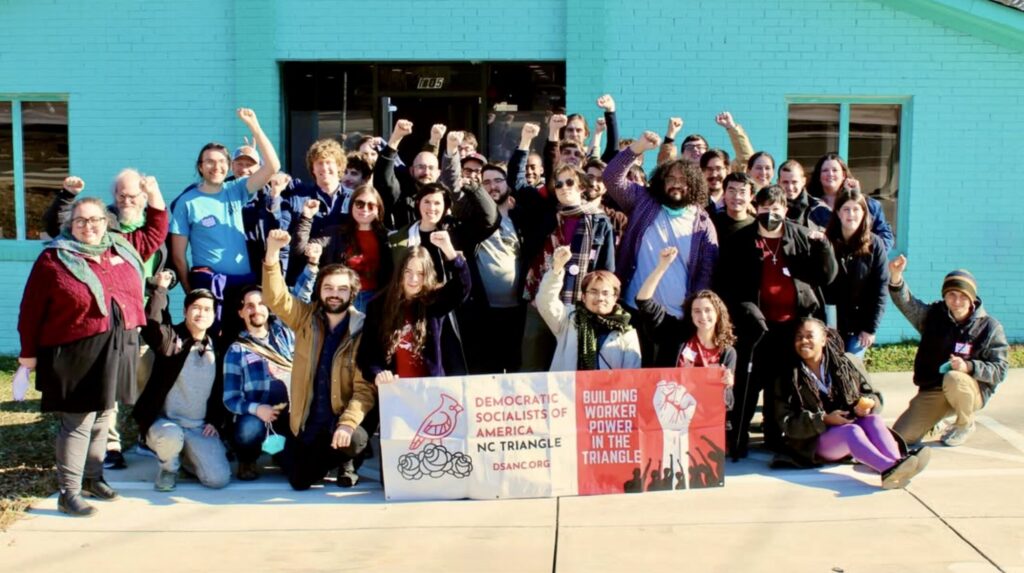
In Orange County socialism advancements are spearheaded by the actions of the Democratic Socialist of America Triangle Chapter, the largest chapter in the state, home to more than 1,000 members.
Nate Baker, a Durham City Council Member and longtime member of triangle DSA, said his identity and experience with socialism and DSA began with him questioning a fundamental aspect of democracy itself.
“When you go to work, is it a democratic place?” he said. “When you’re at home, is it a democratic place? When we are out in the world, do we as ordinary people all have a way of being able to shape the world that we live in?”
Baker’s questions reflect the central argument and ideology among those who identify as socialists. They believe political democracy should be extended beyond participating in elections and should instead be part of the workplace, housing and all economic systems that people interact with in their daily lives.
In North Carolina, however, turning the socialist ideology into practice and policy presents many challenges. Baker said that state lawmakers continue to limit the power of local governments, leaving local leaders, such as himself, with fewer opportunities to enact change.
“The state legislature is very aggressive in eliminating powers for local governments, frankly, in a bipartisan fashion,” Baker said. “It’s obviously much more heavily weighted toward Republicans, but Democrats also like to take away power from local governments.”
Despite the constraints that come with identifying as a socialist in North Carolina, local governments still serve as an important place for socialists to pursue their goal of directing resources away from large corporations and to everyday Americans.
Defining Socialism
Socialism doesn’t have one agreed-upon definition. Even those who identify as socialists have different ideas about what that label means. Some believe that socialism emphasizes investment in healthcare, others education or even the relationship between workers and people who own businesses.
Baker describes himself as a Marxist, meaning that he frames socialism in the lens of ownership and wealth distribution.
“I believe in the framework in Marxian economics,” Baker said. “I think about who owns the means of production and who works for those who own the means of production and how is wealth distributed, who owns the decision making power?”
For Baker, socialism serves as a tool to understand why people who work full time might be unable to afford their basic necessities.
“At a certain point, people are just saying, why can’t I pay my bills?” he said. “I’m working 40 plus hours every week and I can’t pay my bills. I can’t pay my rent. I can’t pay for groceries, something’s going to come out. I can’t pay for child care.”
Other politicians who share the concerns of socialists don’t always approach their interests in the same way. Nida Allam, a Durham County commissioner, ran in the primaries for the U.S. House of Representatives where she lost a close race to incumbent Valerie Foushee.
While Allam is an active paying member of Triangle DSA, she didn’t seek the endorsement of the organization during her race. Allam said that her campaign sought many endorsements and didn’t have the capacity to reach out to every organization.
Allam said her political identity developed through her experiences as a Muslim American. She first became interested in socialism after encountering Bernie Sanders’ presidential campaign when she was an undergraduate.
She said that Sanders’ platform presented a new way of understanding politics and demonstrated how people from all different backgrounds could come together and organize around shared beliefs and concerns.
“I was like, yeah, that should be what all of us are saying, ” Allam said. “Why should our race or creed dictate what your opportunities are and what your safety is in this country?”
Allam remains registered as a Democrat but she incorporated socialist values into her approach to public service.
The line between progressive Democrats and socialists often overlap. Both might support expanded public services and protection for workers. However, for Allam, the difference comes in a politician’s willingness to challenge the interests of our existing systems.
“Progressive in its name itself is about progress, and for me, it’s about progress for everyone, not just a select few,” she said.
The Challenge of Winning
The movement’s ambition of putting more socialists in a place of power faces many obstacles in a state like North Carolina, where Republicans have controlled the state legislature for years.
In efforts to get more people involved and interested in the socialist movement, Baker said that socialists must talk directly with working- class people.
“I think it’s about messaging,” he said. “I think it’s about telling the truth. I think it’s about speaking to people’s true challenges that they face on a daily basis and giving them real options for how they can, and how we can all collectively solve those challenges.”
But building support, especially in North Carolina, requires much more than trying to persuade voters during an election. Baker said that the socialist movement must help people understand both the political and economic systems that shape their lives.
Allam also said she understands the importance of building relations beyond reliably Democratic areas. She said that working-class people across the entire state often share similar concerns about health care, housing and the cost of living regardless of their political affiliation.
Rather than expecting people to research all political organizations, Allam said that political organizations need to meet people in the communities where they live.
“When folks are struggling and already trying to just keep the bare necessities for their families moving forward, working their job, they don’t have the time or capacity to seek us out,” Allam said.
This approach is one way that socialists are working now to try to extend their coalition beyond their already established base and into the lives of a wider range of residents.
Organizing Beyond Elections
For local socialist organizations, while elections are a part of their initiative and strategy, they aren’t the organization’s only objective.
Alex C., Triangle DSA’s Membership Coordinator, said disillusionment with mainstream politics is what pushed him toward the organization. After initially becoming interested in politics during Barack Obama’s first presidential campaign, Alex said he became increasingly frustrated with the gap between promises and action.
Eventually in 2024, after seeing DSA’s response to events in Palestine and protests on college campuses, he joined the organization.
“It was so empowering just to see how excited the members were and how dedicated they were to building a better world and fighting for socialism,” Alex said.
Aside from protests, DSA engages in electoral campaigns, labor struggles, activism and environmental advocacy. While their efforts range across a wide scale of political issues, Alex said these efforts are often connected rather than separate causes.
“The reason our planet is being destroyed is because of the pursuit of profit,” he said. “The reason why your boss or your landlord is trying to squeeze you is because of profit. The reason why we’re seeing these endless wars has to do with things like oil and maintaining the empire.”
DSA works to connect all political concerns and build relationships among those who feel passionate. Their approach helps to shape how DSA views its relationships with elected officials.
The organization works to create relationships with officials before seeking an endorsement, with members participating in decisions about which candidates to support.
So while electoral champions can help the organization reach people who might not otherwise know about them and their agenda, Alex said elections shouldn’t be seen as the entire effort but simply as part of a larger agenda to build a moment.
Building a Lasting Legacy
While electoral success is important, for socialists it’s not necessarily the ultimate measure of progress. Danny Nowell, a Carrboro Town Council member and longtime socialist, said he sees the movement as a way to restore working Americans’ influence.
He said building lasting power requires more than winning individual elections, instead it means creating an organization that can bring people together and give them the tools to create a meaningful impact in politics.
“In order for us to have democracy in this country, we’re going to have to have economic democracy,” Nowell said. “And that means that the people who produce wealth are going to have to have a say about how that wealth functionally governs.”