
Story by Maria Sullivan
On Nov. 3, voters across the country will get in line to cast their ballots. for out-of-state North
Carolina college students, getting to the polls might require jumping a few additional hurdles.
Most UNC students identify themselves at local voting locations with a state driver’s license or
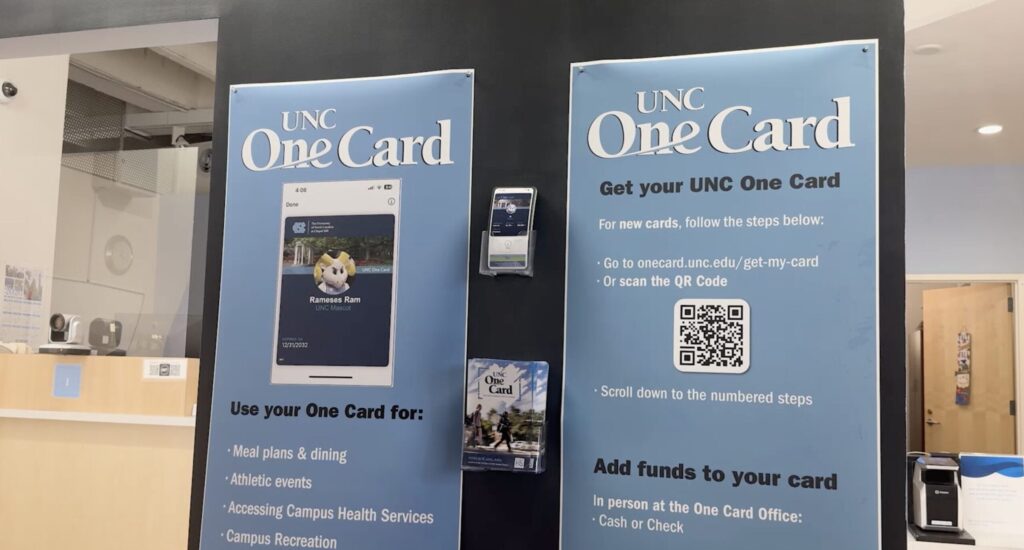
student ID card. However, starting in 2023, the university stopped issuing physical One Cards to
all incoming students. Digital One Cards became the only widely distributed form of student
identification on campus, and came to serve all of the same purposes as a physical One Card.
Except for being accepted as a valid form of voter ID.
For North Carolina natives, this isn’t a problem, and students can show North Carolina licenses.
Out-of-state students don’t have that option and often don’t realize they cannot show a driver’s
license or form of identification issued by their home state once they’ve lived in North Carolina
for more than 90 days. They either have to show a passport or a physical form of student
identification.
By the time they get to the polls, students who don’t own a physical One Card might not realize
they won’t be able to cast their ballots. The ID on their phones won’t be enough.
“Basic civil rights being tied to a cell phone, it’s kind of concerning that this is part of the
conversation,” UNC professor Dr. Tori Ekstrand said.
Ekstrand oversees the UNC Center for Media Law and Policy’s First Amendment Day
programming, which features a voter registration drive. Ekstrand teaches media law at UNC and
said that voting is among the most important freedoms we can work to protect and to practice.
She said given the university’s push to digital forms of ID, some responsibility falls on UNC to
effectively communicate how identification changes could impact student voting ability. More
than that, though, she said the issue is indicative of a larger issue with state legislators in Raleigh
“constantly moving the ball” when it comes to voter registration.
“It feels like some type of Peanuts strip,” Ekstrand said. “With Lucy constantly pulling the
football away from Charlie Brown. I mean, it’s gotten to an incredibly ridiculous level.”
Ekstrand said the dilemma presents an equity issue and a due process concern, aimed at making
voting more difficult. Regarding people attempting to cast votes without proper identification,
she said the scholarship on that phenomenon is negligible and that poll workers know how to
handle anyone without proper ID.
Ahead of the 2024 election, digital One Cards were going to be accepted at the polls, but the
Republican National Committee (RNC) and the North Carolina Republican Party filed a
complaint to stop UNC students from using their digital Mobile One Cards as forms of voter ID.
The RNC initially lost the case, but appealed to the North Carolina Court of Appeals and won.
This case is becoming increasingly relevant as more and more Americans rely on digital forms of
identification. North Carolina lawmakers have directed the Division of Motor Vehicles to begin
plans to develop digital driver’s licenses. Eventually, North Carolina will offer a digital driver’s
license alongside the physical card, which will also pose a reason to reevaluate election law.
Micah Mangot, the president of UNC Young Democrats, said that the effects of that ruling are
still being felt on campus, adding another hurdle to student voter registration. Some members of
the UNC Young Democrats were plaintiffs in the case.
“I think it’s obvious that any obstacle that makes it harder for college students to vote, and
especially schools that are students at a school like you and see voting is a bad thing for the
Republican Party,” Mangot said.
She said that, for out-of-state students who may already feel confused about where they can cast
their ballot, not being able to use the student identification that gives them complete access to
everything else on campus is another hurdle for students to cast their vote, a hurdle that his
organization is attempting to combat.
So far, UNC Young Democrats has registered 850 voters and is on track to hit 1,000 in the
coming days.
“It’s important that people know, especially if they’re out of state and they’ve never voted in
North Carolina before, and especially because North Carolina has more restrictive voting laws
than a lot of other people’s home states, that they have to go to Student Stores,” Mangot said.
Garrett Tomberlin, the President of UNC Young Republicans, said that he views the debate about
digital One Cards as an election security issue. He said that he didn’t realize digital One Cards
couldn’t be used as forms of voter identification until the discussion was brought to his attention.
“I know Republicans these last couple of years have talked a lot about making sure we have
secure elections,” Tomberlin said. “I can understand how the physical card could inherently, I
feel like, be more secure than a mobile one.”
He did say that he understands how the restriction makes it harder for out-of-state students to
vote, adding that the issue is, at its core, a nonpartisan one, and that every citizen should be able
to vote.
Amid all of the concern, students on campus, including Mangot, worked to create a solution to
drive voter participation. UNC’s One Card office, located in UNC’s Student Stores, agreed to
print physical One Cards for students who never received one, free of charge, for the purpose of
voter registration.
Natasha Young, who leads Tar Heels Vote, a nonpartisan student voter education initiative, said
that usually, the ID cards cost $10. The initiative started on Oct. 1, and any UNC student who
was not issued a physical One Card, which encompasses almost three-fourths of the student
population, can now request one.
For students and all North Carolina voters, ID exception forms do exist for those without
physical forms of identification. Appeals must be made on a case-by-case basis.
Young said that working with Tar Heels Vote has shown her how passionate UNC students are in
regard to influencing elections and current events. In 2020, she said, UNC had the highest voter
turnout of all of the ACC schools.
“Every eligible voter deserves the opportunity to cast their ballot,” Young said.