
By Corrie Kelleigh
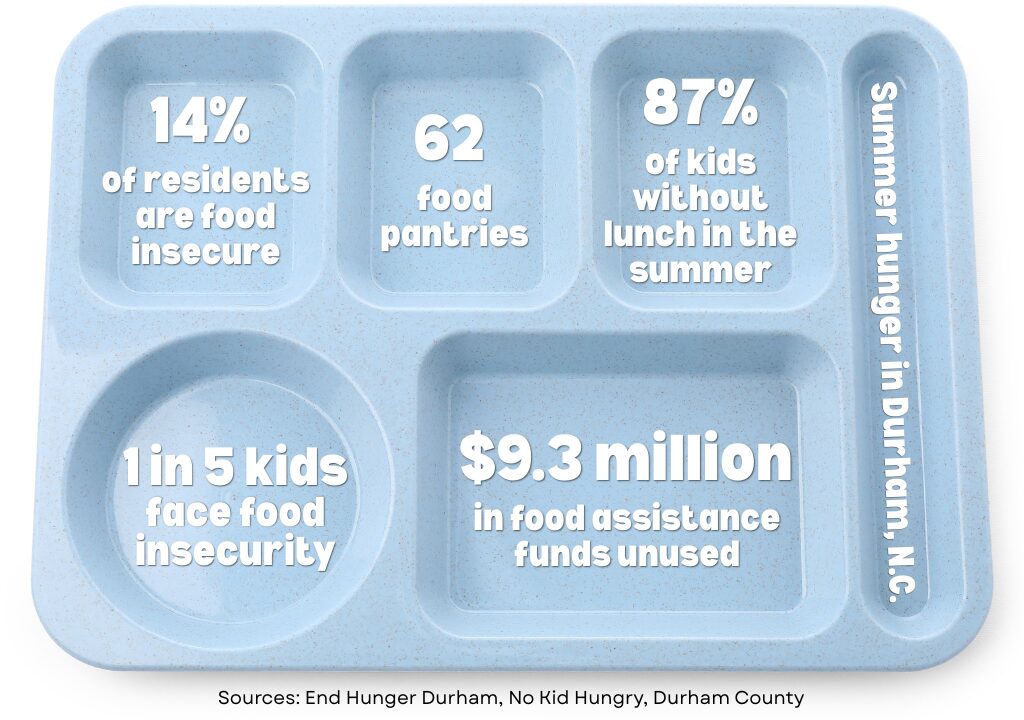
Summer in America means longer days and empty classrooms. For thousands of families, it also means losing one of the most reliable sources of food. In Durham County, about 14 percent of residents are food insecure, with children facing even higher rates. When school lets out, that gap widens.
For some families, that gap is already visible during the school year. “My son told me he gave his food away because one of his friends was really hungry,” said Edwina Barbee, a Durham parent whose son attends Durham Public Schools.
“Hunger is rising, unfortunately,” said Raina Bunnag, Durham County’s food security coordinator. “We’re seeing it every day.”
Across the county, community organizations and school programs are working to fill the gap left when school meals disappear.
Summer Gap
Summer hunger is a persistent issue for children, not just in North Carolina, but across the country. Nationwide, more than 21 million students rely on school meals during the academic year. But when school lets out for the summer, that access disappears. Nearly 87 percent of those students do not receive meals through summer programs, creating a significant gap in food access.
“In the summer, food insecurity with children increases,” Bunnag said.
Students in Durham County are no exception. During the school year, meals provided through Durham Public Schools serve as a primary source of nutrition for many children.
“School meals are the largest food security program in Durham,” Bunnag said. “Many children are getting the bulk of their calories and nutrition needs met in school.”
When that structure disappears in the summer, families are often left to fill the gap on their own.
“It’s expensive packing lunch every day and snacks on top of that,” Barbee said because her son takes his own lunches during the school year.
While programs exist to help, far fewer families take part during the summer months.
“Participation in summer meals is much, much lower than participation during the school year,” Bunnag said.
That gap doesn’t just show up in statistics, it shapes how families eat, plan and get through the summer.
What food insecurity looks like:
Food insecurity doesn’t always mean going without food entirely. While it is defined as a lack of consistent access to enough food to stay healthy and thrive, it often shows up in less visible ways.
“Every time I pack my son’s lunch he’d come home starving,” Barbee said. “I asked him, ‘Baby, I packed you a main item and snacks, what happened?’ And he told me, ‘Mommy, one of my friends was really, really hungry, and I had a lot.’”
Stories like this reflect a broader reality for many families. For some families, the fear of running out of food is constant. For others, it means eating less than they need because that’s all they have. It can also look like relying on cheaper, less nutritious food simply because it’s what they can afford.
Food insecurity can have lasting effects on children, both in the moment and later in life.
“Food insecurity and hunger is linked with a lot of different health problems, including heart disease, diabetes, anxiety, depression, learning issues and concentration issues,” Kelly Warnock, the Durham County Nutrition Program Manager, said.
Even during the summer, when students are not in school, the effects don’t disappear.
“Kids can’t really concentrate when they don’t have food in their belly or if they’re just nervous about where that next meal is going to come from,” Warnock said.
In some cases, food insecurity can also contribute to obesity.
“If we don’t know where our next meal is coming from, we’re going to eat as much as we possibly can,” Warnock said.
This creates a cycle where limited access to consistent, nutritious food leads to long-term health challenges, many of which communities like Durham are working to address.
Durham Numbers:
In Durham County, food insecurity affects a significant portion of the population, but children are bearing the brunt of it. About 14 percent of residents are food insecure, while nearly 18 percent of children face food insecurity, a gap that highlights how families with children are more vulnerable.
That vulnerability is reflected in the school system. More than 71 percent of students in Durham Public Schools are eligible for free or reduced-price meals, with over 22,000 children relying on school-based nutrition programs during the academic year.
Durham reflects a broader national trend. In 2024, 13.7 percent of all U.S. households experienced food insecurity, with one in five children affected nationwide.
Recent trends suggest the problem is only worsening. Local organizations report increasing demand as federal support programs have been reduced.
“We’ve seen drastic and catastrophic cuts to so many of the programs that we work with,” said Brian Burnham, a volunteer at Good Bowls, a Triangle-based meal provider.
At the same time, food banks are struggling to keep up.
“There were lines at the food banks that went out of the parking lots into the streets,” Burnham said, referencing the 2025 Supplemental Nutrition Assistance Program (SNAP) cuts.
Pantries reported a 30 percent increase in demand last fall, even before recent SNAP reductions took full effect.
As demand continues to rise, Durham’s response has not come from one place, but from a network of community programs working to meet families where they are.
Community Response:
In Durham, a web of food assistance programs spans the county, working to catch families who might otherwise fall through the cracks. The Durham County website even offers an interactive map to help residents find resources that best fit their needs.
“We have 62 food pantries in Durham that are open to the public,” Warnock said.
But food pantries are only one piece of a broader effort to address hunger, especially during the summer months.
Students who receive free or reduced-price meals during the school year are automatically enrolled in SUN Bucks, a federally funded program that provides families with grocery assistance when school is out. The program distributes a one-time payment of $120 per qualifying child through an EBT-style card, which can be used to purchase food at participating retailers. In the summer of 2024 alone, more than 30,000 students received benefits, totaling $3.7 million.
In addition to grocery assistance, families who are eligible for SUN Bucks can also participate in programs like SUN Meals and SUN Meals To-Go, which provide ready-to-eat food for families who may not have the time, transportation or resources to prepare meals themselves. While SUN Meals are served at designated community sites, SUN Meals To-Go allows families, particularly in rural areas, to pick up or receive meals more flexibly.
“These meals are free to any child 18 and under, regardless of whether they go to Durham Public Schools or not,” Bunnag said.
Local organizations also play a critical role in expanding the reach of these programs.
The Mustard Seed project, a community group founded by Marcella Thompson, provides home-cooked meals and groceries supported by community donations.
“Miss Marcella helps us out a lot,” Barbee said. Good Bows has partnered with the state’s summer nutrition program to supply prepared meals to children in need. The organization focuses on delivering nutritious, ready-made food to communities that may lack consistent access, but this summer they’re focusing a portion of their efforts on students.
“We’re doing about 105 meals a week for 12 weeks,” Burnham said. “Maybe 1,500 meals.”
While programs like these may not reach every family, they represent a growing effort across Durham to ensure that fewer children go without meals during the summer.
Barriers and Gaps:
Despite community efforts, many families face significant barriers that prevent them from accessing food assistance.
“For many reasons – transportation, working, just lack of awareness – meals are not utilized to the extent that we know they’re needed,” Bunnag said. In 2024, Durham County was allotted $9.9 million for summer food programs, but only $294,700 was used, just three percent of the available funds. The gap highlights not a lack of resources, but a lack of access.
While summer meal sites are allowed to serve up to two USDA-reimbursable meals or snacks per day, seven days a week, meals were offered on an average of just 20 days over the summer, serving roughly 1,600 participants each day.
Access remains one of the largest challenges. The SUN Meals To-Go program offers delivery options, but only in rural areas, leaving Durham County without that support. Many meal sites operate at specific times and locations, making it difficult for working families to attend.
“Families might not have a car,” Bunnag said. “That makes it really hard or impossible to get to a summer meal site.”
Transportation is only one barrier. Many programs distribute standardized meals, which may not meet cultural or dietary needs for all families.
Stigma also plays a role. Because food insecurity does not always present in obvious ways, some families may not realize they qualify for assistance or may hesitate to seek it out.
“No parent wants to be in this position,” the communications manager for the Carolina Hunger Initiative at the University of North Carolina at Chapel Hill, Andrew Harrell said. “There’s a sense of shame and stigma.”
“We’re more used to keeping it private and just suffering in silence,” Barbee said.
Finally, awareness remains a challenge. Language barriers, limited internet access, and gaps in outreach efforts can prevent families from learning about available resources, even as organizations work to expand communication through partnerships across the state.
Community Beyond Programs:
Beyond formal programs, much of Durham’s response to food insecurity happens at a more personal level, through neighbors, volunteers and small community efforts that fill in the gaps where larger systems fall short.
Across the county, individuals are stepping in to support one another, whether through mutual aid groups, local initiatives or simply sharing what they have. For many, addressing food insecurity is not just about access to resources, but about making sure families know those resources exist in the first place.
Raina Bunnag emphasized that awareness is the bridge between resources and the families who need them most.
“It takes all of us to advertise these programs,” she said. “The more families know about it, the better access they’ll have.”
That kind of collective effort is already taking shape across Durham, where, as Harrell noted, “a lot of people are already invested in fixing this problem.”
For Harrell, the impact is most visible at the local level, in moments where neighbors step in for one another.
“There’s something really special when it’s one individual and her community gathering together,” he said, pointing to the quiet, grassroots work that continues to fill the gaps left behind.
For Barbee, that means sending her son to school with more than he needs.
“I pack extra because I know there are kids who don’t have anything,” she said.
It’s a small gesture, but one that reflects a broader reality: while food insecurity remains a widespread issue, many in Durham are working, in ways both big and small, to make sure fewer people face it alone.
Forward Looking:
As demand for food assistance continues to rise, many organizations are working to expand their reach, adapting programs to better meet families where they are. Innovations like non-congregate or “meals to go” options have made it easier for families to access food without the barriers of transportation or rigid schedules.
“Programs like meals to go have been huge game changers, making it easier for families to get food,” Burnham said.
Still, the future of these programs remains uncertain. Many rely on federal funding and local support, both of which have faced recent cuts. Without sustained investment, the gap that already exists during the summer months could continue to widen, leaving more families struggling to keep up.
For those experiencing food insecurity firsthand, the stakes are simple and immediate.
“Nobody should go to bed hungry, especially a child,” Barbee said.