
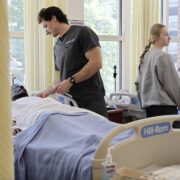
One student is performing a procedure on a manikin, while his teammate observe and help. Hands-on learning in a controlled teaching environment in ITS Manning at UNC-Chapel Hill, Wednesday, Oct. 22, 2025.
Photo by Jinrui Liu
Audio by Jinrui Liu
NARRATOR: In North Carolina nursing schools, students aren’t just learning how to chart or take vitals — they’re learning how to stay safe and calm when the moment turns tense.
DEAN VAL HOWARD (UNC): “So we wanted to show nurse educators that you could implement a training like this in your own facility, using this tag-team approach. You don’t need a manikins that costs $150,000.”
NARRATOR: When a student hits a wall in the scenario, a classmate can tag in, pausing the scene so the watching group can consult their notes before the simulation continues.
NURSING GRADUATE (EMILY, UNC): “So I was like, ‘Punch them,’ and she’s like, ‘Bro… you can’t do that.’ I like that — I throw — when I was like a hundred ridiculous scenario, and she be like, ‘Let’s do it,’ and I was like yes— the literal dean.”
NARRATOR: While these scenes are staged, the emotions and the danger are real. Many nursing students already face aggression during clinical rotations.
NURSING GRADUATE (EMILY, UNC): “He was chillin’, but he was boppin’ around the hallway. But then he took off his little gown. He pooped on the floor and in scrubs everywhere. We’re like, ‘Oh, we need to wipe him down and get new clothes on him,’ but he was so agitated at this point that he would just kind of take turns charging at people. Suddenly he is at me — he takes his little poopy hands and, like, grabs here on my gown — and then whenever a nurse or somebody grabbed him to get him off of me, he held on my gown and shredded it.
NARRATOR: It’s not just about handling a single difficult moment — it’s about building the confidence and resilience a lifelong nursing career demands.
BIMBOLA AKINTADE, a board member of North Carolina Nurses Association: “I think this was in 2021 or 2022 — The American Association of Colleges of Nursing, AACN, had a survey that demonstrated that almost 33 percent of nurses, after their first year, were considering leaving the profession.”
“And we recognize that by 2030–2033, one million nurses are going to retire. So, not all recruitment — keeping nurses in the profession is very, very important.”
NARRATOR: A key part of the solution starts with the workplace environment, since decisions that shape nurses’ day-to-day experience are sometimes made by those outside the clinical world.
BIMBOLA AKINTADE: “Every other healthcare professional that engages with patients are considered consultants — so, physicians or respiratory therapists or physical therapists, occupational therapists. Nurses are the only ones who are part of the room rate.”
NARRATOR: He raises funds to NCNA’s political action committee to help lobby lawmakers with real-time data so they can better represent healthcare professionals.
From tag-team simulations to real-world advocacy, nursing programs here hope one lesson sticks: keeping caregivers safe is part of caring itself.
This is Jinrui Liu reporting.