
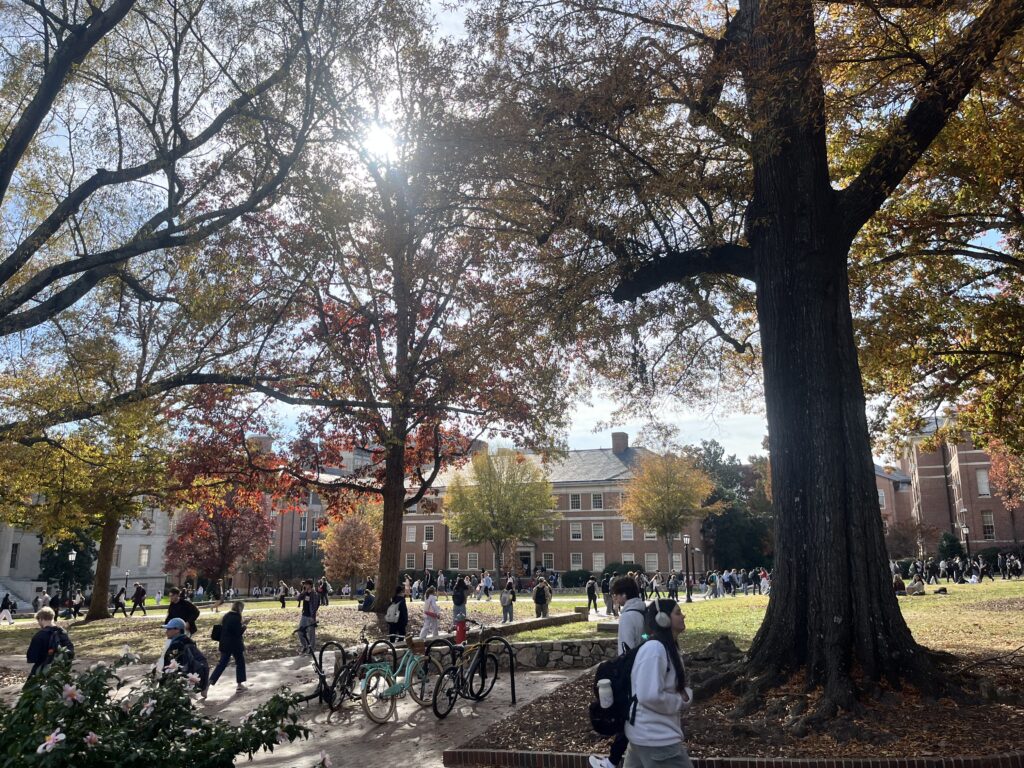
UNC–Chapel Hill campus, students crossing the quad between classes.
Story by Emaan Parvez
The number of international students enrolled in U.S. universities has fallen sharply compared to last fall, according to recently released federal data.
According to fall 2025 snapshot data from the annual Open Doors report from the Institute of International Education, new international student enrollment has dropped by 17 percent. The decline reflects a new wave of immigration policy under President Trump’s second term, as the administration moves to tighten oversight of student visas and expand federal monitoring.
Changes to the immigration policy first began during the spring semester, when overnight, students and campus offices were notified that visa records were being flagged for review under new federal guidelines. By morning, inboxes filled with anxious messages: Was my SEVIS record still active? Could I travel home for spring break?
“That week felt like a blur,” said an undergraduate student from India at the University of North Carolina at Chapel Hill, who requested anonymity to speak freely about their immigration status. “Everyone was panicking, and no one could tell us what was actually happening.”
At UNC-Chapel Hill, six students had their SEVIS records terminated by the federal government in April, which affected more than 300 students nationally. The six UNC students were eventually reinstated, but the incident sent shockwaves through the international student community on campus.
A UNC Media Relations spokesperson said the university’s International Student and Scholar Services office worked with multiple campus departments including the Dean of Students and Carolina Student Legal Services, to support affected students.
In the months that followed, the restrictions deepened. In late May, Secretary of State Marco Rubio instructed U.S. missions abroad to stop scheduling new appointments for student-visa applicants while the State Department prepared to expand social-media vetting requirements, according to a State Department cable obtained by Reuters.
Days later, on June 4, President Trump signed a proclamation suspending entry for nationals from 19 countries, including full bans on student visas for Afghanistan, Burma, Iran, Libya, Somalia, and Yemen, and partial suspensions for several others. Student-visa overstay rates — ranging from 17 percent in Burundi to 70 percent in Equatorial Guinea — were cited as justification.
That same day, Trump signed a separate proclamation suspending new student visas for Harvard University, citing concerns about foreign ties and campus protests.
By August, the crackdown had left more than 6,000 students without legal status, according to reporting by Reuters citing a State Department official.
In September, Trump issued Proclamation 10952, which imposed a $100,000 fee on new H 1B visa applications, a work visa many international students rely on after graduation. The administration later proposed capping international undergraduates at 15 percent of enrollment at nine top-tier universities, with no more than 5 percent from any single country, according to a White House memo dated Oct. 2.
Each change added another layer of uncertainty for those already living with it.
“Whenever I see a headline about visa delays or SEVIS terminations, I immediately worry that my own status could change overnight,” said an undergraduate at Columbia University from Pakistan, who also requested anonymity. “There’s this constant anxiety that one policy change, one processing error, or one expired document could uproot everything I’ve worked for.”
Immigration attorney Rishi Oza of Brown Immigration Law said the recent wave of terminations and policy shifts signal a narrowing pathway to legal immigration in the United States. “I’ve had a number of clients whose SEVIS records were terminated for seemingly innocent reasons — not criminal, just technical violations,” Oza said. “It feels arbitrary.”
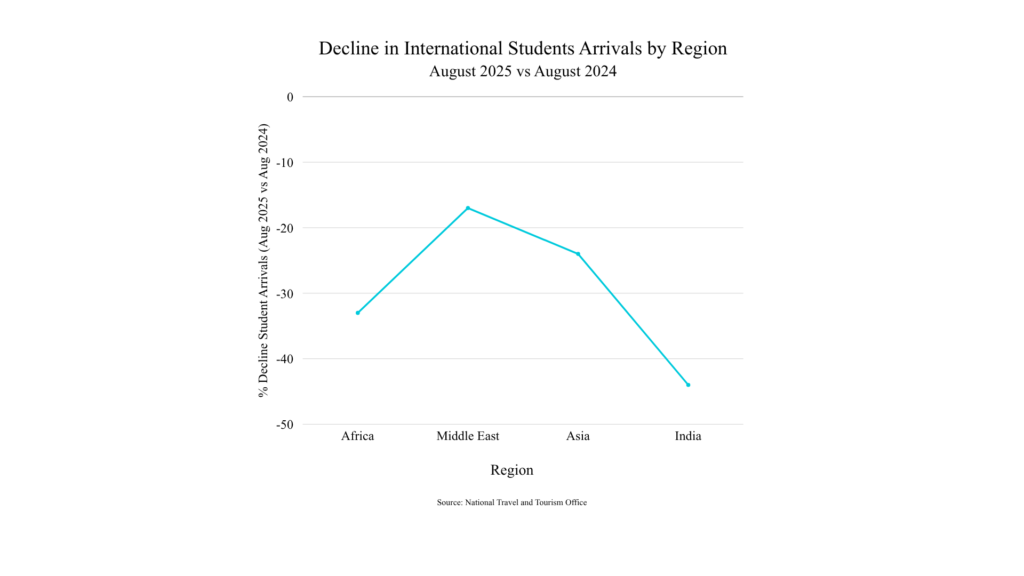
The United States still hosts about 1.1 million international students, according to the 2024 Open Doors report. Federal data show the drop was steepest in several regions: arrivals from Africa fell 33 percent, from the Middle East 17 percent, and from Asia 24 percent — including a 44 percent decline from India, the largest source of international students.
Oza added that the pattern fits a broader effort to make immigration processes more restrictive. “Overall, this aligns with what the administration seems to be doing — making it harder to come to or stay in the U.S., which, frankly, is part of what Trump ran on,” he said.
For international students, that reality has reshaped what once felt like a straightforward path from classroom to career.
“What drew me to study in the U.S. was its sense of opportunity — a belief that if I worked hard enough, I could make it,” said the student from Columbia University. “But lately, that sense of opportunity feels narrower.”
Economists warn that the consequences could ripple far beyond higher education. International students contribute billions of dollars each year through tuition, housing, and local spending, while also fueling research and innovation across universities and industries. According to a projection from the National Association of Foreign Student Advisers (NAFSA), a sustained drop in enrollment could result in $7 billion in lost revenue and 60,000 fewer jobs nationwide.
“Higher education is one of the country’s largest exports,” said Giovanni Peri, said Giovanni Peri, professor in international economics and founder and director of the Global Migration Center at University of California, Davis. He added that limiting international enrollment not only reduces a key source of U.S. revenue but also drives away the skilled graduates who help power innovation and growth.
Peri noted that international students play a critical role in sustaining research and technological growth: Roughly 40 percent of Ph.D. students in STEM fields are foreign-born, a group that drives much of the country’s innovation pipeline. Losing them, he said, could weaken the foundation that supports U.S. leadership in science and technology.
As opportunities in the United States narrow, many students are beginning to look elsewhere. Countries such as Canada, Australia, and the United Kingdom have rolled out policies designed to attract the same pool of talent, offering faster visa processing, clearer post-graduation work paths, and, in some cases, permanent-residency options.
“Student mobility works in networks,” Peri said. “If Indian or Chinese students start going to Switzerland or Australia instead of the United States, others will follow.” He added that companies are already adapting by moving research and innovation hubs to cities like Vancouver, where immigration laws make it easier to hire foreign talent.
But for the students behind the statistics, the consequences are personal.
“The hardest part is feeling like all your effort might not lead anywhere,” said the international student at Columbia University. “You can pour your heart into your academics, internships, and networking, but still face roadblocks because of something completely out of your control.”
Still, amid the anxiety, there remains a flicker of faith in the ideals that first drew them here. “What keeps me hopeful is the belief that the U.S. still rewards resilience and ambition,” the student said. “Despite all the obstacles, I’m not ready to give up on that dream yet.”