
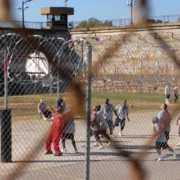
Inmates at Central Prison in Raleigh scrimmage on the basketball court. This is the same court where legendary coach Dean Smith brought his UNC men’s basketball teams from the 1970s through the 1990s.
Photo Courtesy of Rose Hoban/NC Health News
Story by Tess Alongi
Click. The detention doors locked behind them.
Inside Central Prison in Raleigh, everything felt different.
Checkpoint one. Metal detectors. The University of North Carolina men’s basketball team exchanged glances. They had competed in hostile environments. They heard the screams of rowdy fans and bitter opponents. They felt the pressure of crowds, but they had never been searched for weapons pregame.
Checkpoint two. Full body pat-downs. As they walked further away from their freedom, it became real. These college kids, ages 19 to 22, were about to play a game against men serving time in a prison that was home to the most serious offenders in the state.
The year was 1979, a time before one-and-done players. Before NIL. Before Congress got involved in college athletics. When coaches had three or four years with their players. Time when they not only got to teach them the game of basketball but also the game of life.
And teaching the game of life was something Dean Smith did best. Smith coached the Tar Heels from 1961 to 1997 and while he led the team to two National Championships and 879 wins, his legacy extends far beyond the hardwood.
Smith was a lifelong social activist. He recruited Charlie Scott, UNC’s first African American scholarship basketball player. He protested against the Vietnam War and in 1998 he stood before North Carolina Gov. Jim Hunt to speak against the death penalty.
Smith used his position as a coach to expose his players to societal issues beyond the basketball court. Visiting Central Prison and interacting with men locked up for years was one of those opportunities.
Finding Out About the Trip
During the recruiting process, Smith emphasized that his expectations for his players went beyond wins and losses. He took them to churches, he took them to what were known as the dangerous parts of cities when they traveled for games; he once brought his team to the infamous Angola Prison in Louisiana.
But this trip was a little different.
The idea of a scrimmage against the inmates first came up in a coaches’ meeting. Roy Williams, UNC’s assistant coach at the time, said he was nervous about the idea at first, and then Smith came in with the kicker: He told Williams he would be the referee.
“I said, ‘OK coach, but I’m not calling any fouls on the prisoners,’” Williams said. ‘I don’t want anybody to give me a bad look or anything like that.’ And he just laughed.”
Williams may have joked, but beneath the humor, he was apprehensive.
“I just took a deep breath because it scared me a little bit,” he said. “It really did. And I thought this was really great, but, you know, I was a little uneasy.”
A couple of days later, the coaches pulled the team into a huddle at practice and delivered an unexpected announcement: Instead of their usual workout, the Tar Heels would be heading to Central Prison to scrimmage the inmates.
Jimmy Braddock, a UNC point guard who was a freshman at the time, said he returned straight to his dorm after hearing the news, where he talked it over with his teammates.
“We were all like, ‘Oh my,’” he said. “I mean, we were terrified. These guys are on death row.”
Still, within days, the Tar Heels gathered their Converse high-tops and boarded a bus bound for prison.
Inside Raleigh Central Prison
For Williams, the process of getting into the prison was what made the trip real. For the players, the reality came in the clang of steel doors locking behind them, closing off the outside world.
“The noise was deafening walking in,” Braddock said. “I mean, it was just horrible.”
By the time they reached the gym, the bleak surroundings turned into an even more jarring realization: They weren’t playing another college team; they were facing off against incarcerated men, and the inmates were ready to play.
When the game began, the starting players and inmates made their way onto the court, with Williams in the middle, ready to toss the jump ball.
“We’re going to have a jump ball and [an inmate] said, ‘Hey, can I see the ball?’ I gave it to him and I said, ‘Don’t worry, big fella. I am not calling any fouls on you,’” Williams said. “He just laughed like crazy.”
The joke broke some of the tension. It was no longer five college kids and five inmates on the court; it was 10 guys excited to scrimmage.
Braddock said the inmates were athletic and competitive. While they lacked players who matched the Tar Heels in size, they had quick guards who were ready to compete.
From the sideline, the crowd cheered enthusiastically, rooting for their team as they would at any basketball game. But these fans were incarcerated, forced to watch the game through metal fences.
“It was a similar environment to Duke,” Braddock said. “As far as when we went out there, the gym was packed with inmates. And I mean, they’re yelling and screaming and all this stuff.”
The prisoners wanted to prove that they could play, especially against a team as elite as the Tar Heels. The 1979-80 team featured then junior forward Al Wood, senior forward Mike O’Koren and the future NBA Hall of Famer James Worthy.
“Some of them thought they were pretty good players, so they wanted to show James Worthy they had some moves too,” Williams said. “Other ones were just big fans and just wanted to be there and be involved with James Worthy.”
When the final buzzer sounded, the visit didn’t end. And while today no one remembers the final score, maybe that’s because the score was never really the point.
Beyond the Basketball Court
For Braddock, the experience was more than a basketball game. It was life-changing.
“It really was eye-opening,” Braddock said. “It was a lot worse than I could have imagined as far as, you know, having that be your home forever.”
The trip left him with a greater sense of compassion, and that feeling was not unique.
“It was a very positive experience, but a very eye-opening experience and a very solemn experience for me, because Roy Williams is going to walk out and have freedom and those guys are not going to be able to do that,” Williams said. “It was educational for our players, but it was educational for me too.”
He said he believes that the eye-opening experience was exactly what Smith wanted.
“Coach Smith’s goals were always, let’s try to help other human beings,” Williams said. “And I think that’s the biggest thing, trying to make sure that for the next hour or however long we were there to make sure that they had some enjoyment.”
The Lessons That Stayed
That wasn’t the only year that the team went to prison and scrimmaged the inmates. In 1987 the team returned to Central Prison. Kendria Sweet, one of the team managers, was the only female in the group but said she felt safe.
“I think the focus was to make everybody feel like we’re all equal humans,” Sweet said. “And to have not just an interesting outing, but a warm visit.”
And a couple of years after that, former National Player of the Year Antawn Jamison visited Central Prison during his time at UNC.
“You didn’t sense you know, oh, this is a really bad guy or, this guy deserves to be in here,” he said. “It was mostly like, oh, one bad decision can put you in a situation that they’re in.”
Ed Chapman: A Lesson in Humanity
In 1994, Ed Chapman was convicted of double homicide and spent nearly fourteen years on death row before a judge vacated his conviction and prosecutors dropped all charges in 2008.
“It was a lesson of humanity that Dean Smith was teaching,” Chapman said. “And at the time, we didn’t notice that he was teaching us something, too. He was showing us that we matter.”
For someone living on death row, that feeling of mattering meant everything.
Chapman said it was easy for hope to disappear there. Watching close friends leave for executions made the reality of his situation hard to ignore.
“When you see guys going into their death, it takes a lot, it takes a lot away from you,” Chapman said. “That evening takes away your hope, because then you start thinking, well, I’m next.”
But for those hours that Dean Smith and his team entered the gates of Central Prison, things were different.
“To see a legend, somebody that’s bigger than life, come and treat you like a human being, I mean, I feel I was in prison royalty,” Chapman said. “That’s how it made me feel.”
And legends they were. That 1994-1995 team Chapman saw featured future No. 3 and No. 4 overall NBA draft picks Jerry Stackhouse and Rasheed Wallace. The feeling of seeing those players up close lasted long after the Tar Heels walked out of the prison.
“That’s all we talked about after that,” he said. “‘Man, did you see each other?’ ‘Look at Rasheed.’”
And for Ed Chapman, and men inside the prison walls, Smith’s lessons were just as meaningful: a reminder that they were more than their convictions. They mattered, too.
The Lasting Impact
The players walked into the prison nervous, but they walked out with different perspectives on the world.
“I’m 50 now, and all the stuff that [Smith] taught us back then I still implement in my household and in my life,” Jamison said. “That’s a big testament to who he was, not only as a coach, but as a person, and how much his players meant to him as well.”
By all accounts, Smith achieved what he set out to accomplish, not only through the various trips to Central Prison, but also through the lessons he taught during his 36 seasons at North Carolina. He showed the people around him a world they had never experienced and tried to make them better human beings.
Basketball was what brought them all together, but the relationships Smith built and the people he changed are the lasting measures of his work.
“Caring for one another and building relationships should be the most important goal, no matter what vocation you are in,” the late Dean Smith wrote in his memoir “A Coaches Life: My 40 Years in College Basketball.”
Decades later, former players and coaches continue to carry Smith’s lessons into their own lives. He taught them that being a good basketball player mattered, but being a good person mattered more.