
Story by Maria Sullivan
For the past ten years, Angela Georgallis has watched both her children and her mother get older.
In between work calls, doctors’ appointments and school pickups, she has cared for two
generations at once. She’s a member of the “Sandwich Generation.”
The Sandwich Generation encompasses middle-aged adults responsible for both taking care of
both their children and their aging parents. They assume a double caretaking role and financial
responsibility for a parent over 65 while raising a child under 18 and/or providing financial
support to a child over 18.
“Sometimes we say we’re a part of the ‘Panini Generation,’ not the Sandwich Generation,”
Georgallis said. “We’re just being pressed so tight.”
The “Sandwich Generation” has become increasingly prevalent in the past decade and often
impacts Americans at the height of their professional careers. Longer life spans, higher child care
and elder care costs, adult children remaining financially dependent and having children later in
life work in tandem to create this consolidated pressure.
According to the Pew Research Center, more than half of Americans in their 40s are sandwiched
between an aging parent and their own children. Additionally, 23% of all adults, almost one in
four, fall under the “Sandwich Generation” description.
For Georgallis, balancing her family and her mother’s care is one of the many responsibilities
and sacrifices she and her husband have taken on, all while being a working mom, spouse and
sister. It hasn’t always been easy, but it has always been a priority.
“My job is not to make her feel like a burden,” Georgallis said. “On my dad’s deathbed, my sister
and I promised him. His biggest concern was that my mom would be taken care of. That was my
last promise to him before he passed over.”
Geriatrician and family physician Dr. Mallory McClester Brown said that the demands faced by
the Sandwich Generation extend past the physical demands of caring for an aging parent. For
these caretakers, the “invisible labor” is often the most taxing. When the elderly adults living in
the home aren’t able to take care of themselves or contribute to the household, the brunt of
everyday tasks falls on caretakers. Planning appointments and car rides, evaluating finances,
career pressure and dividing responsibilities between adults in the household lead to burnout and
decision fatigue.
“Amongst all of the stress and strain, and being split into multiple directions, there’s also this
grief that we might feel, and that can be really, exhausting. But also okay. I think it’s appropriate
to know that that’s there, and to accept that that’s a normal part of being in the Sandwich
Generation,” Dr. McClester Brown said.
Often, caretakers can become so focused on the health of those they’re taking looking after that
they neglect their own, she said. It’s important for those who take on those roles to still schedule
and attend their own medical appointments, look out for their mental health and maintain a sense
of self.
However, the experience of caretaking for the Sandwich Generation isn’t always a burden. It can
often be a gift. She said that even though it can be difficult for caretakers to ground themselves in
a place of gratitude, having those who you love, and have loved you, under one roof can create
so many opportunities for intergenerational relationships.
“There’s wisdom, and there is life experience, and there are tales to be told. And so I think that
while some of our older adults require that care that we have to provide to an infant who’s really
in need, many of our older adults that we care for, bring with them so much grace and so much to
inspire us with,” Dr. McClester Brown said.
She added that, for older adults, living with family decreases loneliness, one of the key indicators
for dementia development and cognitive impairment. For younger children, having grandparents
in the home can mean that they’re more understanding of aging, and cohabitation can create
space for cross-generational wisdom to be shared.
“Children will lead their lives with less bias and with more openness and caring attitudes moving
forward,” she said.
In the U.S., she said that at 2 or 3 years old, young children begin being exposed to ageism.
Whereas in other cultures, intergenerational caretaking is often more prevalent, and even
celebrated, she said. But we’re not there just yet.
At 54, Warren Neverson is raising four children while also navigating supporting his aging
parents from afar. His parents are in their eighties, and his father was diagnosed with Stage 4
cancer. For Neverson, being a part of the Sandwich Generation means struggling with the guilt of
not being able to care for his parents in person.
He said that financial barriers and distance complicate the amount of time he can spend with his
loved ones. Both of his parents live in New York with his sister and brother, who handle the
day-to-day logistics of their care.
“I don’t feel that in the same way they do, although, and that makes me feel bad because I’m like,
you know, we’re pretty tight and want to,” Neverson said. “So in that way, it’s more emotional,
right? It’s more of the emotional part of not being able to help.”
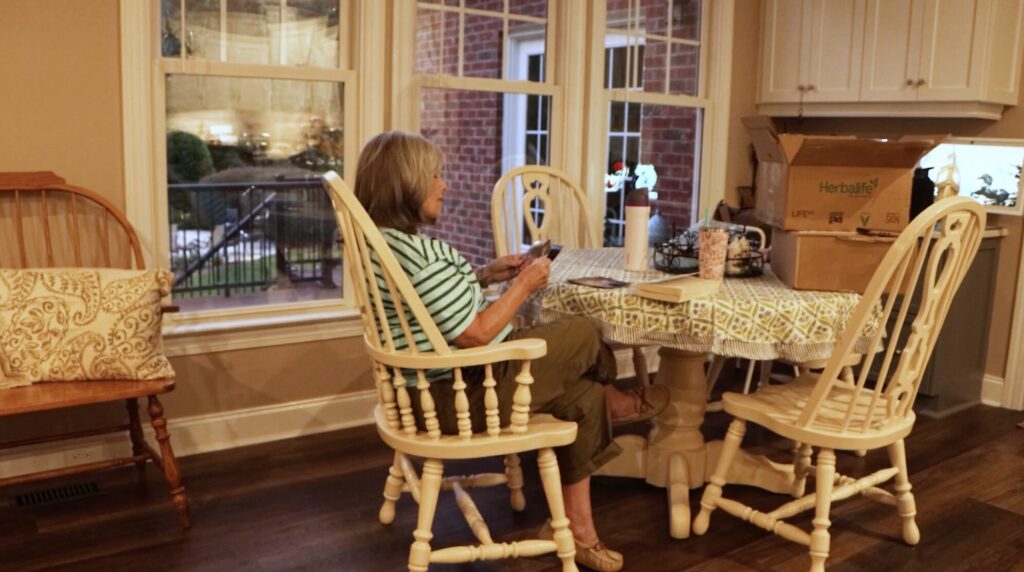
Marcy Scheithe is 73 years old and recently moved in with her daughter, son-in-law and their
two daughters in Raleigh, North Carolina. She knows what it’s like to be on both sides of the
Sandwich Generation, having cared for her own mother and now being taken care of by her
daughter. She said she feels more safe and secure being at home with her family, but also
sometimes feels like her daughter and son-in-law have a lot on their plate as a result.
“Just last week I fell in a grocery store, and I had to call my son-in-law to come and pick me up.
They wanted to transport me to a hospital,” Scheithe said. “But he told them that he would take
me home, and keep an eye on me to make sure that I didn’t have a concussion and I wasn’t in any
pain.”
Scheithe, a widow of 25 years, said she’s been used to taking care of herself for so long that it’s
taken some time to adjust to relying on her family for her care, which she herself attributed to her
stubborn nature. Now, rather than moving into a senior living facility, she’s able to cook for
herself and her family, has her own room, and is able to maintain some of her personal
autonomy. More than anything, though, she’s loved being able to watch her granddaughters grow
up.
“I don’t expect to just sit around. I don’t like to just sit around, and most old people don’t want to
just sit around,” Scheithe said. “They do want to be a help, but they want to be involved with
their family, too.”
Georgallis said that initially, her mother living in her home was going to be temporary. After her
father passed away from congestive heart failure and her mother had lived independently for
some time, Georgallis’s mother moved to the area to be close to family. Georgallis said that her
mom initially planned to get her own apartment, but once she had settled into the home, she
knew that her mom felt she had a purpose there.
“On those days when it is tough and it can be a little crazy, there are going to be those mornings
where you wake up and she’s not here,” Georgallis said. “And when I see the joy that she has in
seeing my children or when my children text her or call her or FaceTime. I mean, those are just
ones that you can’t… they just can’t be replaced.”
She said that both her children and her mom seemed to revel in the routine and closeness after
the move, and after COVID-19 struck and they were all under the same roof for so long, the
concept of her mom moving out felt foreign.
That doesn’t mean it’s been easy. In fact, it’s been hard. As her children got older, so did her
mother. Georgallis said that sometimes she feels like her mom is “her teenager.” When
Georgallis took her kids off of Life360, her mother took their place. She said that her nights often
involve staying up late to answer emails when her day is taken over by her mother’s doctor’s
appointments. Her family has gotten used to giving up some of their privacy and spontaneity.
Now, despite her and her husband’s career success, Georgallis said that even if they wanted to,
affording one of the “good” senior living facilities is out of the picture. Luckily, her job has
allowed her the flexibility to be there for her mother when she needs her. But for those who don’t
have that same choice, she said, the demands of elder care can be even greater.
This challenge isn’t unique to her family, she said, and when getting together with friends, caring
for aging parents is often a central topic of conversation.
“We’re all in this panini generation where we could cry about it, or we can laugh about it, but
we’re all doing it in one capacity.”