
Story by Emily Brietz
“And in taking the five loaves and two fish, he looked up to the heavens and said a blessing over them. Then he broke the loaves and gave them to the disciples to set before the crowd. And they all ate and were satisfied.” Luke 9:16-17, ESV.
* * *
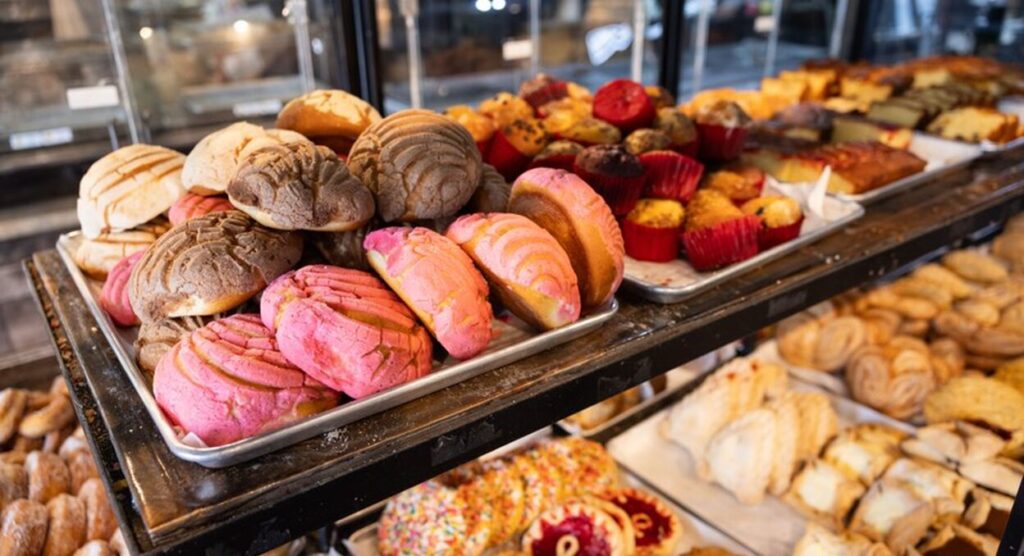
Take a step into Manolo’s Bakery, and a giant hanging display case greets you in the center of the room.
Inside sit the delights of hardworking hands in the back of the shop: pistachio cinnamon rolls and chocolate croissants, sweet churros and all flavors of tres leches cakes. Each has a distinct shape, size and hue, their sweet smell filling the bakery.
Traditional Latin American conchas, empanadas and pandebonos, a Colombian cheese bread, are crowd favorites. The smell of brewing coffee beans, imported monthly from Bogota, Colombia, swirls around the room.
Behind the counter, the bakers are visible, hard at work. Over the clang of icing being whipped in metal bowls and the thud of dough hitting the counters, bits of Spanish chatter rise over the noise.
¡Pásame la espátula!
¡El horno ha terminado!
¿En qué puedo ayudarte?
Each employee is living the American dream — the team of bakers is composed entirely of immigrants from more than 20 different countries.
Next door, Changebaker Place, a new cafe addition to the bakery, is a spot to chat with friends, get some work done or indulge in the pastries made from scratch.
Just off the main entrance is a conference room with a piece of art displayed across the whole wall. It’s an assortment of kitchen items: a pan, spatula and hand mixer, a pot, grater and butter dish. All are uniformly painted white, with Manolo’s script M, lit like a halo in the center.
The artwork is made out of real items immigrants brought to America.
“When you walk in [the cafe], it feels like you’re in someone’s living room,” Jamie Graziano, a Charlotte food reviewer, said. “It just feels homey.”
For some, the two businesses in the Plaza Midwood neighborhood of Charlotte, N.C., are a frequent stop just a short walk down the street. For others, it’s an intentional detour.
“The Latino community is showing up there because it’s in their community, and the rest of the folks are intentionally making it part of their community,” said Britt Yett, who helps run Higher Grounds Café, another one of the owner’s ventures.

That owner is Manuel “Manolo” Betancur Montoya, the namesake of the bakery. He started working there in 2005 when it was called Las Delicias Bakery, and after gaining sole ownership in 2018, he changed the name.
Since then, he has opened Changebaker Place next door, an Artisan Gelato shop in Matthews and Higher Grounds Café at Myers Park United Methodist Church. In 2024, he founded By Immigrant Hands, a nonprofit organization that funds his charitable work.
Grab a tres leches coffee and pistachio croissant, settle into a chair and take in the harmony of different voices filling the space.
“I feel like his bakery describes what it means to be American, in a way that combines so many different cultures and backgrounds, and you just feel incredible energy as soon as you walk in,” said Meredith Dean, who wrote the prologue of Betancur’s book “Speaking from My Heart.”
For more than 20 years, Betancur has set a table for people the rest of the city too often overlooks: immigrant workers, neighbors without homes, strangers who walk in from the street.
But in the bakery, you don’t see the lives he’s changed or the battles he’s fought.
You see people from all walks of life gathered together.
You see hardworking immigrants serving you carefully prepared food.
You see people breaking bread.
* * *
In December 2018, Nathan Arledge stepped into the bakery for the first time.
He took in the pastry display case, the shining Christmas tree in the corner and the crowd filling every table. Then something at the back of the store caught his eye.
In Betancur’s office, a map of North Carolina hung on the wall. Thumbtacks dotted the western and central parts of the state, some of them linked by black and red yarn, as if someone was working an investigative case.
Arledge asked Betancur what it was.
The map was Betancur’s delivery routes: bread runs to immigrant communities across the Charlotte area and into the North Carolina mountains.
After that day, the two’s relationship blossomed, and they have since grown close enough that Arledge’s children know Betancur as an uncle.
Arledge has joined Betancur on many missions to Colombia and broken bread with his family. He said he has also ridden along for many of the mountain delivery trips, handing loaves to workers on Christmas tree and pumpkin farms in the mountains — many of whom are immigrants.
“Here are these hands that are not wanted in our world, that are doing all the things that are wanted in our houses,” Arledge said. “The bread that he provides is healing in communities and it all roots back to his heart.”
Back in the shop, Arledge said, he sees the same bread work in quieter ways.
“Every single time I’m there, people are resting,” Arledge said. “But it’s more than just the sustenance they’re having. It’s the actual building. It’s in the actual chairs that you can see people are a lighter presence when they’re there.”
* * *
In 2014, at a Latin American Chamber of Commerce leadership training, Betancur learned about Raise You Up Ministries, a non-profit that offers food, clean clothing and birthday celebrations for people experiencing homelessness.
He asked the group where they got their cakes. They didn’t. Cakes were too expensive.
“How do you celebrate a birthday without a cake?” Betancur remembered asking.
They sang “Happy Birthday,” the group told him.
That wasn’t good enough for Betancur. He told the organization to send people into the bakery to pick out a cake, free of charge.
“Some of the people, they’re experiencing homelessness, have not had contact with their family, have not shared their birthdays in years and years and years, if they celebrate,” said Mickey Correa, executive director of Raise You Up Ministries. “And having that celebration is just a life-changing gift for people that have nothing.”
Betancur expected to donate cupcakes or a small cake. Then one man asked for a full sheet cake.
The man wanted to celebrate with his community, Betancur said, and he needed a cake big enough for all of them.
The bakery was going through a financial rough patch. Betancur wondered if he should steer the man toward something smaller, but he went with the large cake.
A few days later. Betancur hand-delivered a batch of cakes to Raise You Up.
“Are you the cake guy?” a woman from the organization asked.
“I guess so,” Betancur replied.
“You saved a life yesterday.”
The day prior, a man arrived at the ministry to find himself sitting at the head of the table. A ceramic plate and silverware — not the plastic he was used to. A crisp white linen tablecloth.
A cake.
The community gathered around the man, ready to sing, when the guest of honor began to weep.
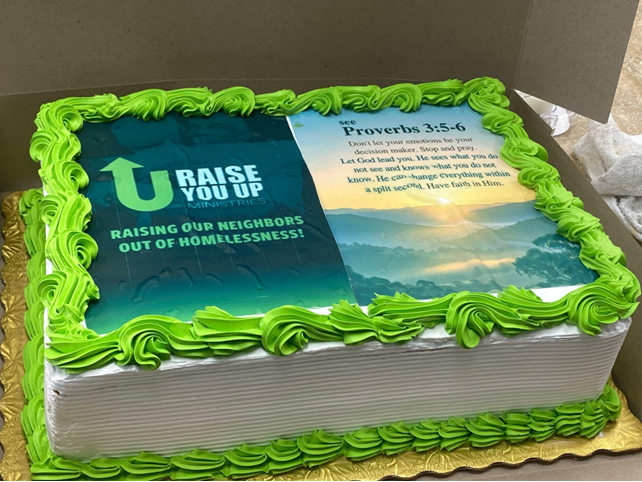
Looking down at the script icing wishing him a happy birthday, then at the people around him, the man pulled a gun from his pocket and set it on the table next to the cake.
“‘I was gonna kill myself today.’” Correa recalled the man saying. “‘I bought the gun with the rest of the money that I basically had, but I’m not gonna kill myself today, because God showed me that through you guys, that he loves me.’”
“Since that day, that became the most important cake in our bakery,” Betancur said.
Today, each donated cake has a personalized message or bible verse, catered to what each person might need to hear: resilience, strength, community, love.
More than 5,000 donated cakes later, Betancur is still wishing his neighbors happy birthday — no matter the size, no matter the price.
“We don’t call them ‘homeless,’” Betancur said in a 2025 interview. “They’re our neighbors.”
* * *
Giving away cakes large enough to feed a crowd doesn’t lend itself to profit, but to Betancur, a successful business is measured in lives changed.
“I don’t run my business around money,” Betancur said.
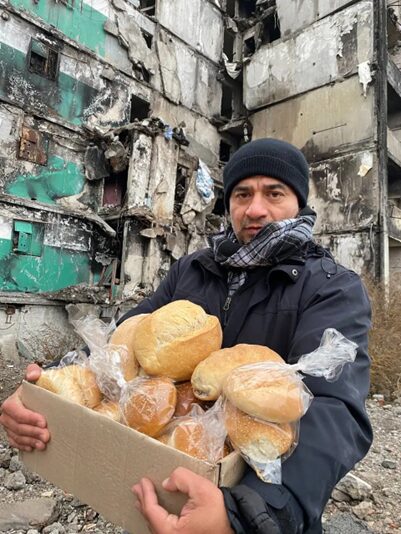
In 2022, he traveled to Ukraine to help rebuild bakeries and feed hundreds of people worn down by war. This September, he went to Colombia to support the small town of Novita after a magnitude 7.4 earthquake struck on Aug. 10, 2026. He posted daily updates on his social media, asking followers for donations and prayers.
With that money, Betancur said, he helped local bakeries build an artisan oven that runs without electricity and taught residents how to make bread themselves.
“If they have food, your spirit is alive, and if your spirit is alive, you have faith,” he said. “As long as you have faith, you can face and deal with whatever comes into life.”
* * *
In November 2025, Manolo’s Bakery closed its doors for the first time in 28 years.
The Department of Homeland Security had launched Operation Charlotte’s Web, a surge of federal immigration enforcement across the city on Nov. 15. DHS said the operation was meant to target people it described as “criminal illegal aliens” protected by “sanctuary politicians” in North Carolina.
In the first week, 402 people were arrested, according to WFAE, Charlotte’s NPR member station. Thousands more lived in fear. Laundromats and grocery stores closed, students stayed home from school and some churches cancelled their Sunday services.
On the first day of the raids, Betancur was walking near the bakery and saw Border Patrol agents throw his neighbors to the ground, put them in cars and disappear.
“I thought about my employees, their families, my kids, myself, my wife, my customers, and I didn’t want anyone to lose their freedom because they were on their way to buy bread, to get a cake,” Betancur said.
On Nov. 15, he closed the bakery’s doors for a week, costing him $64,000. The closure also cost Betancur his largest wholesale customer, a chain that decided to buy cheaper bread from factories.
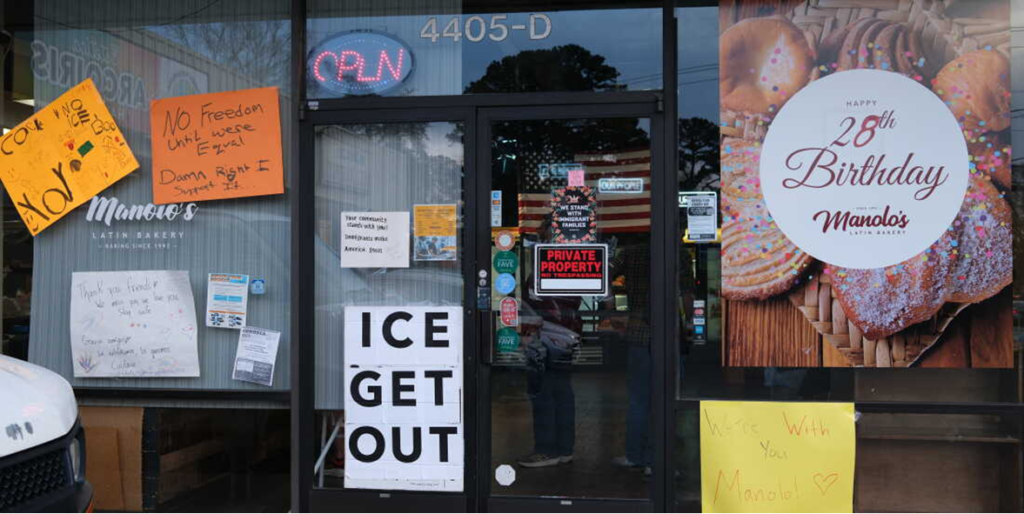
While the doors were shut, people gathered to rally. On one of those nights, Arledge and his wife brought Betancur and his wife a late dinner.
“He’s making sure his employees are safe. He’s making sure the folks who are rallying outside have good bites to eat and everything — but always putting himself last,” Arledge said. “That’s the humble leader he is.”
Daniella Blanco, a Colombian immigrant who has worked at the bakery for more than a year, recalled how supportive Betancur has been.
“He, all the time, is paying attention, what I need, or if I need something, or offering support,” Blanco said.
He doesn’t oversee the bakery from an office, she said, but Betancur gets his hands dirty alongside her. Most importantly, she noted, was his constant attention to helping his employees.
Betancur said he is now out more than $96,000 since the raids last November. Five employees left their jobs at the bakery, fearing for their freedom — some even left Charlotte.
“They didn’t come here just to check our immigration and stuff. They just came here just to take us for our race profile,” Betancur said.
In August 2026, Gregory Bovino, the former U.S. Border Patrol commander who led the Charlotte operation, showed up at Manolo’s Bakery.
Bovino parked his black truck out front while his cameraman framed a shot.
Bovino told news outlets that he was revisiting enforcement operation locations with Border Hawk News, a registered 501(c)(3) nonprofit news organization which claims to be “monitoring the situation” of immigration in the United States.
Betancur said he thought about slipping into the back of the store and acting as if Bovino wasn’t there.
“I even thought about, ‘Act like, oh, he’s not here, and I’m leaving,” he said. “And then I said, that would be too cowardful. That would be the most cowardest thing I have ever done in my life.”
Instead, he walked out to the parking lot. Betancur said the two spoke for 40 minutes.
At one point, Bovino asked why Betancur carries his passport in his back pocket. Betancur is a naturalized U.S. citizen, but he takes it everywhere.
“Every single day of my life, I also have fear,” he said.
Then, Bovino asked him to pose for a photo.
“He made me mad with that comment, and I say, ‘You’re not welcome in this city, man,” Betancur remembered saying. He told Bovino to leave his property.
“There is no way that an illegal is going to tell me where I can be in my nation,” Bovino responded, according to Betancur.
“Well, I’m not illegal, and I can tell you, you’re not allowed here,” Betancur retorted.
Eventually, Bovino left and Betancur returned to the bakery. He said, even as he went back to kneading dough, his hands were still shaking.
* * *
Betancur said he learned to act courageously in the Colombian Navy.
There, he realized, “that if I’m gonna die, I’m gonna die fighting.”
Betancur was the first person from his small hometown to attend Escuela Naval Almirante Padilla, where he trained in the naval academy while earning a degree in naval science and operational studies. He rose in rank, eventually becoming an officer.
The path was expensive. In the United States, the military pays you. In Colombia, his family had to pay for the school that prepared him for combat with the scant money they had.
“To become a Navy officer is like the equivalent of going to Harvard in America,” Betancur said.
He had just joined a counterguerrilla battalion special forces group in the Montes de María when he realized he didn’t believe in fighting in Colombia’s internal armed conflict.
“I wasn’t happy killing each other with my own people in Colombia,” Betancur said.
So he left.
Betancur had been exposed to American influences since childhood through TV, toys and news.
“Since I was little, I was always thinking that one day I want to come to this nation,” he said.
At 14, Betancur got his first taste of America, traveling to Miami with Colombia’s national Taekwondo team. He called his mother from the United States and told her that he wanted to stay.
“My mom said, ‘No, you’re a teenager, you need to turn around and come back to Colombia. But when you are grown up, and you get done with your education, you decide what to do in life,’” Betancur recalled.
In 2000, he decided to go and his mother wasn’t happy. She didn’t say goodbye.
Betancur moved to Miami to learn English, then to Bristol, Tenn., where he graduated from King University in 2004 with a degree in modern languages. The next year, he moved to Charlotte and took a job at Las Delicias Bakery.
“I didn’t know anything about baking until I went to [Las Delicias Bakery],” Betancur admitted.
Around the time he moved from Tennessee to North Carolina, his student VISA expired — but his immigration attorney failed to tell him he had an immigration interview.
Betancur was going to be deported.
He traveled to Washington, D.C. to appear in front of a federal judge, costing him more than $20,000 in legal fees.
When Betancur approached the stand at court, the judge asked him to tell his story. Betancur described his immigration, college, AmeriCorps and how he owned a business.
Afterward, the judge thanked him for his contribution to the country, saying, “You are an example for many Americans to follow.”
The charges were dropped in 2006, and the next year, he completed the citizenship process.
Betancur had walked into the courthouse expecting to be deported, and walked out as a soon-to-be American citizen.
***
Years later, on a family trip to the North Carolina mountains, a rainy day left Betancur and his family stuck in their cabin with nothing to do.
As any baker would do, he went to the town grocery store and bought flour, salt, water and yeast — the family made bread all weekend.
Betancur measured, kneaded and watched the dough rise, surrounded by the people he loved.
He felt something click.
“That’s when I felt what the meaning of what bread really is,” Betancur said.
It’s a meaning Scripture returns to again and again. Bread provides: Jesus feeds a crowd of thousands from five loaves. Bread welcomes: Abraham sets a table for three strangers at his tent. Bread sacrifices: a widow bakes a small loaf for the prophet Elijah from the last of her flour.
Betancur’s work encapsulates all three values. The mountain bread deliveries provide. The strangers who walk in from the street are welcomed. The free cakes, especially when the bakery was struggling, were a sacrifice.
“Everything is in God’s hands,” he said. “Because I believe a lot in God and I know that he is always with me, I am a man of a lot of faith.”
He grew up Catholic, but calls himself a “diet Catholic” now — like a Diet Coke, he said. Betancur doesn’t attend church as much as he used to, but still relies on God in his daily life. He has seen how divisive the church can be and doesn’t want to contribute to that.
Britt Yett sees the Scripture in his work more plainly.
“There’s a lot of scripture about the humble beginnings of bread and how bread feeds the masses — that is something very essential,” Yett said. “So, from that perspective, he’s an essential part of our community.”
* * *
But who feeds the man who feeds the masses?
“He touches a lot of people,” Yett said. “The downside is that I’m sure he spreads himself too thin.”
Courtney Dixon, who directed “The Changebaker,” a 2025 documentary following Betancur, said that the small business consumes him sometimes.
“He was talking about, at the bakery, it’s 24/7,” Dixon said.
Even so, he still finds time to connect with his employees, customers and his community.
Yett said he never opens a message with a question or demand.
The first message is always the same: Hello friend. How are you?
He signs every email and social media post the same too: Big abrazos (big hugs).
“He’s a connector,” Yett said. “He wants to make sure that his people are your people.”
“You hear all of that very often: ‘I don’t have time. I’m so busy.’ But that’s literally an excuse,” Correa said. “Because when you see someone like Manolo, giving back, that just shows you how things are possible and how God is using him, even with lack of time.”
Betancur, now 50 years old, admitted that he wants to slow down; he doesn’t plan to work in the bakery forever. He sets goals for one year, five years and 10 years — one of them is for By Immigrant Hands to grow into a major nonprofit.
He’s also thinking about the time he has left.
“I really want to spend more time in my life’s mission that is inspiring,” Betancur said.
Towards the end of filming for the documentary, Dixon went to Betancur’s home for dinner.
She remembers the sweet moments he shared with his wife, Leidy, and their children, 16-year-old Emanuel and 13-year-old Julia, as the family made bread together and sat down to enjoy it at the dinner table.
It all comes down to sitting down with the people you love. With strangers. With people who are different from you.
It all comes down to breaking bread.