
Story by Gabe Thumm
On Jan. 27, the U.S. District Court for the Eastern District of Virginia decided Schmidt v. City of Norfolk. The case addressed whether widespread use of automatic license plate readers, or ALPRs, deployed by the city violated individuals’ Fourth Amendment privacy rights. ALPRs, mounted near roadways, take photographs of vehicles and create a nationwide network to aid law enforcement.
The Court opted for a summary judgment, rather than a full trial, citing the question of when this government surveillance could become a violation to the average citizen’s privacy.
“While a definitive answer to that question is elusive, what is readily apparent to this Court is that, at least in Norfolk, Virginia, the answer is: not today,” district judge Mark S. Davis wrote in the case’s summary judgment.
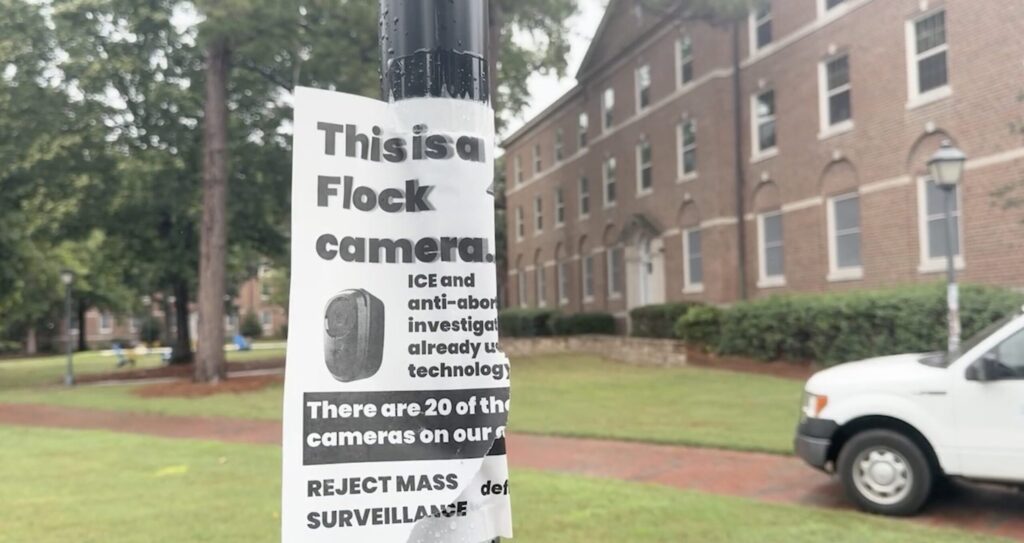
Today, many continue to hold conversations about when these cameras pose a threat. In July, the North Carolina State Budget authorized the use of ALPR’s across all state-maintained roadways. Many towns and universities have also bought into the technology, with UNC-Chapel Hill entering a contract with Flock Safety in February 2024 for the implementation of 23 cameras across campus.
Flock utilizes artificial intelligence-powered cameras. Its website outlines the boundaries of their surveillance.
“No facial recognition, no predictive policing, and no demographic profiling,” its website reads.
Members of the UNC community have expressed their opinions about the cameras’ place on campus, with UNC senior Shreya Hansalia saying she wasn’t aware they didn’t use facial recognition. She also didn’t know UNC authorized 23 of them.
“I’m feeling a little bit irritated,” Hansalia said. “I think I would’ve felt a lot better and safer if I had known what the University was doing.”
The contract came due to reports of weapons on campus. One of those cases resulted in the death of a professor.
UNC senior Dylan Sinople said the use of these cameras requires a cost-benefit analysis.
“Obviously I think the cases where it can be used super well probably outweigh the worst cases, but I think regardless of that it’s still an invasion of privacy,” Sinople said.
In August, The Washington Post reported an account of a law enforcement officer using the ALPR database to search his ex-girlfriend’s plate number more than 500 times. It also reported that authorities charged or accused at least 50 law-enforcement officers for using the cameras in an unauthorized way.
UNC freshman Bailey Chinnan said this accumulation of ALPRs around campus is a bad sign for the future when it comes to personal liberties and privacy.
“If you give them an inch, they’ll take a mile,” Chinnan said. “Every single step that they’re taking in the direction of continuing to surveil us is going to just make us more conditioned and accepting of being surveilled.”
Across campus, ALPRs are oriented toward roads, and locations include facing East Cameron Avenue near Phillips Hall and along East Franklin Street near McCorkle Place.
Though many towns have deployed these cameras, some are resisting. Hillsborough, N.C. entered an agreement to install these cameras in mid 2025, but decided to cancel it.
In a statement, the town said the Hillsborough Police Department originally intended to use the readers for investigations.
“Upon a closer review of the contract this month, town leaders became concerned about language that could be interpreted as allowing Flock Safety to disclose data to any government entity or third party if the company had a “good faith belief” of a need to do so,” the statement read.
There are more than 100,000 Flock cameras across the country.
Chapel Hill activist Jolene Sweitzer described the use of flock cameras as being like a freight train without brakes, careening off a cliff.
“Because it’s so profitable, there’s no putting it back in the box,” she said. “Pandora’s box has been opened.”
She said she has become outspoken against these cameras because of cases like those that involve tracking down people who have crossed state lines to access abortion care, stating that this should be a deep concern for everyone.
In August of 2025, Congressman Robert Garcia, ranking member of the House Committee on Oversight and Government Reform, sent a letter to Garrett Langley, CEO of Flock Group Inc., saying that the tracking women achieving reproductive healthcare based on license plate data is a “gross misuse and abuse of surveillance technology,” and could lead to women being prosecuted for this reason. In this case, Garcia said the Texas law enforcement reviewed more than 83,000 ALPRs, including those in Washington and Illinois, where abortion is legal.
Jeff Welty, professor of public law and government at the UNC School of Government, said that since most students on campus walk rather than drive, Flock’s impact will be minimal.
“They might be incidentally captured in the background of a photograph that a Flock camera takes, but the direct impact on anybody’s ability to monitor their location is not very big,” he said.
In the court system, Welty said Flock and other agencies are winning arguments on the basis that the system is just taking pictures of cars on public roads, like anyone can do, and as long as they continue to do that, they aren’t doing anything unlawful under the Fourth Amendment.
The unsuccessful flip side of that litigation, he said, is the argument that this isn’t just taking a few pictures; rather, that it’s a system of network surveillance that performs constant and holistic tracking instead of intermittent or episodic.
Welty said the theory that courts have yet to subscribe to is that because it’s been long-written that tracking people’s location over a protracted period of time is so invasive that it should require a warrant, Flock operating without a warrant violates the Fourth Amendment.
He said there could be a time that, provided enough additional cameras are registered, it could constitute a comprehensive system of surveillance.
“The question is, will a Court sometime say, ‘Yeah, we’ve reached the tipping point, and in this community or in this jurisdiction, we’re there,’ and it’s a system of surveillance,” Welty said.