
Story by Maggie McNinch
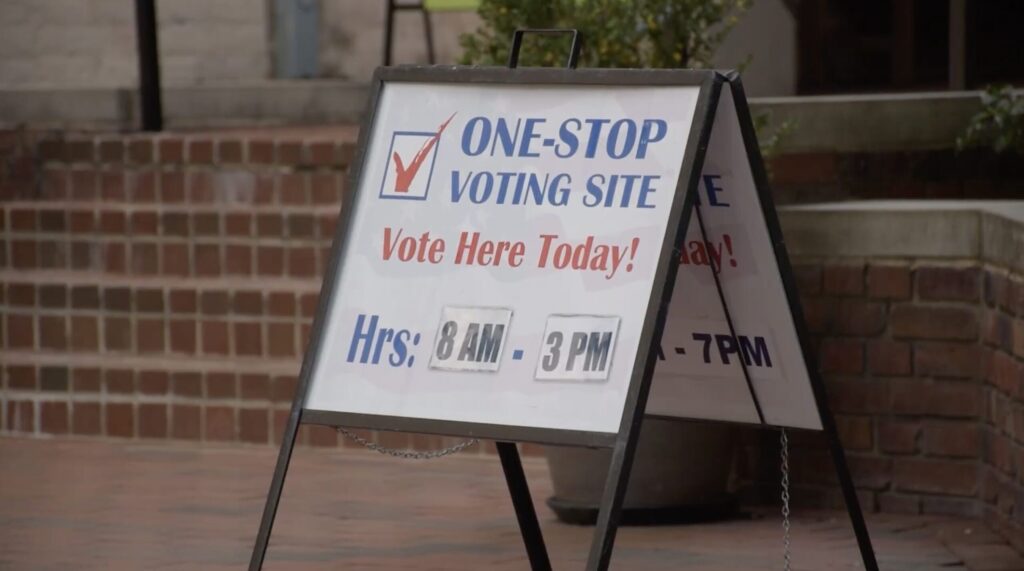
At Chapel of the Cross, an early voting site in Chapel Hill, a poll worker calls out “First-time voter!” The small room fills with the sound of jingling bells and poll workers drumming on tables.
The 18-year-old first-year student smiles, grabs a ballot and heads into the voting booth. It’s a moment they might repeat countless times throughout their life, but this one is a first.
Sarah Smith, assistant director at UNC’s Campus Y and a volunteer poll worker, said the small celebration is one way poll workers mark the occasion, particularly during an election when many young people are navigating the process for the first time.
In the final days of early voting, at least a third of the people registering at the site were new registrants, Smith said. Some students waited as long as an hour to register and vote in one place.
“We’re happy they’re here,” Smith said. “We’re happy that they’re willing to do that, get registered, and then they can do it all in one spot.”
But for some UNC students and recent graduates, voting wasn’t so straightforward. Between deciding where to register, navigating absentee ballots and understanding the proposed constitutional amendments, students encountered a range of decisions and challenges along the way.
One of those students was recent UNC graduate Lucy Miller, who didn’t vote in the election after running into difficulties changing her registration to Durham.
Throughout college, Miller kept her registration in her hometown of Boone and traveled home to vote. With her new full-time job for the Town of Carrboro, however, she couldn’t make her usual trip and was concerned about the handling of absentee ballots.
“This year, I decided that I wanted to vote in person where I live now because there was a lot going on with mail-in ballots,” Miller said. “The Trump Administration had tried to implement new restrictions and in the last election cycle, there were a lot of ballots that were being questioned and not counted, so I didn’t want to put myself in a position where my ballot may not have been counted.”
Her plan was to register and vote during early voting. But after moving into her Durham apartment in August, she found that the documents she had available didn’t meet the Help America Vote Act requirements for same-day registration.
Her apartment’s utility bills were bundled through the complex and didn’t list her name directly on them. She also learned that her lease, which she had assumed would be accepted, didn’t qualify as proof of residence.
Having majored in political science and public policy while at UNC, Miller said not being able to vote was deeply upsetting and disappointing to her.
North Carolina allows eligible voters to register and cast a ballot at the same early voting site. However, same-day registrants must provide proof of their current residence, such as a utility bill, bank statement, paycheck or qualifying government or university document. A private apartment lease doesn’t meet the state’s requirements.
Miller said she moved too late to update the address on her driver’s license before early voting, leaving her without an acceptable document showing her new address.
Although her experience was separate from the constitutional amendment on photo identification, it reflected a concern that voting can become more difficult when people don’t know exactly which documents they need or how to obtain them.
“I think that having voter ID laws just creates more barriers to voting for people in a system where we clearly already have a lot of barriers,” Miller said.
The amendment, which voters approved, asked North Carolinians to decide whether to change the state constitution’s photo identification requirement. The ballot question read: “Constitutional amendment to require all voters, not just those presenting to vote in person, to present photo identification before voting.”
The change extends the constitution’s language beyond in-person voting to include all voters, including those who vote by mail. The state’s existing election procedures also require absentee-by-mail voters to include a photocopy of an acceptable photo ID or an ID Exception Form with their ballot.
For students who rely on absentee voting, the issue carried particular weight.
Mary Shelton, a UNC student from Henderson County, chose to vote by mail so her ballot would count in her home county. She said she wanted to remain involved in local elections there, even while attending school in Chapel Hill.
Shelton ordered her ballot to her dorm and mailed it after filling it out. She was careful to follow the instructions, including printing a copy of her driver’s license and finding two witnesses to observe her completing the ballot.
“I’ve never been so petrified to just seal an envelope,” Shelton said.
She signed up for text and email notifications to track her ballot. After receiving confirmation that her ballot had arrived at the county board of elections and been counted, she said she could finally relax.
Despite the extra steps, Shelton said she hopes to continue voting by mail rather than change her registration to Orange County.
“It is discouraging to see them get even more complicated than it was this year,” she said.
Other students said they had more positive experiences with absentee voting. Garrett Tomberlin, president of UNC College Republicans, voted by mail in Union County, where he’s registered. As a senior planning to graduate, he said he wanted his vote to reflect the community where he expected to live after college.
Tomberlin said he would likely vote in person in future elections, but he supported the amendment. He described photo identification as a way to strengthen confidence in election results and said he viewed the issue as one that should extend across party lines.
“In a democracy, elections [are] the heart and the most important part of the whole entire process,” Tomberlin said. “So having that trust and reassurance matters.”
He also acknowledged that the wording of the constitutional amendments could have been clearer. Tomberlin said he had to reread the amendments to understand what they meant and had helped explain them to family members.
“I highly encourage everyone to do some research before they go into the polls,” he said. “But at the same time, we need to trust our government and they need to do better on writing these questions.”
Another student, Mil Laursen, also found the amendment wording confusing but was more concerned about how the requirements could affect access to voting. Laursen said additional requirements could make voting less accessible for people who live far from polling places or cannot easily leave their homes.
Sophie Flynn, a recent UNC graduate who now lives and works in the Washington, D.C., area, offered a different perspective. Flynn kept her registration in Wake County because she planned to return to North Carolina and remained connected to the state through her work in politics.
Her absentee ballot initially appeared to get lost in the mail. After contacting election officials with help from her father, who serves on the Wake County Board of Elections, she was able to have a replacement sent and returned in time.
Flynn said she supported the photo identification requirement, describing it as a protective measure. She said the additional step of including a copy of her ID was manageable, though she recognized that access to a printer or scanner could be an inconvenience for some voters.
“I don’t really find the ID thing being a cause of discomfort,” Flynn said. “I think that having that extra step is good.”
These different experiences point to a broader challenge for young voters: Not only do they have to research and decide whom to vote for, they also have to figure out where and how to cast a ballot. Each decision can affect which local elections they participate in and what steps they must take to vote.
Miller said she understands why students might choose to remain registered in their hometowns, particularly if they still feel connected to those communities. But she also said the process of establishing a new voting residence can be difficult when students are moving, graduating and starting jobs on tight timelines.
She also worried that young voters might overlook constitutional amendments while focusing on candidates. Even people who follow politics, she said, might not always understand what ballot measures would mean in practice.
“I think they’re kind of an afterthought for a lot of people,” Miller said. “People might not even know who the candidates that they’re voting for are, and to know that there are ballot measures, to understand what the language means and what the implications will be, I think is just a lot of extra steps for young voters.”
At Chapel of the Cross, Smith’s bells offered a reminder that, for some voters, simply making it through the process was an accomplishment worth celebrating.