
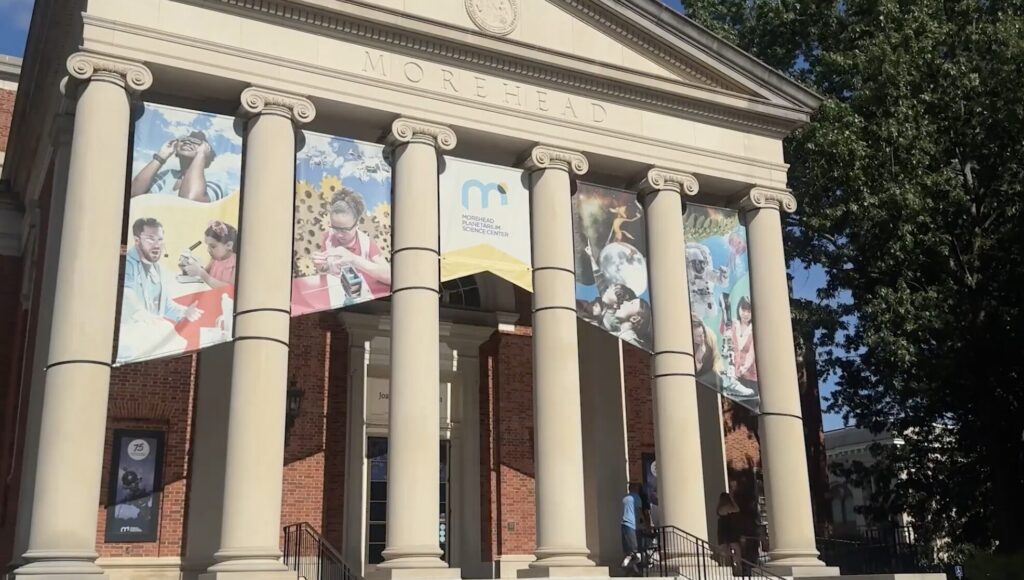
Story by Emmy Benton
Simran Panda, a senior at UNC-Chapel Hill, looks out the window of her lab inside an old
airplane hangar at the now decommissioned Horace Williams Airport, about 1.5 miles north of
UNC-CH’s main campus. In the distance, she sees another hangar — this one with an
unexpected history.
For years, it was the site of many a landing by some of the nation’s most renowned names in
space exploration. They flew into the private airport and drove over to Morehead Planetarium
and Science Center for one thing: “cookie time.”
Astronaut training and chocolate chip cookies went hand in hand at the planetarium from the late
1950s to the mid 1970s. The biggest names in spaceflight needed fuel for the hours of celestial
navigation training they would go through in the 68-foot dome.
Tony Jenzano, the director of the planetarium at the time, came up with the secret code to protect
the privacy of the astronauts who had been thrust into the public eye during the high-stakes space
race. Turns out, they had a fondness for the chocolate chip cookies that Myrtle Jenzano, Tony’s
wife, was known for — making “cookie time” a natural fit.
Chapel Hill was chosen because of its central location to other NASA hubs like the Kennedy
Space Center, the Johnson Space Center and the Langley Research Center. First opened in 1949,
Morehead was the first planetarium in the South and the first on a college campus, offering
state-of-the-art technology that proved useful to early astronauts.
Officials from Langley reached out to Tony asking him if he thought he could train astronauts to
prepare them for the unknowns of space travel. His survival training for the Navy included
learning 57 navigational stars to find his way in case he ever got lost, making him the perfect
person for the job.
“When NASA came down here and they looked, they were like, ‘Wow, you’ve got astronomers
on-site, you’ve got the best equipment in the world, you’re right in our flight path, this is a town
where everybody’s not trying to clamor to get in these guys’ faces, and Tony had a good
reputation,’” Michael Neece, local historian and author, said.
A total of 62 astronauts trained at Morehead Planetarium through the years, including 11 of the
12 astronauts who walked on the moon, such as Neil Armstrong, Buzz Aldrin and Alan Shepard.
Crews from the Mercury, Gemini, Apollo and Skylab missions spent time at Morehead,
solidifying the planetarium’s contribution to the space race.
Astronauts needed the training in case the guiding systems onboard the early spacecraft failed,
requiring them to manually find their way through space. They started off getting familiar with
key stars and constellations before working their way up to specialized instruction for their
mission.
“Kind of like navigators on Earth’s oceans for millennia before that, the astronauts needed to
have a reference for how to orient themselves when they were in space, whether that was to get
to the moon or to get home safely,” Nick Eakes, a science education specialist at Morehead
Planetarium, said.
Unlike having a panoramic view of the stars, astronauts only had the window of their spacecraft
to look through to orient themselves, which made the training even more vital. The stars were
projected onto the planetarium’s dome and manipulated as the astronauts sat in contraptions
reminiscent of what their spacecraft would feel like.
Jenzano, a former electrician in the Navy, played a hand in building these models. For the
Gemini mission, plywood, cloth, foam rubber and paper were arranged in a specialized way and
mounted onto two barber’s chairs. This way, the astronauts could sit side-by-side and control the
movement of the star field.
The training ended up being valuable on multiple occasions. One of the most accurate manual
splashdowns was accomplished by Gordon Cooper after the automatic stabilization and control
system short-circuited on the Mercury-Atlas 9 mission. He had to orient the capsule using the
positions of the stars he had memorized during training and landed less than five miles away
from the prime recovery site.
“They needed the information as much as they needed spacesuits or oxygen,” Neece said.
In addition, James Lovell, the mission commander for Apollo 13, wrote a letter to Jenzano in
1995 letting him know that his training at Morehead was still helping him 25 years later. He was
teaching Tom Hanks, who would go on to play Lovell in the movie adaptation of the mission,
about the stars that proved most useful.
Karsen Kitchen, who graduated from UNC-CH in 2025, walked the same halls as Lovell and
other astronauts when she worked at the planetarium as a student— a history that she said
intensified her desire to visit space.
“To be in a place that was pivotal, with astronaut training and stellar navigation, was very
inspiring for me,” Kitchen said. “I feel like, in a lot of ways, that part and that summer
represented a first step in a long journey to the stars.”
Kitchen made history when she became the youngest woman to cross the Kármán line in August
2024 during the Blue Origin NS-26 spaceflight mission. The Kármán line is widely considered to
be the boundary that separates Earth’s atmosphere and outer space.
Panda also dreams of going to space one day and took over as co-president of the Carolina
Astronomy Association, a club that Kitchen founded. Panda, who currently works at Morehead,
agrees with Kitchen, saying that being able to look up at the same dome that the astronauts
trained in is surreal.
Panda’s connection to the astronauts at Morehead and her lab inspires her to imagine herself
following a similar path one day.
“Every time I visit Argus, my lab, the path that we walk down to get to our hangar is parallel to
the same runway that the astronauts were flown into,” Panda said. “I think about that and I’m
like, ‘Wow, this is such a cool school.’”
Panda said she believes that history is worth remembering, not just because of the astronauts who
once trained at the planetarium, but because of the ways it connects people.
“I think that a lot of people look at astronomy or the aerospace industry or space exploration as
something that is super detached from their reality,” Panda said. “They look up at the sky and
they see themselves as separate from space, but it’s important to understand that we are all a part
of this big, massive thing that we do not understand.”