
By Nicholas Baumstein
Tensions between the United States and Iran have escalated in recent days, even as both governments signal a tentative willingness to avoid further confrontation. Iran’s President Masoud Pezeshkian has instructed his foreign minister to pursue negotiations with the United States, while U.S. officials have framed talks as a possible path toward de-escalation. At the same time, the U.S. military confirmed that it shot down an Iranian drone over the Arabian Sea, underscoring how fragile the situation remains.
Inside Iran, those diplomatic signals have done little to ease a growing domestic crisis. Nationwide protests that began Dec. 28, driven by a deepening economic collapse and long-standing political repression, have been met with widespread violence. Iranian authorities imposed a sweeping internet blackout Jan. 8, severely limiting communication with the outside world and making it difficult to independently verify reports of killings and arrests.
As pressure mounts inside Iran and uncertainty surrounds what comes next between Tehran and Washington, the effects are being felt far beyond the country’s borders. That uncertainty was visible last month in downtown Raleigh, where around 100 members of North Carolina’s Iranian community gathered for a candlelight vigil, one of several held across the state, to mourn those killed in the protests and to call for international action.
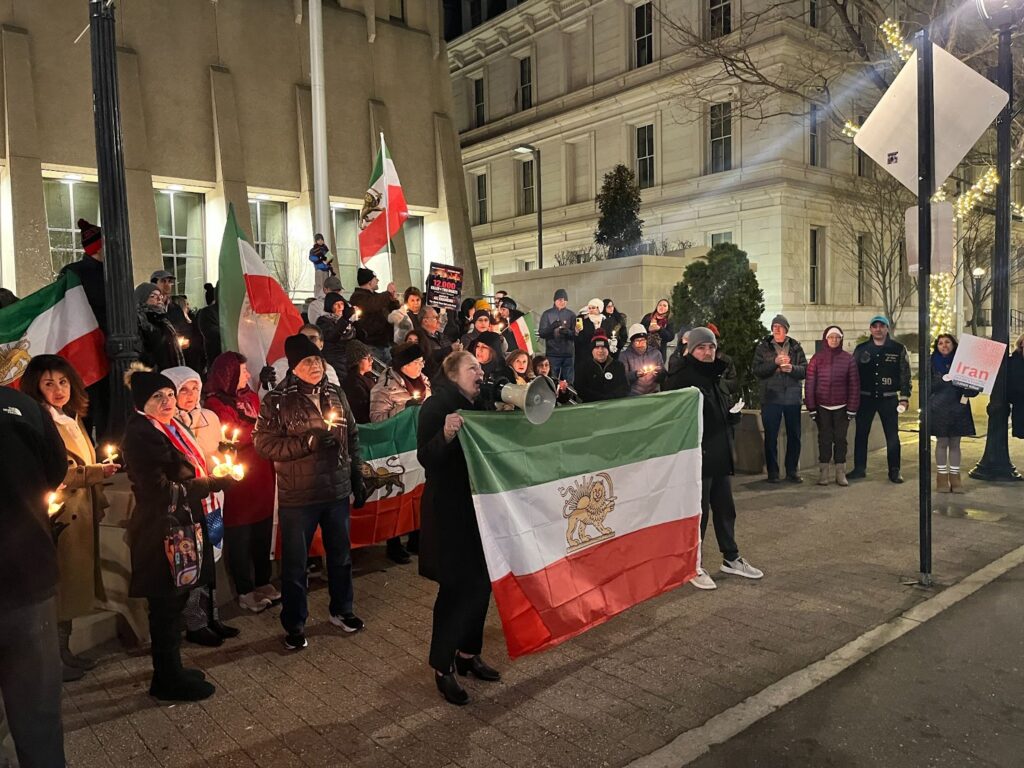
January 16: Members of North Carolina’s Iranian community gather outside the Wake County Courthouse in downtown Raleigh, holding candles and Iranian flags to honor those killed during protests in Iran.
Chants of “Make Iran great again” rang out as attendees called on the United States, and particularly President Trump, to intervene. Protesters held signs reading “12,000 killed in two days,” reflecting the unverified but widely circulated reports emerging from inside the country.
Although the chants implied a call for Trump to take aggressive and decisive action on the ground, the opinions among individuals varied greatly, underscored by the belief that the Iranian protesters could not reform, or topple, their government on their own.
“We don’t want American boots on the ground, but we need help,” said Kazem Yahyapour, one of the organizers of the vigil. He advocated for economic and diplomatic pressure towards the Iranian government, but his moderate opinions were not shared by many of his co-mourners.
Vahid, who chose to withhold his last name over concerns that he might face retribution for his comments if he were to come back to Iran, said, “Our nation is weird; we are all hoping that America will attack us. The sooner the better because they are still actively killing people.”
Among these calls for action was a general nostalgia for the Iranian monarchy. Before the Iranian revolution in 1979, Iran was governed by a Western-backed monarch, Shah Mohammed Reza Pahlavi, whose power was reinstated in Iran after a United States-backed coup placed him as a pro-western autocratic leader that implemented modernization and reform policies.
After 1979, the shah was overthrown and forced to flee the country by a coalition of Islamists, populists and leftists, united behind an anti-Western sentiment. Replacing the shah was an Islamic government, today led by Supreme Leader Ali Khamenei and President Masoud Pezeshkian.
According to attendee Mike Zibae, who left the country in 1977 before the Iranian revolution: “We had a Shah that was doing a good job from an economic perspective. There was a little bit of oppression. People wanted reform, but the reform got translated into a revolution that wasn’t necessary.”
Vahid said: “I don’t think the shah was necessarily unpopular, I think people acted with the limited information. I think he is one of the only options today.”
Among all the attendees, it was clear that there was no interest in compromising with or reforming the government. “Down with the Islamic government,” the crowd chanted. Although this view remains popular among the Iranians living in America, the reality inside Iran is far more complicated, where information about both the scale of the protests and what demonstrators are calling for remains ambiguous.
Mohsen Kadivar, a theologian and professor of Islamic Studies at Duke University who participated in protests that led to the removal of the Shah in 1979 and has long been a critic of the Islamic Republic, said in an interview with Der Spiegel, “Many Iranians now believe the Islamic Republic is incapable of solving the country’s fundamental problems. While there is broad agreement on what people reject, there is no consensus on alternatives.”
Although a monarchist tendency has emerged from the recent protests, evidence of widespread support for the shah is limited. According to Omid Safi, another professor of Islamic Studies at Duke University, “The Shah ruled like a despot and carried out very drastic and draconian measures. That led Iran to be considered the worst violator of human rights in the world in the 1970s.” He continued, “If you put aside the diaspora, there is little indication that there is significant support for the son of the former Shah (Reza Pahlavi), whom Trump and his associates favor.”
Safi points to several reasons why the shah sees more support among diaspora members than within Iran. “Many Iranian diaspora members left Iran 50 years ago and, for all practical purposes, have never gone back,” he said. “The Iran that they remember and the Iran they seek to recreate simply does not exist anymore.”
Safi also noted that “the Iranian diaspora tends to be more ethnically and religiously reflective of minority communities who fled Iran in the immediate aftermath of the revolution.” For many, a westernized Iran represents one of the few ways they could return and thrive in their home country.
While some members of the Iranian diaspora argue that international intervention is the only way to topple the Islamic regime, many others remain wary. Charles Kurzman, a UNC-Chapel Hill sociology professor who specializes in Middle East and Islamic studies, said that skepticism is rooted in what many see as the United States’ mixed track record of global intervention. “According to surveys from recent decades, huge majorities are very wary of U.S. intervention—in Iran, in the Middle East, and around the world,” he said.
In a 2021 survey of Iranian citizens from the Center for International and Security Studies at Maryland and IranPoll, overall approval for the United States was under 50%, with especially low belief in the benefit of U.S. sanctions, at around 7.5%. Iranians generally believed that the United States allowed attacks on the nation by Israel and expressed support for government demands against U.S. interference in trade deals.
Kadivar echoed that assessment, saying “most Iranians, despite deep opposition to the Islamic Republic, would defend their country against foreign aggression.” He argued that attacks on Iranian nuclear facilities and top officials by the United States and Israel in June 2025, while exposing military vulnerabilities, ultimately strengthened the regime. “At the same time, the regime was strengthened because the attack came from outside,” he said. “Believe me: change in Iran from outside is out of the question.”
Despite the clear risks of U.S. intervention, it remains difficult to see a path forward for Iranian protesters after being met with such brutal force. Vigil attendee Sahar Teymouri expressed frustration. “People say we need to free ourselves by ourselves,” she said. “They have all the police and all of the guns. How can we free ourselves?”
With the internet blackout still in effect, it is nearly impossible to assess the current state of the protests or the government’s stability. According to Kurzman, “If the scale of the massacre this month is anywhere near what the rumors suggest, it will be hard for any government to recover. It would mean a total breach between the government and the people, which could dramatically change how the state and society interact.”
Still, there is no historical precedent for reform within the regime, which continues to hold power with an iron fist. Despite widespread civil rights violations many of its beneficiaries still remain loyal to the current government. “You still have a segment of the population, including the security forces, willing to stand up and defend the system,” Kurzman said.
Uncertainty remains the prevailing sentiment among the diaspora, scholars and observers, as it is still unclear whether the protests, and talks between the United States and Iran, will lead to lasting change. While opposition to the Iranian government is widespread, there is little consensus on what a viable alternative would look like or how it could realistically be achieved. The ongoing internet blackout has left much of the world in the dark, even as protests continue across Iran.
For many Iranians in the United States, that uncertainty is deeply personal. Contact with family members in Iran has been brief and often incomplete. “Yesterday I spoke to my sister,” said Zibae. “She was near crying, but on the line she couldn’t say much. She said their neighbors are mourning a loss. That is all she could say.”
Teymouri described a similar experience. “I just spoke to my sister four days ago. It was extremely unsettling,” she said. “I immediately asked how she was, how my nieces were, how my parents were. She said they were okay, but I know deep down they are not. They hang up very quickly.”