
By Sienna Ayes
A dark green mesh helmet caked heavy with dust. A white-and-blue silicone cap stretched tight for the Olympics. The smooth snap of Carolina blue latex on a pool deck thousands of miles away from his home.
Adam Maraana’s story is stitched into the colors — and the causes — he’s carried.
Who is this athlete, and why should you care about his story?
Some stories are bigger than a name or a headline. They’re built stroke by stroke, moment by moment.
…
Maraana is an Arab-Israeli swimmer whose path from a Haifa beach to the 2024 Paris Olympic Games, and now to the University of North Carolina, traces a story much larger than medals or records. His life has been a collision of identities, loyalties and dreams, each one leaving its mark on the colors he’s worn.
Before Maraana clutched a rifle on the battlefield, or climbed onto an Olympic starting block, he was just a boy drawn to the water. In Haifa, Israel, where the sun scorched the sidewalks and the Mediterranean stretched endlessly into the horizon, Adam first felt the pull of the ocean at 4 years old. His father, a beach manager, spent his days along the shore, and Adam spent his childhood chasing waves, which later transformed into chasing his friends in lap lanes.
The water was a second home — a place where borders and expectations seemed to dissolve. “My son’s happiness was everything to me,” said his mother, Alexandra Nikonov. “I was happy when I first started signing Adam up for swim lessons because it brought him such joy. It was only after that I realized his future was swimming — and how successful he was going to become. He fills me with immense pride.”
But behind the joy of watching Adam thrive in the water, a quieter struggle was beginning to take shape — one that couldn’t be solved with a sharper turn or a stronger stroke. Even from a young age, Maraana carried complexities that few of his peers could understand. Growing up Arab-Israeli meant living in two worlds at once, straddling cultures and histories that never were able to easily coexist. In Israel, identity is rarely a simple thing — and for Maraana, every race he swam, every cap he wore, would eventually come to represent something far bigger than himself.
Sometimes, the conflict between his dreams and duty arrived without warning. Maraana can vividly recall an incident that will forever stick with him. In the middle of a practice, the sharp blare of sirens sliced through the humid air of the Netanya Wingate Institute training facility. Maraana had 30 seconds — just 30 — to scramble out of the pool, water streaming down his body, and take shelter before potential rockets rained down.
The chlorine still burned in his nose as he stumbled out of the pool, the world blurring between wet footsteps and shouting coaches. The crackle of distant explosions was faint, but the siren’s wail was deafening. In just 30 seconds, the training center transformed from a place of dreams into a place of fear.
For many young swimmers around the world, training was a bubble of focus and privilege. For Maraana, it was a whirlwind of interruptions, anxieties and split-second decisions.
At 18, like every Israeli citizen, Maraana answered the call to mandatory military service. He traded his swim cap for an IDF uniform, putting his Olympic dreams on hold.
As part of the School of Advanced Naval Command, Maraana’s days shifted from lap counts to tactical drills, from early morning swims to pre-dawn marches. Yet through it all, the water remained a distant anchor —a reminder of the life he promised himself he would return to.
But nothing in his training could have prepared him for what came next. It was a week after Oct. 7, 2023, the day Hamas terrorists launched a surprise attack on Israel, killing more than 1,200 people in one of the deadliest assaults in the nation’s history.
For Maraana, that morning began like any other — training, swimming, chasing the dream of becoming an Olympic champion. But the pool would have to wait. His country needed him first.
Deployed to Gaza with 32 men from his military unit, Maraana entered a reality no swim set could have conditioned him for. Serving in a Jewish-majority army as an Arab-Israeli came with unspoken tension. Maraana often felt the pressure to prove his loyalty — to his commanders, to his fellow soldiers, and maybe even to himself. He was no stranger to the IDF — but he had never seen combat. That changed overnight.
“We got surprised so badly from the sudden attack, there was a lack of soldiers all around the south,” Maraana said.
His unit’s mission was urgent: evacuate wounded IDF soldiers trapped near the front lines.
The sun hung low and merciless as they moved through crumbling Jabalia camp villages, sweat stinging their eyes beneath heavy helmets. Inside one abandoned house, Maraana spotted something he would never forget — a copy of Mein Kampf, Hitler’s manifesto, left in plain sight, as if it belonged there. He stared at the book, the twisted backbone of an ideology that had once fueled the murder of 6 million Jews, and felt the sharp, cold truth of it all: he was standing in a place where people were taught to hate him for simply existing.
There was no time to process the horror before a sharper one followed.
His friend Ofik stepped on a landmine.
For 48 hours, Maraana and 31 others refused to leave Ofik’s side, crouched in the rubble, waiting for another team to arrive and neutralize the explosive. They sat in the dirt, barely breathing, dust clinging to their skin like a second uniform. Time twisted — an hour stretched into eternity.
The silence grew heavier than the body armor strapped to his chest. Maraana found himself counting heartbeats, not just his own, but Ofik’s too — willing him to stay alive, willing the world to stay still. In that endless stretch of rubble and dust, friendship became survival, and every second became an act of resistance. Maraana pressed his back against the cracked wall, counting the seconds between each breath, willing his muscles to stay frozen. Every heartbeat felt too loud, too dangerous.
One wrong move, one flinch, and everything would end.
For nearly two days, they waited — frozen in place, drenched in sweat, whispering prayers they weren’t sure would be heard. When the rescue unit finally arrived and safely neutralized the explosive, no one cheered. There was no celebration, just quiet relief. Ofik was alive. So were they. But something in all of them had changed.
…
After two weeks inside Gaza, the mission was over — but something inside Maraana had shifted permanently.
The battlefield had left its mark.
The horrors Maraana endured would never fade. Neither would the lessons: teamwork, resilience, loyalty under fire.
When Maraana returned to the pool, it was no longer just about speed, endurance or precision.
Every stroke became an act of defiance — a silent tribute to his country, to his teammates, and to the boy from Haifa who once found peace in the endless blue of the sea.
…
The road back to the pool was not easy. The battlefield had carved new scars, but it had also sharpened Maraana’s will. Less than a year after returning home, he stood on the blocks at the National Performance Center in Netanya, Wingate Institute — June 6, 9:50 a.m. — with everything on the line. In the 100-meter backstroke, Maraana surged through the water like a man chasing more than a time. This was his 10th and final opportunity to qualify for the Olympics. If he did not show up at that moment, he would not get another chance like it for another four years.
When he touched the wall in 53.60 seconds, a new Israeli record flashed on the board. It was the 12th fastest time in the world that season — and it made him an Olympian.
As he turned to look at the scoreboard, the world seemed to hold its breath. For a heartbeat, there was only silence — then the explosion of cheers as his new record flashed under the bright arena lights. Maraana’s eyes blurred with tears before he could even process the numbers. It wasn’t just the record. It wasn’t just the fact he became an Olympian. It was the weight of every sacrifice — the battles fought, the miles swum, the dreams deferred and reclaimed — all crashing over him at once. On the pool deck, surrounded by teammates and strangers alike, he let himself cry. Tears of joy, of relief, of something deeper: the certainty that he belonged — that every mile, every obstacle, had been worth it.
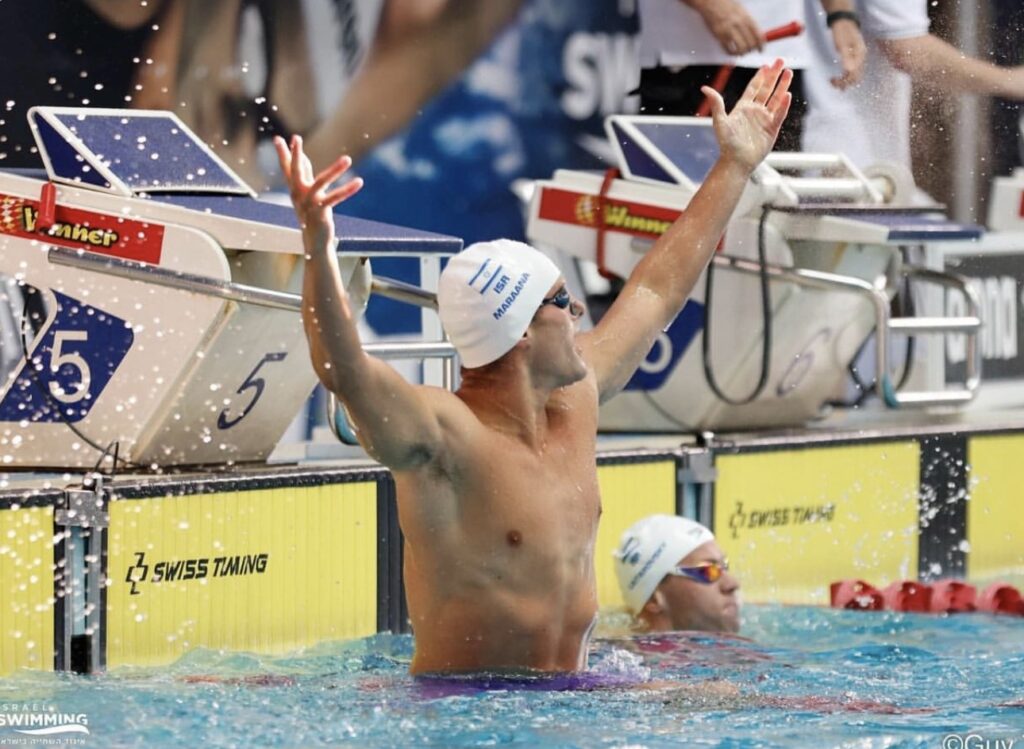
“Adam is one of the most disciplined athletes I’ve ever worked with,” said Galit Goldzak, his longtime nutritionist, mentor and mental coach. “He doesn’t just follow a plan — he studies it, asks questions, and adapts like a professional. That level of commitment shows up not just in the pool, but in everything he does.”
That commitment carried Maraana all the way to Paris.
In the Olympic Village, he wasn’t just a competitor — he was a leader.
Maraana had shared a decade of training and competition with teammate Martin Kartavi — from the grind of early-morning workouts in Israel to the surreal experience of rooming together in the Olympic Village in Paris. They knew each other’s routines, strengths and silences. In many ways, Maraana had become a quiet leader in the team’s day-to-day.
“He always made sure I was ready — whether that was waking up on time or making sure I was in the right mental space to swim my main event, even when he was swimming right after me.” Kartavi said. “That’s just who he is — selfless.”
But for Maraana, stepping onto the Olympic stage meant more than chasing a time. It meant stepping into history. As the first Arab-Israeli swimmer to represent Israel at the Olympics, he carried more than national pride — he carried the weight of visibility.
“People don’t even realize there are over 2 million Arabs living in Israel,” Maraana said. “I got to show the world that we exist, that we’re part of the country, and that we can be proud of both sides of our identity.”
At the Olympics, the media wanted to talk as much about who he was as what he swam.
“I wasn’t just asked about my time,” Maraana said. “I was asked how it felt to be Arab and Israeli. It was the first time I realized how rare that combination is on the world stage.”
His father, originally from Egypt, had passed down that duality — a bridge between cultures, religions, and histories that rarely find harmony in headlines. In Paris, Maraana wasn’t just swimming for Israel. He was swimming for everyone who had never seen themselves in that arena before. For the children watching in Haifa, in Cairo, in conflict zones and quiet neighborhoods alike, he became a symbol of what was possible.
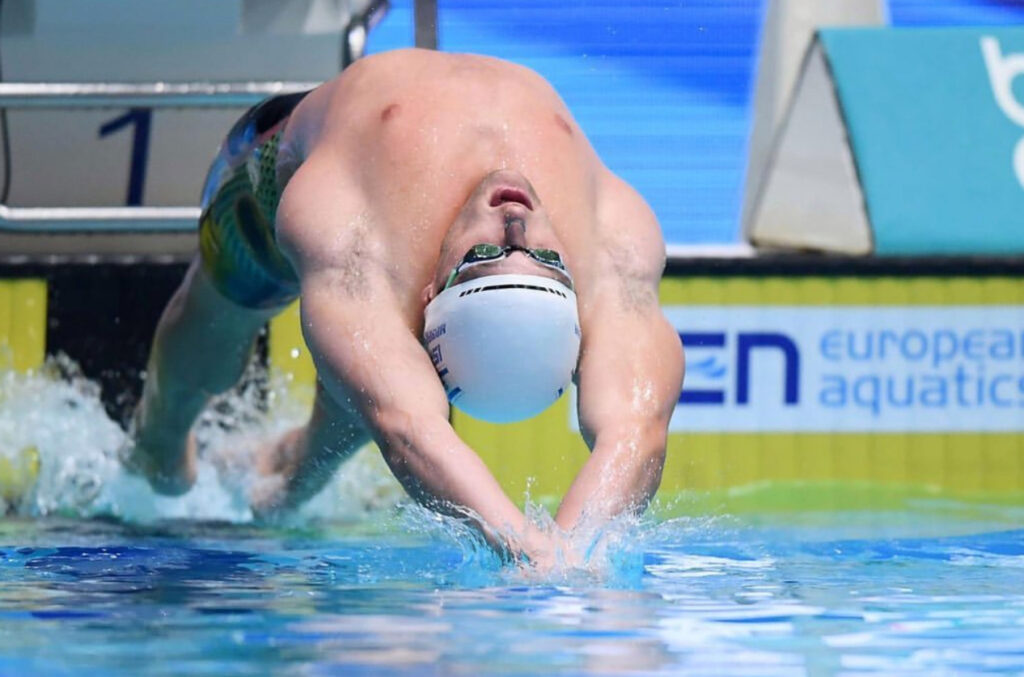
On July 28, 11:30 a.m, Maraana dove into the pool under the glare of the world’s brightest lights. The roar of the crowd was a living thing, rising and falling with each heat. As Maraana stepped onto the deck, he caught a glimpse of the Israeli flag flashing across the big screen, his name spelled out in block letters. His heart hammered against his ribs, louder even than the roar of the crowd. For a moment, everything — the battlefield dust, the chlorine stung lungs, the sleepless nights — it all led here. He whispered a quiet thank you in Hebrew, to no one in particular, and stepped onto the block carrying a country on his back.
For a moment, the years of sacrifice, the memories of Gaza, the long nights of loneliness all collapsed into a single heartbeat.
He finished 19th overall — a respectable showing for a first-time Olympian, even if it wasn’t the race he had dreamed of.
“Although his Olympic performance wasn’t an iconic race execution in terms of what Adam is truly capable of, if there is one thing that he knows best, it is using failure to boost growth,” said Maraana’s coach, Carmel Lyviatan.
The medals would have to wait.
But the mission — to represent, to preserve, to inspire — was already well underway.
For Maraana, the Paris Olympics were about more than just swimming.
They came at a time when the world was fractured — when antisemitism surged across continents and the conflict between Israel and Palestine cast heavy shadows over international headlines.
Maraana’s appearance in Paris had already made headlines — not just because of his record, but because of what it symbolized. He was the first Arab-Israeli swimmer to compete for Israel on the Olympic stage. Overnight, he became a celebrity back home, celebrated not only for his athletic achievement, but for what his presence symbolized: unity, resilience and pride in a time of profound grief and division.
He could have stayed silent— kept his head under water, focused only on the lane ahead.
Instead, Maraana carried more than just his ambition to Paris. He carried his home, his people, and a voice that refused to be drowned out. Representing Israel — and standing against hatred — mattered just as much as the race itself.
He chose to fight ignorance with education. Partnering with organizations like StandWithUs, he recorded videos and spoke out publicly, working to raise awareness about antisemitism and to share a story too often overlooked: that terrorists had marched into his home, murdered his people, and tried to silence voices like his.
Through every interview, every post, every race, Maraana carried more than himself. He carried the memory of Oct. 7. He carried a nation scarred but unbroken. And he carried a message the world needed to hear — a message about resilience, coexistence and the courage to keep swimming forward, even when the waters are the stormiest.
…
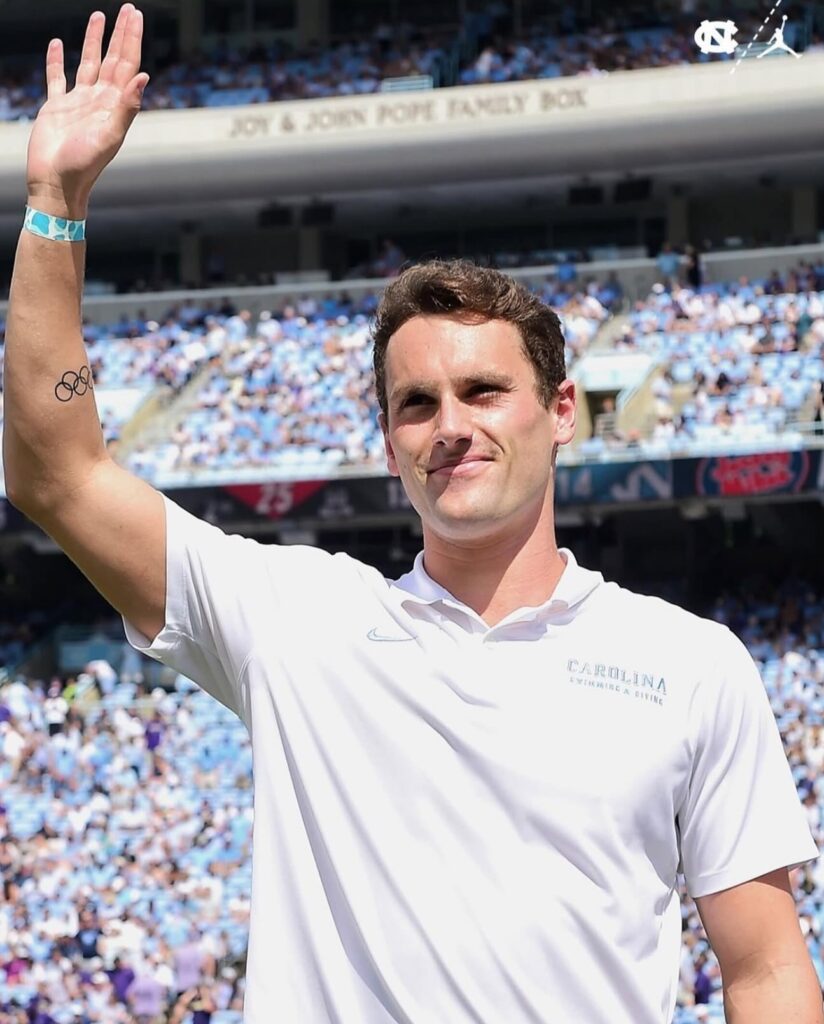
Adversity didn’t disappear when Maraana left the battlefield behind.
It just changed shape.
Choosing to move halfway across the world — away from family, friends, and the only home he had ever known — was a leap far more difficult than anything he faced in the pool.
Unlike many elite athletes who place their sport at the very center of their lives, Maraana made a different choice. He decided to prioritize not just swimming, but education, personal growth, and a future beyond the stopwatch.
In the fall of 2024, Maraana began his next chapter as a student-athlete at the University of North Carolina at Chapel Hill.
The decision came with costs he couldn’t fully predict.
The culture shock hit him immediately. Customs he never thought twice about in Israel — greetings, manners, even casual jokes — suddenly felt foreign in a new world. He wasn’t just adjusting to American college life; he was living it as a 21-year-old first-year student surrounded mostly by 18-year-olds, three years younger and worlds apart in maturity.
At times, the loneliness was sharp. Some days, Maraana missed the simple things most — the smell of his mother’s cooking drifting from the kitchen, the chatter of Hebrew filling the streets, the short walk to the beach where his story began. But homesickness, like fatigue, was just another current to swim through.
At times, the small misunderstandings felt endless. Some days, it felt like learning to breathe underwater again — each social interaction a stroke against an unseen current. But just like in the pool, Maraana knew the only way through was forward, even when the strokes felt heavy.
Maraana had found his way through rough waters before. There were nights he questioned why he left. Nights where the silence in his dorm felt louder than any siren back home. But even then, he reminded himself: Swimming had taught him how to keep going — even when he couldn’t yet see the wall ahead.
He forged friendships, leaned on his teammates and slowly carved out a place for himself in Chapel Hill.
One teammate in particular, Xavier Ruiz — a Puerto Rican swimmer and Maraana’s roommate — became a constant presence.
“Adam is like an older brother to all of us,” Ruiz said. “We all love to fool around, but Adam knows when it is time to lock in and do work. I strive to be as dedicated to school as he is.”
Even far from home, even surrounded by new rules and new rhythms, Maraana’s discipline never wavered. If anything, it deepened — not just in the pool, but in every aspect of his life.
But even at Carolina, his identity was not something he could leave behind. Though he arrived months after the protests and encampments that followed Oct. 7, the echoes of that discourse were still everywhere — in classroom conversations, in student group chats, on signs that hadn’t yet been torn down. He found it hard to turn the other cheek when a walk across campus meant passing students waving “Free Palestine” posters and chanting into megaphones. Maraana listened. He tried to understand the perspectives, the pain on all sides — he had grown up knowing that stories were never one-sided.
But sometimes, the slogans crossed a line. Certain words, he said, felt more like veiled antisemitism than protest — reinforcing a divide between Muslims and Jews that he knew didn’t have to exist. Having grown up in a household shaped by both identities — Arab and Jewish — and in a neighborhood where coexistence wasn’t ideal but a reality, the rhetoric shocked him. It shook him. And it made the question of identity harder than ever to untangle.
“It’s like people want to split me down the middle,” he said in an interview. “But I’ve never lived that way.”
He’s still figuring out how to carry both parts of himself — Arab and Jewish — in a place that often forces people to choose. But maybe, he said, that’s the whole point of being here: to keep showing that the two can exist together.
At UNC, the questions surrounding his identity feel louder than ever — but they’re not new. They’ve followed him across every border he’s crossed.
…
Maraana’s journey has never been linear.
It’s been a series of leaps — from saltwater to chlorine, from the pool to the battlefield, from the battlefield back to the Olympic pool, and now from the familiar shores of Haifa to the uncharted waters of Chapel Hill.
Each leap has asked something more of him.
Each leap has left a mark — not just on his body, but on his heart.
The dark green mesh helmet, heavy with dust.
The white-and-blue cap stretched tight under the bright lights of Paris.
The smooth snap of Carolina blue latex in a foreign pool thousands of miles from home.
These aren’t just colors.
They are memories, scars and promises.
They are reminders that greatness is not measured only by medals, but by the burdens an athlete is willing to carry — and the causes he refuses to abandon.
Maraana has never simply chased records.
He has carried legacies.
He has carried histories.
And through it all — the triumphs, the heartbreaks, the miles and medals and migrations — he continues to move forward, stroke by stroke, moment by moment.
Maraana is ready to embrace new colors — and write the next chapter of his story.