
Story By Catherine Wiles
Tony Marks, a 58-year-old from Pinehurst, North Carolina, developed a severe case of COVID-19 in February of 2021. After a 10-day stay in the hospital, he was told he would feel better in about two weeks.
“Two weeks has never come,” Marks said.
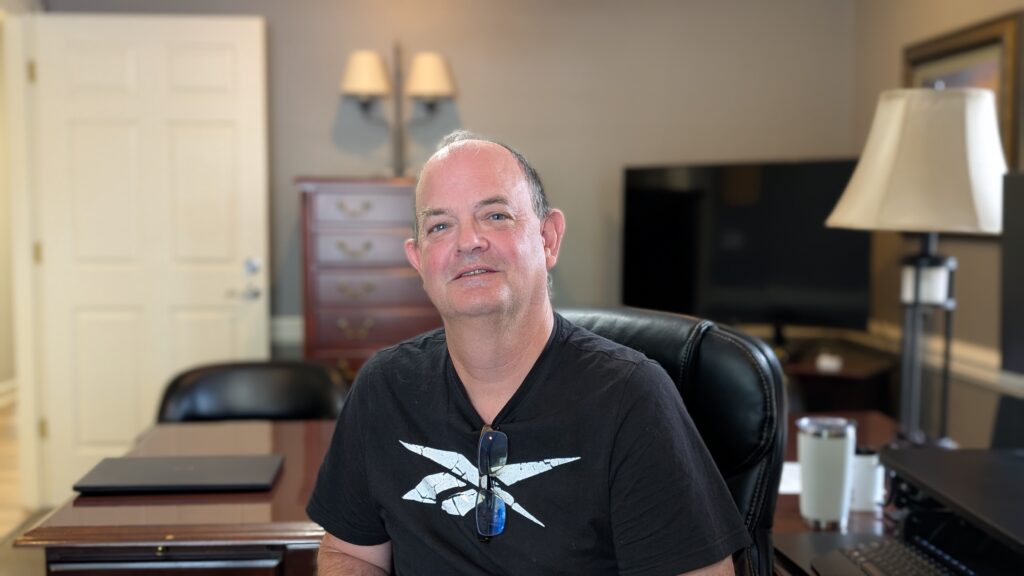
For the past four years, he has struggled with muscle pain, brain fog and extreme fatigue, among other ailments. He’s fallen asleep in the shower, outside of his office building, even during meetings with clients. A cot sits in the corner of his office in Southern Pines, an accommodation that allows him to rest throughout the day.
“It’s unheard of from the way that I was raised, but it just got to the point that I had to, or I had to quit working,” Marks said. “Like a lot of people, I still have a house payment, I still have car payments, and, you know, I couldn’t just stop working. So every day was just a struggle. And it’s been that way for four and a half years.”
Marks is among the one in six North Carolinians who has experienced long COVID-19, according to the North Carolina Department of Health and Human Services. The symptoms and duration of long COVID can vary greatly, from a few weeks of fatigue to years-long disability which impacts one’s ability to work and engage in day-to-day life. Yet, as the shock of the initial lockdown fades into the past, fewer and fewer resources remain available to those suffering from the condition in North Carolina.
From 2021-2022, a number of specialized long COVID clinics were founded throughout the state, but many have since closed, including services by the Mountain Area Health Education Center and Cone Health. On June 16, UNC’s COVID Recovery Clinic became the last major multidisciplinary clinic in the state to close its doors due to a loss of funding, leaving a critical gap for those seeking care.
“Finding care that is validating of their experience can be really hard for a lot of patients,” Dr. John Baratta, the clinic’s founder and co-director, said. “I think that’s part of the reason why many have gravitated to our clinic, especially after they’ve been connected with us. They feel heard and they feel believed. Many times, patients, during their initial evaluations, will break down and cry because they feel finally validated.”
While Baratta said 94% of the COVID Recovery Clinic’s patients came from North Carolina, patients visited the clinic from 20 states in total, including on the West Coast and as far as Alaska. Now, he said, the closest equivalent clinic is operated by Johns Hopkins University in Baltimore.
While Baratta and some of his colleagues continue to treat long COVID patients through the UNC Department of Physical Medicine & Rehabilitation, they no longer have the resources they once did. The COVID Recovery Clinic included a multidisciplinary team of specialists to create individual treatment plans for each patient, as well as social worker support to help them apply for disability and other services. Now, Baratta is able to offer fewer services to fewer patients.
“It’s becoming more challenging with diminishing numbers of resources, both here, locally, and nationwide, a reduction in the access to research funding to investigate the condition and to seek out treatment approaches, and increasingly challenging access to mental health and disability resources,” Baratta said. “Patients with long COVID are not going away at this point, they’re just not being heard or seen as much. They’re not able to be treated as adeptly as before.”
Outside of specialized settings, medical professionals often struggle to diagnose and treat long COVID. Baratta said that this is often due to a lack of understanding: The biological mechanisms behind long COVID are little-known, and the symptoms vary so widely that it tends to defy traditional medical management techniques.
“Medical management is oftentimes done with very specific guidelines and practices in mind: if X, then do Y. And that does not exist in long COVID evaluation or management,” Baratta said.
But for patients, that lack of understanding can be catastrophic. Betsy Moll, a long COVID coach in Raleigh, said she often hears from clients who have been told that their symptoms are all in their head, or that there’s nothing they can do. For people whose symptoms have inhibited their ability to work and engage socially, or have even left them housebound, being told that there’s no relief in sight can prove detrimental to mental as well as physical health.
“Sometimes when I hear some of these things, I want to get the doctor on the phone and say, ‘Are you trying to get people to kill themselves?’” Moll said. “‘Really, is that what your goal is?’ Because that’s what it sounds like.”
Brooke Keaton, a 45-year-old mother of two from Charlotte, North Carolina, first caught COVID-19 in December of 2020. She has not been able to return to her work as a teacher since her infection but is now an advocate for others through the COVID-19 Longhauler Advocacy Project, a grassroots volunteer nonprofit that pushes for public awareness, research, and policy to address long COVID and provides a support network for those affected by the condition.
Through her work, Keaton works directly with fellow long COVID patients to help them navigate their condition, including helping them to self-advocate in medical settings. She said that she had some experience with medical gaslighting due to her weight, but that she didn’t struggle nearly as much as others she’s spoken to over the last five years, particularly fellow Black women.
“I’ve seen a number of them because they posted it, where they did drug tests on them, or the police were called on them in the emergency room where they were trying to seek help,” Keaton said. “You know, I felt, to me, those were the most horrific because you’re becoming criminalized because you’re advocating for your life.”
For many, long COVID is financially devastating. According to Baratta, 69% of patients at the clinic reported reduced work hours due to their condition, and 33% went into debt.
“I know people that are homeless, you know, that have been homeless,” Keaton said. “I know a lady who lived in a tent, and it’s just a matter of time before it can happen again.”
Keaton herself has never been a patient of a dedicated long COVID clinic, considering herself “blessed” to have found a team of doctors who care for her. However, she said, this is not the case for many of the people she’s spoken to. Without a clear place to go, moving between specialists seeking a diagnosis isn’t easy — or free.
“When I heard that the clinic in North Carolina was closed I actually cried, because I’ve talked to people,” Keaton said. “I’ve read the comments that people have made in North Carolina about the difference that the clinic has made for them. I mean, when you hear somebody say, ‘I don’t think I would be alive if it wasn’t for this clinic,’ they mean it.”
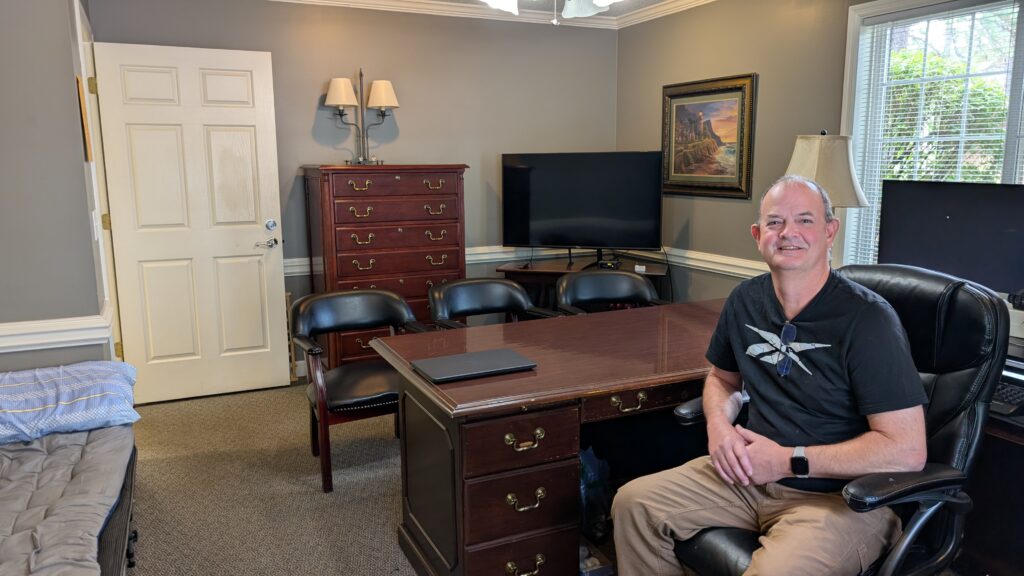
For Marks, the COVID Recovery Clinic was the first breakthrough in his search for care. In the early stages of his illness, trips to the emergency room proved useless; he said that the staff at his local emergency room were ill-equipped to handle long COVID, but wouldn’t admit it. Instead, he was misdiagnosed with seizures and sent to a neurologist, only to find at his own expense that he hadn’t suffered any.
Now, a packet hangs in his office instructing anyone who finds him in a medical emergency not to call 911.
“As long as I’m breathing, as long as I still have a have a pulse, don’t call 911, because they’re not going to understand what I’m what I’m going through,” Marks said.
Marks’ primary care physician, however, was willing to admit that he wasn’t the best fit to treat his long COVID. He referred Marks to the COVID Recovery Clinic, where he first started working with Baratta.
“I just cannot speak about the quality of care that I felt like I got at the COVID clinic,” Marks said. “Every person, from the person that checked you in, every nurse, to Dr. Baratta and a couple of the other doctors that I saw, everybody was top notch, and that’s something that you just don’t get everywhere else.”
Marks said he knows people from across the state who made their way to the clinic, including the Triad, Charlotte and even Asheville. He still works with Baratta through the Department of Physical Medicine and Rehabilitation, but this isn’t the case for all patients whose clinics have closed. Instead, many are being told to return to primary care physicians who don’t understand or believe in long COVID.
“People are just kind of washing their hands of it, saying, ‘We’re done.’ It’s scary. It’s scary to think what I’m going to go through for the rest of my life,” Marks said. “But then, like you say, as young as you are, as young as my kids are, I go, ‘Man, I sure hope you guys don’t get this, because I don’t know what you’re going to do for care.’”