
Story by Daneen Khan
UNC Chapel Hill’s beloved mascot, Rameses, takes on a central role in every home football game as adoring fans clamor for photographs. But Rameses doesn’t appear only as someone in a larger-than-life costume with yellow horns and cartoonishly-furrowed brows. He’s also a living, breathing Dorset Horn sheep, usually raised in Chapel Hill.
But as iconic as he is, Rameses can’t make it to every game. Sometimes, the Tar Heels go ram-less. Other times, a substitute steps into the role. The replacement ram’s experience might be short-lived, but their impact stays with the Carolina community.
When UNC’s 2026 season kicked off in Dublin, Ireland for the annual Aer Lingus College Football Classic, bringing a large, fluffy sheep on a more than seven-hour-long flight was quickly determined to be more trouble than it was worth.
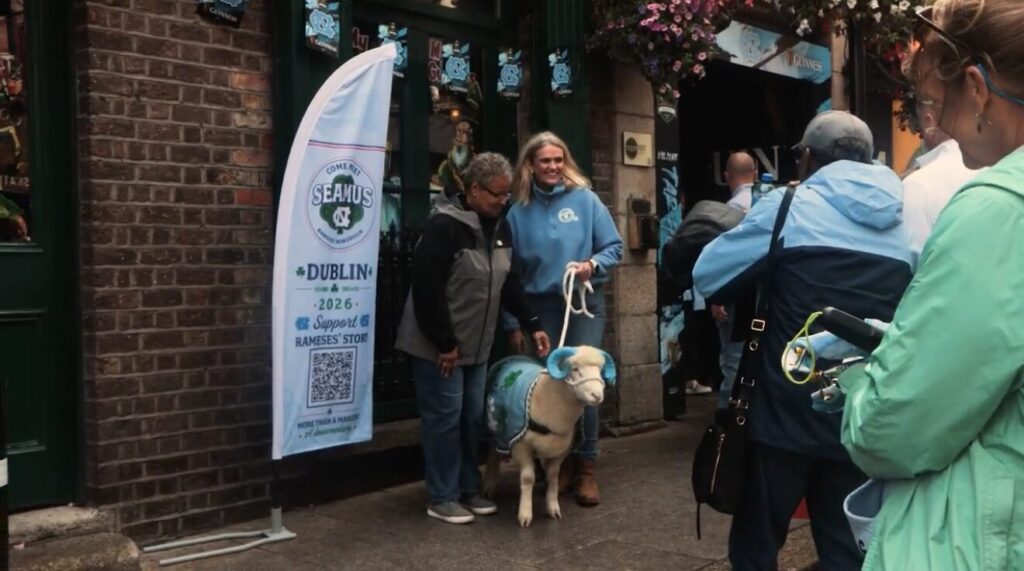
Enter Seamus: Rameses’s Irish “cousin.”
Though younger and smaller than Rameses, the ram captured Tar Heel’s hearts all the same. Seamus proved himself a perfect substitute to keep UNC’s live mascot tradition afloat.
A 102-year history
Despite being nicknamed as Rameses’s cousin, Seamus bears no relation to UNC’s live mascot (no sheep DNA tests were run, but it’s highly unlikely). The actual Rameses XXII — whose real name is Otis — resides at Hogan’s Magnolia Farm in Chapel Hill.
Otis is the 22nd ram to portray Rameses for the university; his earliest predecessor, the original Rameses, first took to the field on Nov. 8, 1924. While there are contrasting records about whether the first three live mascots lived with the Hogan family, it’s certain the fourth Rameses called the Hogan’s farm home by 1936. Today’s Rameses likely isn’t a descendent of the earlier mascots, but the Hogans have remained in charge of the rams ever since, watching after Rameses as he became a staple at football games, a star at campus events and the subject of occasional “ram-napping” attempts from rival Duke University students.
UNC alumnus Stasia Droze was fascinated by the live mascot. That’s why she and a team of filmmakers began developing “More than a Mascot,” an upcoming documentary following Rameses and the Hogan family’s place in UNC history.
Droze said she became involved with the documentary after its executive producer — and an old friend from her time at UNC — Brad Bennett reached out to her. Bennett and his wife, she recalled, had been speaking with the Hogans.
“They were all talking about the Hogans and what an amazing family they are, and that they’ve cared for Ramses for 100 years,” she said. “So they contacted me and asked me if I would help
them make this documentary about Rameses and the family that has given so much so generously to the Rameses tradition for 100 years — 102, now.”
When she learned UNC was playing in Dublin, Droze immediately began searching for a reason to attend. There was no real motive or budget for the documentary crew to take a trip to Ireland for a football game, so she needed a connection.
It took some Facebook digging, but Droze eventually found exactly what — or rather, who — she was looking for: a woman named Orla Hogan in Tuamgraney, Ireland.
And if the surname wasn’t enough, Orla Hogan also happened to be a sheep farmer.
‘Keep tradition alive in a modern world’
When Orla Hogan saw the message from Droze asking if she knew of a sheep to step in for Rameses at the game, she immediately began her search. It took a while to track Seamus down — she said she first reached out to a friend, who then put her in contact with a sheep breeder from Ballymena, a town in Northern Ireland.
Droze said she was hesitant about Orla Hogan having to travel to bring the ram from Ballymena to Dublin, but the farmer insisted it was no problem. Her attitude instantly reminded Droze of the Hogans back in Chapel Hill.
“The Hogans, they’re volunteers,” Droze Jost said. “They’re doing this from their heart because they want to keep tradition alive in a modern world.”
Eventually, Orla Hogan was able to obtain Seamus from his farmer. She quickly stepped up as the ram’s temporary caretaker.
Orla Hogan had no issues painting Seamus’s horns the night before his first appearance in Dublin; Seamus was quiet and calm, perfectly ready to follow in his honorary-cousin’s footsteps.
She said the inclusion of Seamus shows UNC’s great respect for its traditions.
“I’m very proud to be able to help to carry that out here in Ireland like in Carolina,” she said.
Jim Jost, Droze’s husband, said witnessing the culture around UNC’s live Rameses was overwhelming.
“I’m not used to getting all of this enthusiasm surrounding a live mascot,” Jost, who went to university in California, said. “But sure enough, what is there, maybe 350,000 UNC alums out there that are really interested in keeping this legacy alive? So really, I’m overwhelmed with the support from the alumni.”
A game day star
By 4 p.m. on game day, Seamus bore a striking resemblance to his honorary cousin. His pale wool was clean and fluffed, and he donned a classic Carolina Blue jacket (with a few shamrock decals pinned for added Irish spirit).
UNC alumnus Freddie Kiger said Seamus had the makings of “a future Rameses.”
“This could be the farm club for the advancement and promotion of Seamus to a Rameses XXIII or XXIIII, down the road,” he said.
Seamus kept a calm demeanor as Tar Heels gushed and awed over his adorable appearance, but by kickoff at 5:30, attention had shifted to the field. UNC was up against Texas Christian University, and some fans were feeling a dismal sense of deja vu; when the same teams faced off in the 2025 opener, TCU drubbed North Carolina, 48-14. Kiger hoped that the Tar Heels would at least play a competitive game.
But whether it was the luck of the Irish or a more strategic improvement, UNC took home the win, 15-10.
As the celebrations dwindled down, Orla Hogan scrubbed the paint off Seamus’s horns and prepared him for the journey home. UNC’s athletes, administrators and students boarded their own flights back to campus.
The Tar Heels left Dublin victorious, and Seamus returned to his peaceful life in the Irish countryside. Though we’ll never know if the young ram thinks fondly of his week as a live mascot — or if he was even cognizant of the once-in-a-lifetime experience — he’s now a cherished part of UNC history.