By Gwen Peace
Twenty miles south of the Virginia border, along a winding and dusty two-lane road, lies the town of Littleton, North Carolina, population 539. But despite its small footprint, Littleton draws hundreds of visitors from around the world each year.
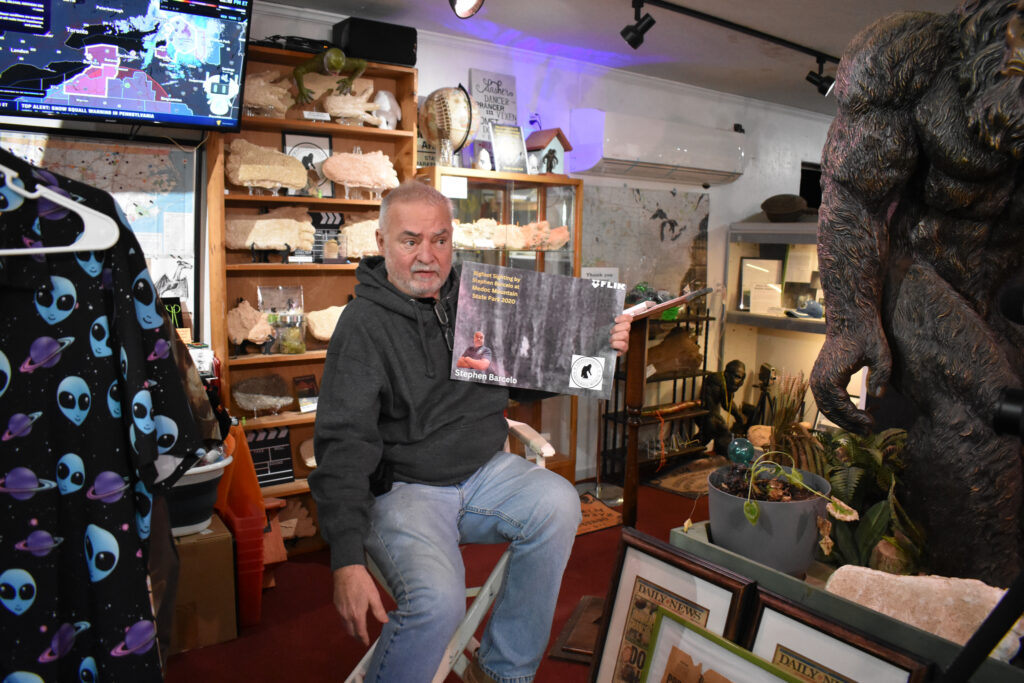
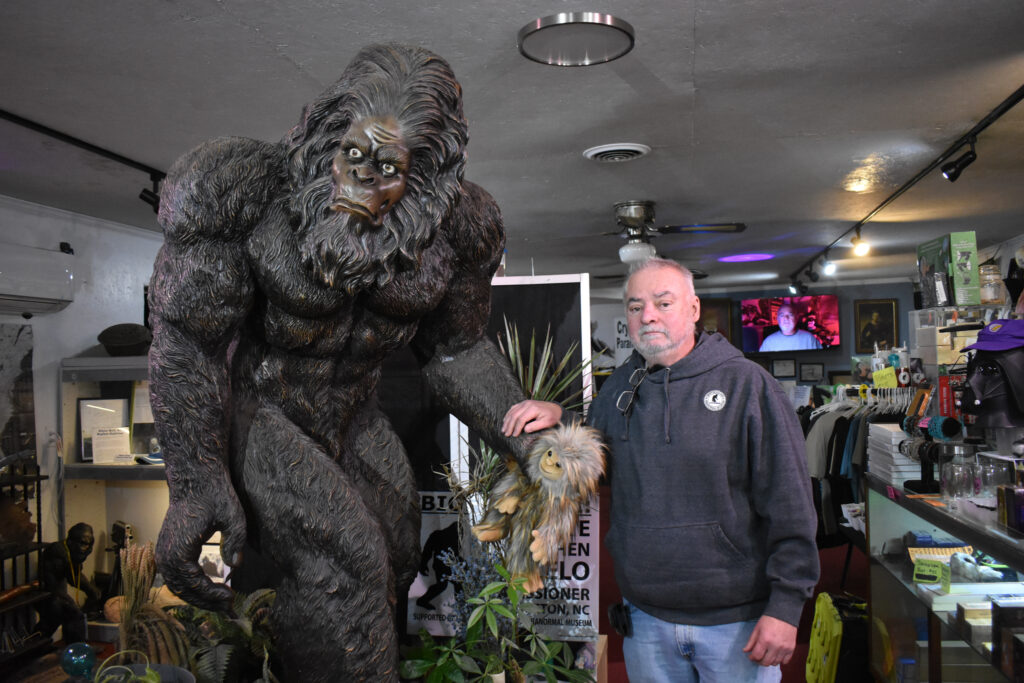
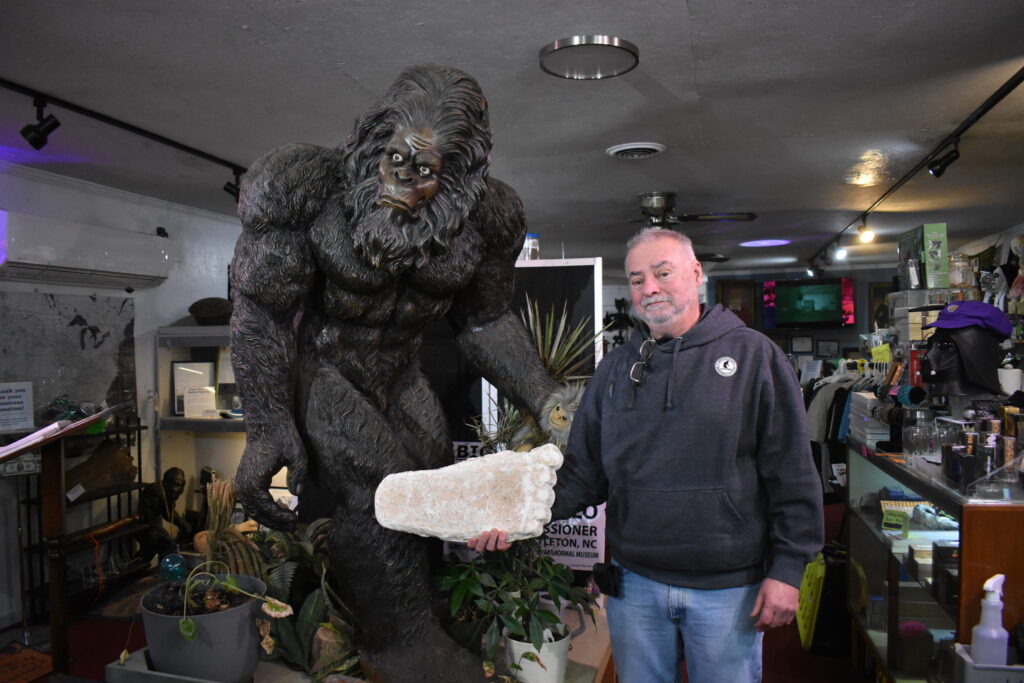
The town’s main attraction? The North Carolina Cryptozoology & Paranormal Museum, owned and operated by Stephen Barcelo.
The museum is unmistakable, sitting at the entrance to the town and housed in a squat, whitewashed building decorated with a plethora of paranormal-themed illustrations and stickers. Guarding the entrance stands a life-size statue of Dracula that creaks and sways in the wind, priming potential visitors for what they might encounter inside.
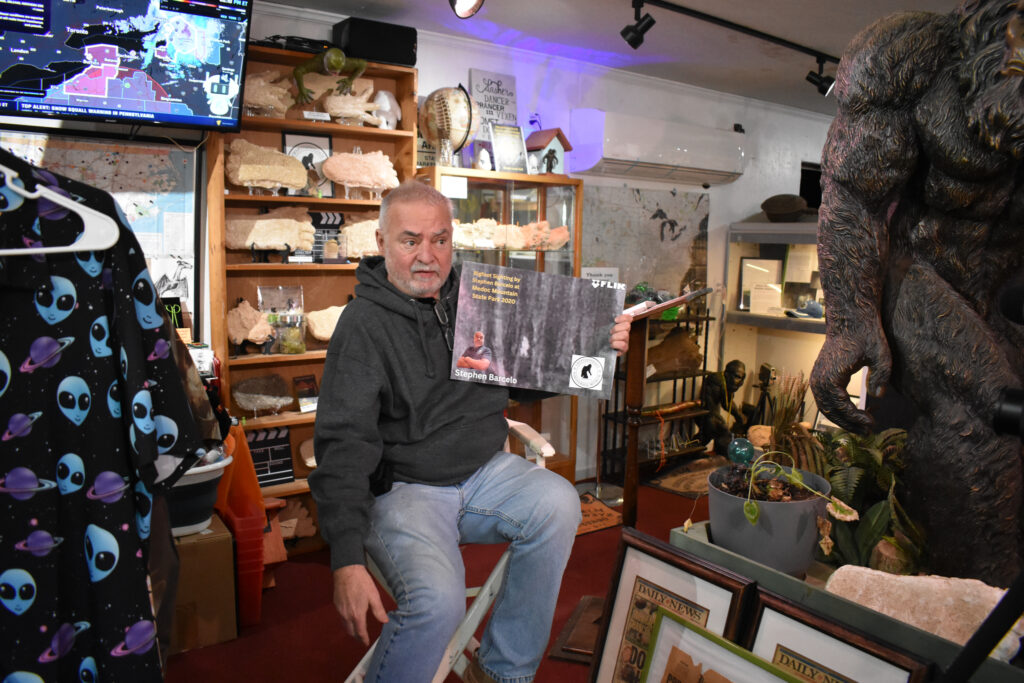
The main focus of the museum, however, is Bigfoot. In fact, an 8-foot-tall statue of the cryptid dominates the middle of the space, demanding attention (and maybe a selfie) from all who come across it. The rest of the front room is filled with Bigfoot-themed paraphernalia and evidence, ranging from kitschy Hawaiian button-ups to plaster casts of the giant cryptid’s footprint.
Despite the odd contents of the museum, its presence has given Littleton a new life. Employment in the town has gone up by 8 percent, according to the latest census data, and multiple new restaurants have opened along Main Street. The brand-new Timber Waters Brewery, for example, has a merchandise corner focused on Bigfoot and is planning on adding a Bigfoot-themed beer. The bartender, while admitting that she had never seen the creature, did note that the cryptid was popular among patrons.
“The town has turned around, it’s been doing phenomenal,” Barcelo said. “We’ve got a lot going and we can keep on moving forward.”
Barcelo, a Long Island native, started his career as a tabloid journalist before discovering his passion for the paranormal after being assigned a story about Bigfoot sightings in New York. The rest was history. Eventually, when the tabloid journalism industry was dying down and he was nearing retirement, he decided to purchase a big, historic home in Littleton, a town he had driven through on previous Bigfoot hunts.
After moving in, he began to hear paranormal tales about his new property and the surrounding town. Instead of being horrified — as most new homeowners likely would be — Barcelo was enthralled.
“I heard all kinds of stories about someone being murdered with a knife — I’m sorry, with a sword — up on the second floor,” Barcelo said. “We actually used Luminol and got a blood [spot].”
Soon, he took his fascination and turned it into ghost-walking tours, which started in his house and advanced into the town. It then progressed into an amateur museum taking up the front three rooms of his house, and then finally into the full-fledged and separately housed museum that it is today.
Since opening the museum, Barcelo said he has seen Bigfoot himself multiple times, even catching him on camera with thermal imaging in blurry photos that he has displayed on posterboard throughout the building.
In the last decade, Halifax County, which includes Littleton, has gained attention as a hotspot for Bigfoot sightings, with local news documenting several alleged encounters in and around Medoc Mountain State Park.
Barcelo, who also ran for mayor of Littleton in 2022, evoked mixed feelings from locals through the pursuit of his paranormal passions in the town. However, due to the museum’s popularity, many have changed their tune about Bigfoot because of the business opportunities it has brought to the community.
“A lot of the same people that gave me a hard time came back to me and said, ‘Listen, I know I gave you a hard time, but what you’ve done has been so beneficial to the town,’” Barcelo said. “‘And by the way, I saw one when I was younger.’”
Littleton is not the only small town in North Carolina that has been economically bolstered by the Bigfoot business.
Troy, located on the edge of the Uwharrie National Forest an hour east of Charlotte, draws hundreds of prospective hunters a year, who meet at the El Dorado Outpost — an outdoors supply shop filled with bedazzled Sasquatch shirts — to set off on the many UTV trails leading into the wilderness that begin there.
The cashier at El Dorado Outpost, although being extremely skeptical about the existence of Bigfoot, said the store sold a lot of Bigfoot merchandise to tourists during the summer.
The town’s local watering hole, The Bigfoot Bar and Grill, also takes after the theme, serving “Sasquatch Fries” and “Bigfoot Burgers” to eager patrons.
About 250 miles west in Bryson City, Carolina Bound Adventures leads a Bigfoot hunt hike in the Smokies for believers who want in on the hunting action under the supervision of a guide.
“Ever since we launched, it’s [the hike] had a very high interest in it,” Mark Van Osdal, who leads the hikes, said.
Despite hearing about sightings of Bigfoot in Bryson City for years, Van Osdal, who has been leading guided hikes in the area for nine years, only had the idea to capitalize on it after a group of tourists from the Northeast came into town and inquired about the cryptid. This inspired Van Osdal to start both a Bigfoot hike and a Bigfoot brewery tour in 2024, both of which draw visitors from around the country each year.
The hike, which runs at $94 per person, consists of going up into the Smokies for around four hours and searching for Bigfoot by knocking on trees (a Bigfoot-hunting staple), making Bigfoot calls and walking through a local tunnel that is considered a hotspot for ghost sightings and supernatural experiences. Van Osdal said that they have seen multiple potential indicators of Bigfoot on the hike, which have inspired them to continue hunting.
The rest of the town has followed suit, and multiple stores and breweries in Bryson City have adopted a Bigfoot theme to appeal to tourists interested in the cryptid.
But why are people so drawn to Bigfoot, to the point where they are willing to travel hundreds of miles to North Carolina for a chance to see the creature?
According to Chad Bryant, a history professor who studies conspiracies and misinformation at UNC-Chapel Hill, it has to do with the modern human psyche.
“It’s the idea of exploring and wanting to discover something,” Bryant said. “In everyday life we don’t discover anything. I can look almost everything up on my computer.”
This theory was corroborated by John O’Connor, the author of “The Secret History of Bigfoot” which explores what O’Connor calls the “obsessive world of Bigfoot believers.”
“A huge point of it is just to go out into the woods and look for something that might be there,” O’Connor said.
O’Connor, who is a journalism professor at Boston College, spent months embedding with Bigfoot-hunting communities throughout the United States and attempting to understand what drove them to continue to look for Bigfoot as research for his book.
In the end, he came to the conclusion that it was not so much about the evidence that they had found, but about what was left to find.
“This belief or hope and possibility for what might be there can be really enticing and intoxicating to so many people,” O’Connor said.
One of those people is UNC-CH junior Evan Shotwell. He has been infatuated with Bigfoot since elementary school, when an older friend introduced him to the subject.
He went so far as to write a research paper on Bigfoot during his senior year of high school and centered his college personal statement around the subject. As part of his research for the paper, he attended a Bigfoot community event in North Carolina where people got together to share their experiences with the cryptid.
“It was interesting hearing a lot of the stories,” Shotwell said. “They get kind of repetitive to an extent, and you can kind of tell the people that are super serious about it and who aren’t.”
Whether or not people are serious about their belief in Bigfoot, it remains a huge tourism draw in North Carolina. The WNC Bigfoot festival in Marion attracts more than 40,000 people from around the state and the country, and local attractions like the museum in Littleton, the UTV exploration in Troy and the walking tours in Bryson City, the lure of Bigfoot appears as though it’s here to stay – despite the lack of concrete evidence proving its existence.
“Sometimes it’s really difficult to say with any conviction what we really believe in and what we don’t believe in,” O’Connor said, “and in some way in that mess of belief and unbelief is faith and just wanting to hold desperately to the possibility of something being true.”