

Story by Mackenzie Thomas
For Mel, a North Carolina nurse, getting ready for work was like getting ready for war.
That’s what she told co-workers when she worked in the emergency room, she said. Headed into a shift, she wondered, “who’s gonna fight today?”
In North Carolina, more than 48% of nurses said they witnessed violence at work, while more than 27% of respondents reported they were victims of it themselves in a 2022 survey from the North Carolina Nurses Association– and “the problem is getting worse,” according to a press release from the association.
That’s why North Carolina passed the Hospital Violence Protection Act, part of a bill in 2023 to require improved safety measures to protect health care workers in hospital settings and to increase criminal penalties for assaulting medical and emergency personnel.
A patient was charged with felony assault causing physical injury to emergency personnel and for resisting a public officer in connection with an incident at First Health in January, according to court records. ER nurse Crystal Thompson said the patient put her in a choke hold and broke her leg. The defendant’s next hearing is scheduled for Nov. 17.
The hospital had already established its own police department with fully sworn officers who have jurisdiction across the entire system to improve safety for its staff, said Emily Sloan, director of public relations for FirstHealth.
“Prior to this incident, FirstHealth implemented a company police department in 2024 to further prioritize the safety and security of our staff, patients and visitors across our hospital campuses and facilities,” Sloan said. “While we have long employed security officers, the decision to create a FirstHealth Police Department reflects our commitment to continually enhance safety measures in response to the need for law enforcement assistance.”
Sloan said violence against health care workers is a “critical issue” and that the incident in January “highlights a growing concern seen across the country.”
Mel, who requested her last name be withheld to protect her identity, worked in a North Carolina ER for five of the roughly 12 years she’s been a nurse, having witnessed and experienced her fair share of violent incidents.
She was spat on by a patient brought in by EMS, forcing her and other co-workers to put on protective gear.
She experienced a hospital lockdown after a patient’s upset family member threatened to shoot her and her co-workers.
She had a pregnant co-worker go into pre-term labor because she was punched in the stomach by an angry patient.
The hospital she was working at did nothing in response, Mel said.
“Nothing happened at the hospital that I was working at,” Mel said. “The patients were given the excuse of, ‘Oh they have psych issues.’”
But the “nail in the coffin” for Mel was a violent psych patient who came into the ER one night. When a male co-worker tried explaining to the patient that they were going to restrain and sedate her, she punched one of Mel’s female co-workers in the face, Mel said.
“We all kind of like backed up, and then the patient actually ended up running out of the emergency room,” Mel said. “The police had to be called. They found her in the parking lot, and then they got her.”
Experiencing that made her realize she couldn’t work in the ER anymore, Mel said.
“From then I was like, you know, I don’t feel comfortable working like this,” Mel said. “I don’t want to come to work and possibly be punched and kicked and whatnot. So that was it for me.”
But if law enforcement was already on site when the incident occurred, she said things may have turned out differently.
“I think if we had had law enforcement, the situation would’ve been handled much better,” Mel said. “We had to call the police to help find her in the parking lot. Luckily, there was one near who was patrolling who came quickly.”
Before the bill passed, hospitals were left to determine the level of security themselves, said Bonnie Meadows, president of the North Carolina Nurses Association, and a nurse herself with more than 20 years of experience on the job.
“Everybody pretty much did whatever they wanted to do. They did their own risk assessment as far as, what do we actually need?” Meadows said. “That bill said, we need the police. And I know just in my 21 years of health care that they may have had their own security, but having police presence is totally different.”

Security officers were reported by health care workers as often having limited capabilities when it comes to handling violent patients, according to a 2022 study from the National Institutes of Health. Some reported that security officers were “not physically able” to manage the patients, and one paramedic was quoted saying security “has no jurisdiction as far as arresting powers.”
Along with round-the-clock police presence, the bill also calls for hospitals to conduct security risk assessments and violence prevention training, as well as to report assaults against health care workers to the state.
Because of the chaotic nature of the ER, Mel said, it can be hard to file complaints when incidents occur.
“Sometimes it’s so busy that if you do want to make a complaint, then you’ll get behind or your other patients will not get care on time because there isn’t enough help,” Mel said.
Only 1 in 3 nurses said their employer provides a clear way to report incidents, according to a survey from National Nurses United in 2023.
But violent experiences aren’t limited to the ER, they can occur anywhere in the hospital, with any patient. For Carolyn Paschall, a home health hospice nurse who used to work at a North Carolina hospital, it happened to her while working in medical-surgical care. One minute, she was helping a patient get dressed; the next, he was grabbing her arm and telling her to stop what she was doing before he punched her.
Startled, she said she left the room and immediately notified her charge nurse. While the experience shook her, Paschall said she was pleased with the hospital’s response, as they offered her the option to press charges, which she declined. Her only request was to be reassigned, Paschall said.
“It did kind of shake me, because he seemed like any other person you know, for you to just turn and switch like that. It was kind of scary,” Paschall said. “I’d be lying if it didn’t make me more cautious. But like I said, I would never work in the ER. So I was just like, that was a bad patient. I kind of shook it off, and I kind of moved on.”
But violence can take the form of verbal abuse too.
Roughly 8 in 10 nurses reported experiencing at least one type of workplace violence in the NNU survey. Verbal threats were the most common type of violence experienced, reported by almost 68% of respondents.
“You definitely don’t want to deal with verbal abuse, but the physical abuse is definitely what’s going to make you way more anxious,” Meadows said.
Violence not only has an impact on those involved, but also on the next generation of nurses.
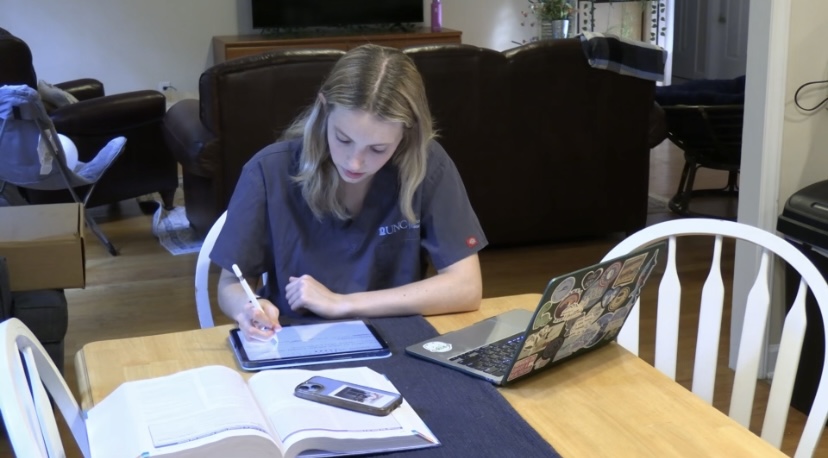
Lexi Rumbaugh, a junior at UNC-Chapel Hill who is in her first semester of the nursing program, said it’s worrying to see cases of nurses and other health care workers getting hurt at work.
“I think it is a little bit worrisome. I’m not really sure what I would do in that situation. I’d be scared, definitely, if it happened to me,” Rumbaugh said.
Workplace violence is a contributing factor in nurses’ desire to leave their place of work, and even the profession itself, according to an NIH report from 2022. It’s hard when you go into nursing with a desire to help people, only to feel taken advantage of, Mel said.
“I have a lot of friends who, and I hate to say this, a lot of people have said that if they knew how nursing was, they wouldn’t have gotten into it,” Mel said.
While she hasn’t faced any violent patients herself, Rumbaugh said she believes the most important thing in that situation would be to keep seeing the patient as a person.
“I would definitely think that that’s something that’s really hard to try and juggle,” Rumbaugh said. “Like, this is a scary situation, versus I need to take care of this person.”
As the new president of the North Carolina Nurses Association, Meadows said her goal is to “help every nurse to understand their voice.”
“To me, that is a huge piece of workplace violence and understanding that you’re not just a nurse, but you are a key piece,” Meadows said. “You are the key piece to the health care team, and what you have to say is valuable. What you have to offer is valuable.”